

I've spent the better part of five years dissecting iGaming from the financial side - tracking transaction flows, auditing payment processors, and stress-testing casino platforms across dozens of jurisdictions. And the single most common question I still get from readers, investors, and even people already working in gambling is deceptively simple: what is iGaming, exactly?
The term gets tossed around in earnings calls, licensing applications, and LinkedIn bios like everyone already knows. But the definition is blurrier than most people realize - and the industry behind it is moving fast enough that last year's overview is already outdated.
What iGaming Actually Covers
iGaming is the umbrella term for any form of gambling conducted over the internet. That includes:
- Online casinos - slots, table games, live dealer rooms, and RNG-based games
- Sports betting - pre-match and in-play wagering on professional and amateur sports
- Online poker - cash games, tournaments, and sit-and-go formats
- Bingo and lottery - digital versions of traditional draw-based games
- Esports wagering - betting on competitive video game tournaments (Counter-Strike, League of Legends, Dota 2)
- Fantasy sports - daily and season-long contests where participants draft real athletes
That's a wide net. A sportsbook in Ontario, a live blackjack studio in Malta, and a fantasy football platform in the US all fall under the same iGaming umbrella. The common thread is digital delivery and real-money stakes.
What iGaming doesn't include - and this trips people up - is social gaming or free-to-play mobile games. If there's no real money at risk and no real money paid out, it's gaming, not iGaming. The "i" stands for internet, but the gambling component is what defines the category.
iGaming vs Online Gambling - Is There a Difference?
Technically, no. Functionally, yes.
"Online gambling" and "iGaming" describe the same activity. But the industry uses them differently depending on context. "Online gambling" tends to show up in consumer-facing content, regulatory language, and news headlines. "iGaming" is the preferred term on the B2B side - among operators, software providers, payment processors, and conference organizers.
Think of it this way: a player Googles "online gambling." An operator applies for an "iGaming license." Same industry, different audience.
The distinction matters because the terminology signals who's talking - and who they're talking to. If a company's website says "online gambling," it's probably player-facing. If it says "iGaming," it's selling to other businesses. I've sat through enough SBC and ICE conference panels to confirm this pattern holds almost universally.
Industry Size and Growth - The Numbers That Matter
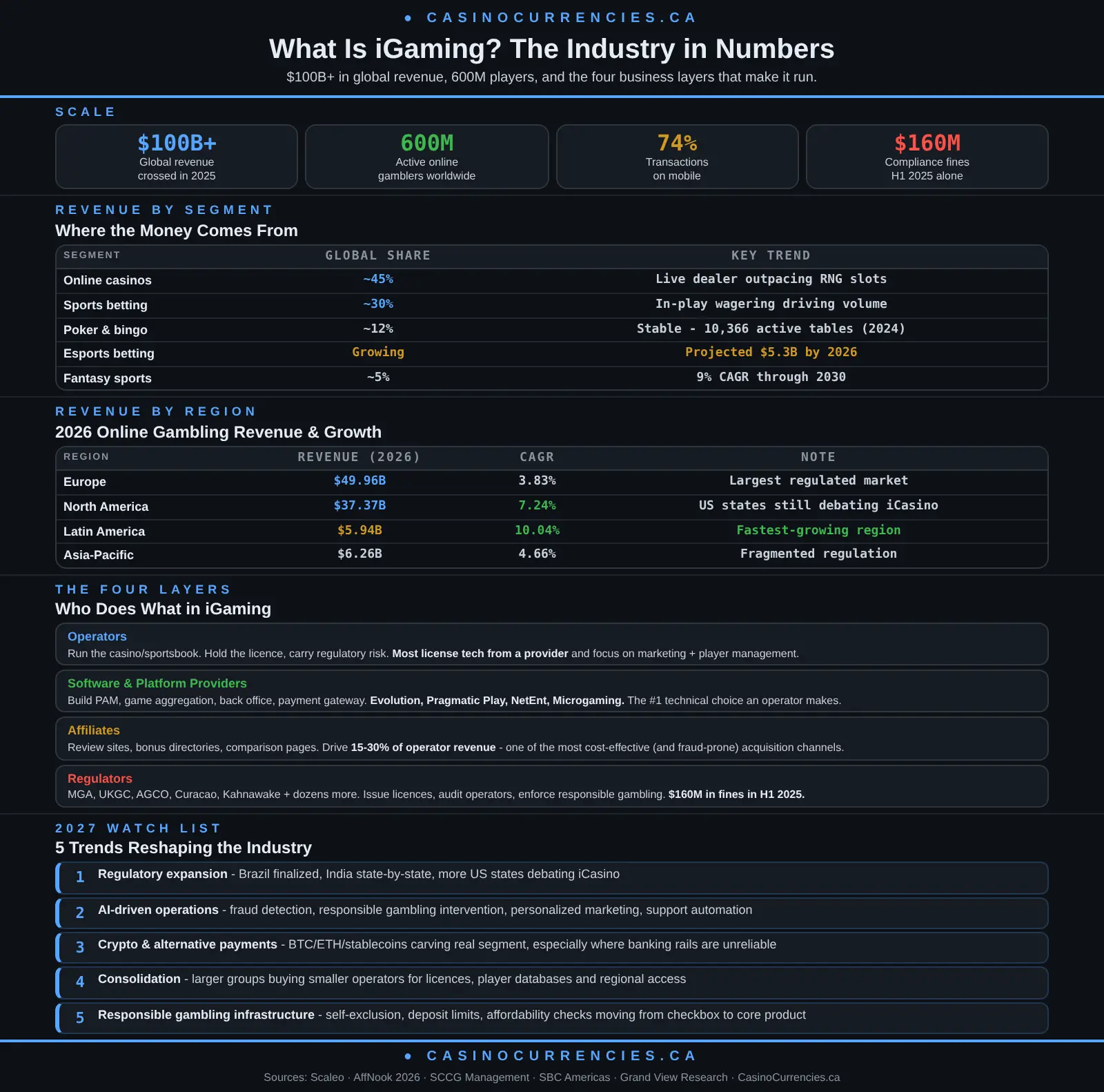
The iGaming sector crossed the $100 billion revenue threshold globally in 2025, according to Scaleo's market overview. That's not a typo. North America's online gambling segment alone is projected at $37.37 billion in 2026, growing at a 7.24% CAGR. Europe remains the largest regulated market at roughly $49.96 billion, while Latin America - the region everyone's watching - sits at $5.94 billion and climbing at a 10.04% CAGR, per AffNook's 2026 industry analysis.
Here's a snapshot of how the revenue breaks down by segment and region:
| Segment | Share of Global Revenue | Key Trend |
|---|---|---|
| Online casinos | ~45% | Live dealer growth outpacing RNG slots |
| Sports betting | ~30% | In-play wagering driving volume |
| Poker and bingo | ~12% | Stable - poker saw 10,366 active tables globally in 2024 |
| Esports betting | Growing fast | Projected $5.3 billion by 2026 |
| Fantasy sports | ~5% | 9% CAGR through 2030 |
| Region | 2026 Online Gambling Revenue | CAGR |
|---|---|---|
| Europe | $49.96B | 3.83% |
| North America | $37.37B | 7.24% |
| Latin America | $5.94B | 10.04% |
| Asia-Pacific | $6.26B | 4.66% |
Latin America deserves a closer look. Brazil's regulatory framework kicked into gear, Mexico posted over 55% year-over-year growth, and mobile accounts for more than 70% of total gaming revenue across the region, based on SCCG Management's 2026 LatAm report. The region isn't one market - it's a dozen distinct ones with different player behaviors, payment preferences, and regulatory timelines. But the aggregate trajectory is steep.
Roughly 600 million people actively participate in some form of online gambling worldwide. That's a user base larger than the entire population of the European Union.
The Four Player Types That Make iGaming Work
Every dollar wagered online passes through a chain of businesses. Understanding who does what is the fastest way to understand the industry.
- Operators run the consumer-facing platforms - the casino sites and sportsbooks where players deposit, bet, and withdraw. Some build their own technology stack from scratch. Most license it from a platform provider and focus on marketing and player management. The operator holds the gambling license and carries the regulatory risk. I've covered what it takes to start an online casino and the real costs involved - the barrier to entry is high enough to filter out the underfunded, but low enough that new operators launch every month.
- Software and platform providers build the infrastructure. This includes the Player Account Management (PAM) system, the game aggregation layer, the back office, and the payment gateway. Companies like Evolution, Pragmatic Play, Microgaming, and NetEnt sit here. Picking the right provider is arguably the most consequential decision an operator makes - I break that process down in my guide to choosing an iGaming software provider.
- Affiliates drive traffic. They run review sites, comparison pages, bonus directories, and content platforms that funnel players to operators in exchange for commissions. The affiliate channel accounts for 15-30% of an operator's total revenue, which makes it one of the most cost-effective acquisition channels in the industry - and one of the most prone to fraud. I've covered both the casino affiliate side and the broader iGaming affiliate program landscape.
- Regulators set the rules. Every legitimate iGaming market has a licensing body - the Malta Gaming Authority (MGA), the UK Gambling Commission (UKGC), the Ontario AGCO, Curacao eGaming, the Kahnawake Gaming Commission, and dozens more. They issue licenses, audit operators, enforce responsible gambling standards, and levy fines. Compliance penalties hit $160 million industry-wide in the first half of 2025 alone. I've written a dedicated breakdown of how gambling licenses work for anyone evaluating jurisdictions.
What Modern iGaming Players Actually Expect
The average iGaming player in 2026 looks nothing like the player of 2016. Here's what I've seen shift - hard - based on platform data and operator interviews:
Mobile-first, not mobile-friendly. About 74% of all iGaming transactions now happen on mobile devices. Roughly 80% of online gamblers use smartphones as their primary access point. Players don't want a desktop site crammed onto a phone screen. They expect native-feeling speed, touch-optimized interfaces, and instant load times. An operator launching without a strong mobile experience is launching dead.
Instant payouts. The days of waiting 3-5 business days for a withdrawal are ending. Players - especially younger demographics - expect same-day cashouts. Operators using modern payment solutions with e-wallets and pay-by-bank options have a measurable retention edge over those still running on legacy banking rails.
Personalization. Generic bonus offers and one-size-fits-all lobbies don't hold attention anymore. Players expect game recommendations tuned to their history, loyalty rewards that reflect actual play patterns, and communication that doesn't feel mass-blasted. This is where real-time data and CRM segmentation become critical - a topic I dig into more in my coverage of iGaming player retention.
Transparency on odds and terms. RTP percentages, wagering requirements, maximum bet limits during bonus play - players are reading the fine print now. The operators that publish this data clearly and don't bury it in 40-page terms documents earn trust. The ones that hide it earn chargebacks and regulatory complaints.
Why People Build Careers in iGaming Tech
This is a question I hear at every conference. Why iGaming? And the honest answer is: the combination of technical complexity, regulatory challenge, and growth velocity is hard to match in other industries.
iGaming needs software engineers who can build platforms handling thousands of concurrent sessions with sub-second latency. It needs compliance officers who can navigate licensing requirements across 20+ jurisdictions simultaneously. It needs data scientists building real-time personalization engines and fraud detection models. It needs payment specialists managing multi-currency, multi-method transaction processing in markets where banking relationships are fragile.
The career paths span product management, UX design, DevOps, risk analysis, affiliate management, and legal - all within a single operator. And the industry is growing fast enough that experienced talent commands premium compensation. Entry-level roles in iGaming tech start around C$50,000-$70,000 in Canada, while senior platform architects and heads of compliance regularly clear six figures.
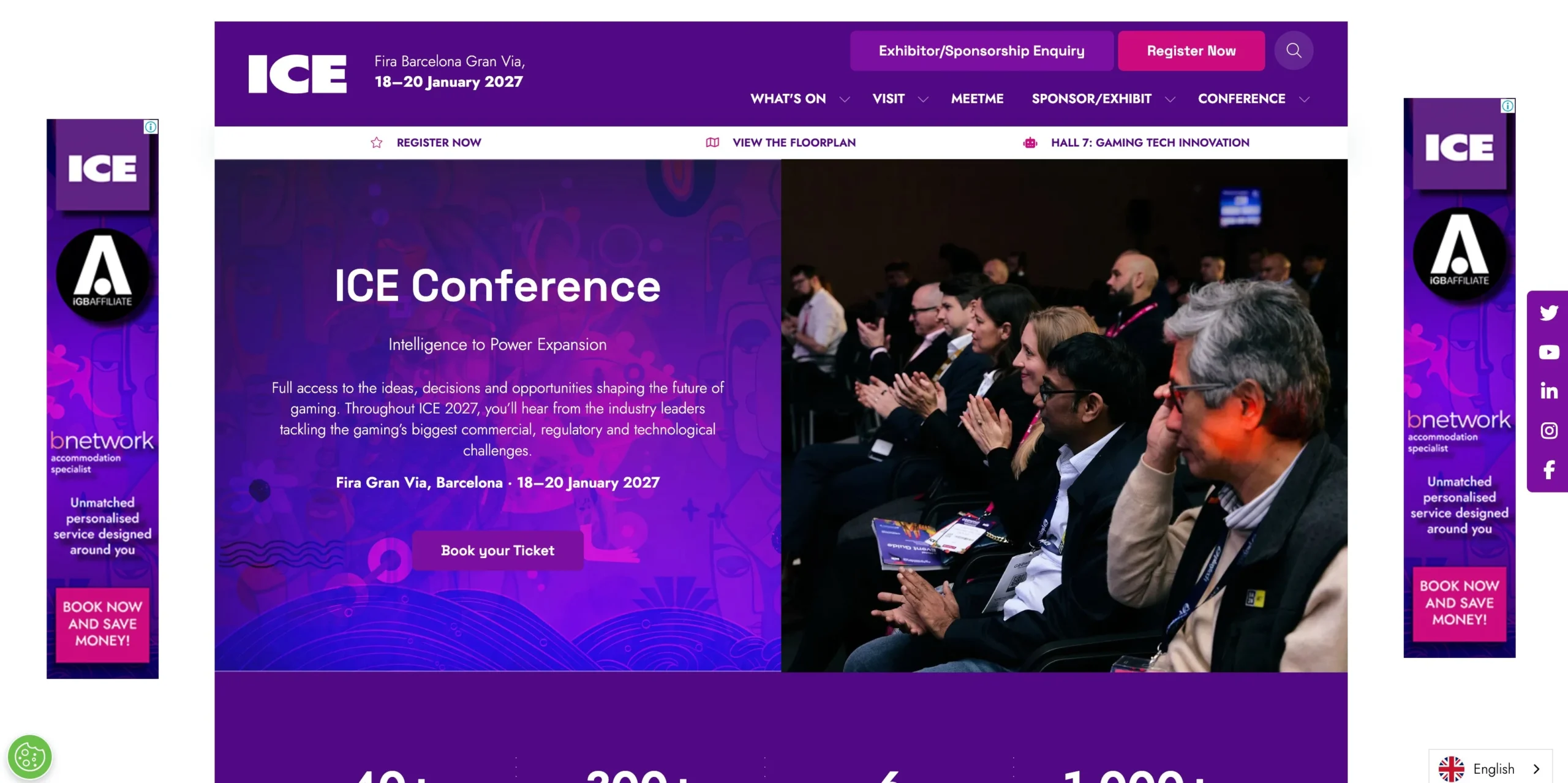
The iGaming conference circuit - ICE London, SBC Summit, SiGMA, G2E - isn't just networking theater. It's where hiring happens, partnerships form, and the industry's direction gets set in real time.
Where the Industry Is Headed
I track trends for a living, and here's what I'm watching most closely heading into 2027:
Regulatory expansion. More countries are moving from prohibition to regulation. Brazil finalized its framework. India's states are making individual decisions. Several US states are still debating iCasino legalization beyond the current handful. Each new regulated market creates a wave of licensing applications, platform deployments, and affiliate activity.
AI-driven operations. Operators are deploying machine learning for fraud detection, responsible gambling intervention, personalized marketing, and customer support automation. The technology isn't replacing human teams yet - but it's making smaller teams competitive against larger ones. I discuss practical applications in my iGaming marketing strategy guide.
Crypto and alternative payments. Digital currencies aren't niche anymore in iGaming. Bitcoin, Ethereum, and stablecoins have carved out a real segment - especially in markets where traditional banking rails are unreliable or restricted. The challenge is regulatory clarity. Some jurisdictions embrace crypto deposits openly. Others haven't addressed them at all. I've covered the technical side of building crypto-ready platforms in my casino website development guide.
Consolidation. The operator landscape is thinning through mergers and acquisitions. Larger groups are buying smaller operators for their licenses, player databases, and regional market access. This is the natural maturation cycle - the same pattern I watched play out in fintech five years ago.
Responsible gambling infrastructure. Regulators are tightening requirements around self-exclusion tools, deposit limits, affordability checks, and intervention triggers. Operators treating responsible gambling as a checkbox exercise are getting caught. The ones building it into their core product are earning regulatory goodwill - and increasingly, player trust.
The bottom line: iGaming isn't a speculative niche anymore. It's a $100-billion-plus global industry with regulated markets on every continent, institutional investment backing, and a talent pipeline that's finally catching up to demand. And it's still growing - fast enough that the landscape I'm describing today will look different again by this time next year.
For anyone considering entering the space as an operator, the roadmap starts with understanding your model - and I've laid that out in detail in my guide to starting an iGaming business.
FAQ
What does iGaming stand for?
The "i" stands for internet. iGaming refers to any form of gambling conducted online - including online casinos, sports betting, poker, bingo, and esports wagering. It's the industry's preferred B2B term for what consumers typically call "online gambling."
How big is the global iGaming market?
The global iGaming market exceeded $100 billion in revenue in 2025. North America accounts for roughly $37 billion, Europe for about $50 billion, and Latin America - the fastest-growing region - is approaching $6 billion with a 10% compound annual growth rate.
Is iGaming legal in Canada?
Online gambling is legal in Canada, but the regulatory framework varies by province. Ontario operates a fully regulated iGaming market through the AGCO and iGaming Ontario. Other provinces offer gambling through provincial lottery corporations (BCLC, Loto-Québec, etc.) while offshore operators continue to serve Canadian players in a legal grey area.
What's the difference between iGaming and online gambling?
There's no technical difference - both terms describe the same activity. "Online gambling" is more common in consumer and regulatory contexts, while "iGaming" is the standard term used among operators, software providers, and industry professionals on the B2B side.
How many people gamble online worldwide?
Approximately 600 million people actively participate in some form of online gambling globally. Mobile devices account for about 74% of all iGaming transactions, making smartphones the dominant access point.
Can I build a career in iGaming?
The industry employs people across software engineering, compliance, data science, marketing, payment processing, UX design, and legal roles. Growth is strong enough that experienced talent commands premium salaries - senior platform roles and compliance heads regularly earn six-figure compensation in Canadian markets.