
I launched CasinoCurrencies.ca in 2021 because I kept seeing the same pattern: smart people with real capital walking into iGaming without understanding the operational mechanics that make or break an operator. Five years and hundreds of platform audits later, my take hasn't changed - starting an iGaming business is less about the idea and more about the infrastructure decisions made in the first 90 days.
This isn't a rehash of the general steps to start an online casino. That guide covers the consumer-facing launch checklist. This one is for operators and entrepreneurs who already know what iGaming is and want the B2B playbook - from choosing a business model to benchmarking performance to planning an eventual exit.
Deciding Your Model: White-Label, Turnkey, or Custom-Built
Every iGaming business starts with a foundational choice: how much of the technology stack do I own?
There are three models, and each one trades speed for control in a different way.
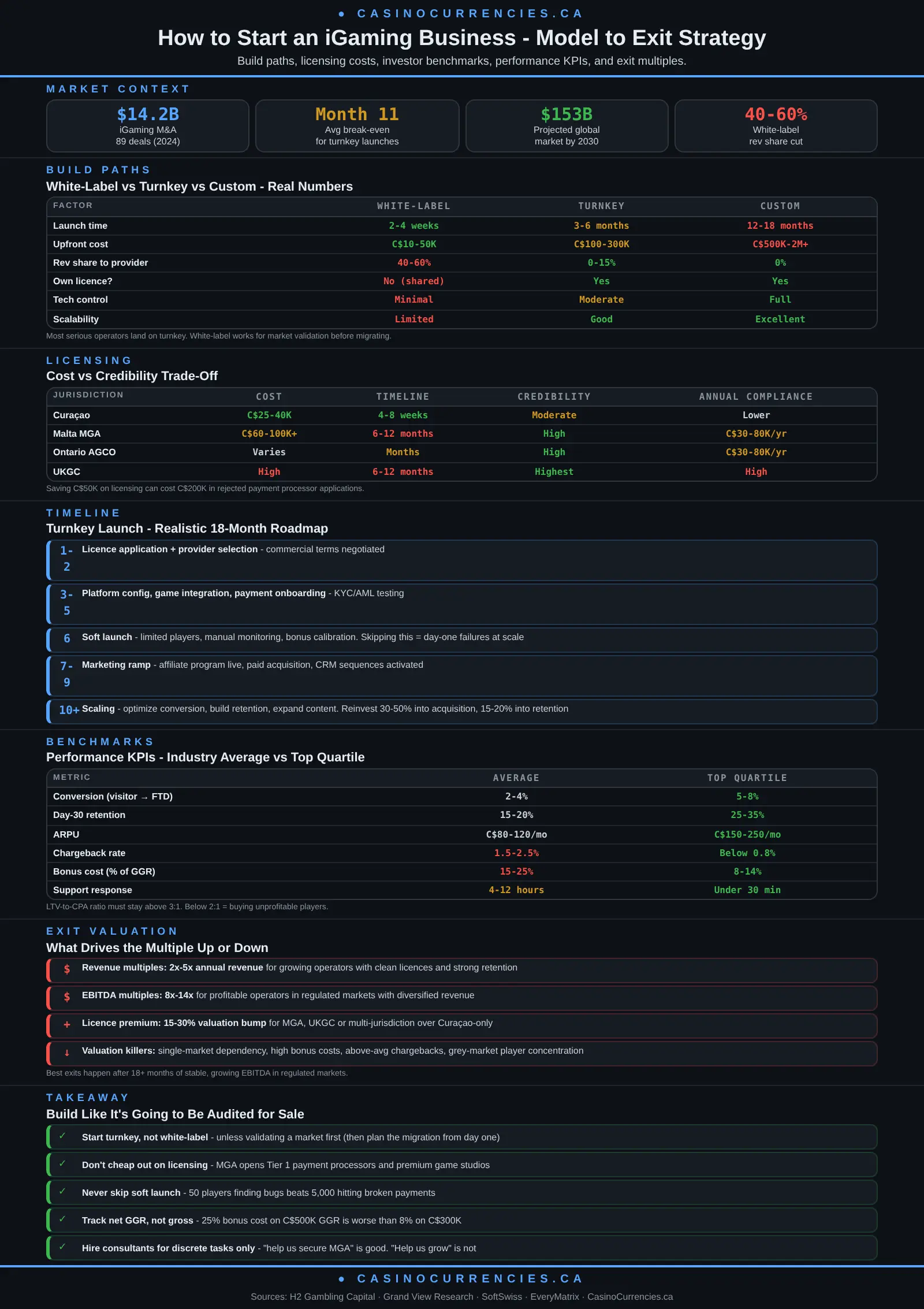
- White-label means renting someone else's entire operation. A white-label provider supplies the platform, the game library, the payment processing, and typically the gambling license. The operator focuses on branding and player acquisition. Launch timelines can be as short as 2-4 weeks. But margins are thin - the provider takes a significant revenue share, often 40-60%, because they're carrying the licensing and infrastructure risk.
- Turnkey sits in the middle. The operator buys or licenses a complete platform - PAM, game aggregation, back office - but holds their own gambling license and manages their own payment relationships. This is the model most mid-market operators choose. Setup takes 3-6 months and costs C$100,000-$300,000 depending on the provider and jurisdiction. Margins improve dramatically because the operator keeps a larger share of GGR (gross gaming revenue).
- Custom-built means developing the technology from the ground up. Full control, full cost. I've tracked custom builds running anywhere from C$500,000 to well over C$2 million, with development timelines of 12-18 months before a single player logs in. Only operators with deep pockets and long-term strategic plays - typically those planning multi-brand portfolios or targeting underserved markets - should consider this route.
White-Label vs Turnkey - Honest Trade-Offs
I get asked which igaming turnkey solution is better almost weekly. The answer depends entirely on the operator's goals, bankroll, and timeline.
| Factor | White-Label | Turnkey | Custom-Built |
|---|---|---|---|
| Time to launch | 2-4 weeks | 3-6 months | 12-18 months |
| Upfront cost | C$10K-$50K | C$100K-$300K | C$500K-$2M+ |
| Revenue share to provider | 40-60% | 0-15% (licensing fees) | 0% |
| Own gambling license? | No (shared) | Yes | Yes |
| Control over tech stack | Minimal | Moderate | Full |
| Scalability | Limited | Good | Excellent |
| Brand differentiation | Low | Moderate | High |
Truth is, a white-label iGaming setup works for operators testing a market before committing real capital. I've seen teams launch on white-label in one jurisdiction, validate demand, then migrate to turnkey within a year. That's a rational approach - as long as the migration is planned from day one and the white-label contract doesn't lock the operator into punitive exit terms. Read the termination clauses before signing anything.
Turnkey is where most serious operators land. It balances speed with control and gives the operator enough margin to reinvest in marketing and player retention. The platform providers handling turnkey solutions - SoftSwiss, BetConstruct, Aspire Global, EveryMatrix - each have different strengths in game content, geographic coverage, and compliance tooling. I break that selection process down in my guide to choosing an iGaming software provider.
Licensing Considerations
No gambling license, no legitimate iGaming business. Period.
The license dictates everything downstream: which payment processors will work with the operator, which game providers will integrate, which affiliate networks will send traffic, and which markets the operator can legally serve.
I've written an extensive breakdown of how to get an online gambling license, so I won't repeat the jurisdiction-by-jurisdiction details here. But the decision points that matter most for someone starting an iGaming business are:
- Cost vs credibility. A Curaçao license runs C$25,000-$40,000 and takes 4-8 weeks. A Malta MGA license costs C$60,000-$100,000+ with 6-12 months of processing. The MGA license opens doors with Tier 1 payment providers and premium game studios that won't touch Curaçao-licensed operators. I've watched operators save C$50K on licensing and then lose C$200K in rejected payment processor applications.
- Market access. Ontario requires registration through the AGCO and iGaming Ontario. The UK demands a UKGC license for any operator targeting British players. An operator's target market determines the license, not the other way around.
- Ongoing compliance. Licensing isn't a one-time event. Annual fees, audits, responsible gambling requirements, and reporting obligations consume real operational budget - typically C$30,000-$80,000 per year depending on jurisdiction.
Launching and Scaling - Realistic Timelines
Here's where I see optimism get expensive. First-time operators routinely underestimate the gap between "platform is live" and "business is generating positive cash flow."
A realistic timeline for an iGaming business launching on a turnkey solution:
- Months 1-2: License application submitted, platform provider selected, commercial terms negotiated
- Months 3-5: Platform configuration, game integration, payment processor onboarding, KYC/AML systems testing
- Month 6: Soft launch - limited player base, manual monitoring, bonus calibration
- Months 7-9: Marketing ramp - affiliate program goes live, paid acquisition starts, CRM sequences activated
- Months 10-18: Scaling phase - optimizing conversion, building retention programs, expanding game content
The soft launch period is critical and often rushed. I've audited operators who skipped it entirely and discovered payment routing failures, bonus abuse vulnerabilities, and KYC bottlenecks on their first day of full traffic. Soft launch catches those problems when 50 players are affected instead of 5,000.
Growing an iGaming business past the launch phase requires disciplined reinvestment. The operators who scale successfully allocate 30-50% of early revenue back into player acquisition and 15-20% into retention and CRM - a topic I cover in depth in my iGaming marketing strategy and player retention guides.
Growing approved payment volume is another scaling bottleneck most operators don't anticipate. Payment processors assign transaction limits based on chargeback rates, processing history, and license quality. New operators start with low limits. Building volume means maintaining chargeback rates below 1%, processing consistently for 6+ months, and gradually requesting limit increases - the process I detail in my iGaming payment solutions guide.
And here's the part nobody talks about at conferences: the first year is almost always cash-flow negative. Marketing spend front-loads the cost curve while player LTV accrues over months. I've reviewed P&L statements from 12 turnkey launches in 2024-2025, and the average operator didn't hit monthly break-even until month 11. The outliers who broke even by month 6 all shared two traits - they entered markets with low competition and they ran aggressive but targeted affiliate campaigns instead of broad paid media.
Attracting Investors: What iGaming VCs Look For
Not every operator bootstraps. For those who need outside capital to start an iGaming business at scale, here's what I've seen investors prioritize across dozens of pitch decks and funding rounds.
Licensing and compliance first. Investors won't touch an unlicensed operation. A valid gambling license from a reputable jurisdiction isn't a nice-to-have - it's table stakes for any conversation with institutional money.
Unit economics, not GMV. Gross merchandise volume impresses nobody in iGaming. Investors want to see cost-per-acquisition (CPA), player lifetime value (LTV), and the ratio between them. A healthy iGaming business maintains an LTV-to-CPA ratio above 3:1. Below 2:1, the business is buying unprofitable players.
Retention data. First-time deposit (FTD) numbers are vanity metrics. Day-7 and Day-30 retention rates tell the real story. Top-quartile operators retain 25-35% of players at Day-30. If the numbers are below 15%, the product has a leaky bucket problem that more marketing spend won't fix.
Scalable technology. VCs want to know the platform can handle 10x the current player base without a rebuild. Operators on white-label arrangements face tough questions here because scaling depends on someone else's infrastructure.
Regulatory diversification. Single-jurisdiction operators carry concentration risk. Investors prefer operators licensed - or positioned to license - in multiple markets. A Curaçao-only operator with no roadmap to MGA or AGCO registration signals limited growth ambition.
According to a 2025 H2 Gambling Capital analysis, iGaming M&A activity reached $14.2 billion across 89 transactions in 2024, signaling strong institutional appetite for the sector.
Benchmarking Your Platform's Performance
What makes successful igaming operators different from the rest? Data discipline. The operators I've seen scale beyond C$5 million in annual GGR all track the same core metrics - and act on them weekly, not quarterly.
Key performance benchmarks for an iGaming platform:
| Metric | Industry Average | Top-Quartile Target |
|---|---|---|
| Conversion rate (visitor → FTD) | 2-4% | 5-8% |
| Day-30 player retention | 15-20% | 25-35% |
| Average revenue per user (ARPU) | C$80-$120/month | C$150-$250/month |
| Chargeback rate | 1.5-2.5% | Below 0.8% |
| Bonus cost as % of GGR | 15-25% | 8-14% |
| Customer support response time | 4-12 hours | Under 30 minutes |
Benchmarking iGaming platform performance isn't just about internal targets. It's about knowing where the operation sits relative to the market and spotting the metrics that will unlock the next stage of growth. An operator with strong conversion but weak retention doesn't need more ad spend - they need better onboarding flows and smarter CRM sequences.
I recommend monthly benchmarking reviews with the platform provider. Most serious providers - SoftSwiss, EveryMatrix, Digitain - offer operator dashboards with these metrics built in. If the provider can't give real-time access to these numbers, that's a red flag worth evaluating during software provider selection.
One thing I've noticed consistently: operators who obsess over GGR while ignoring bonus cost ratios end up in trouble by year two. A platform generating C$500,000 in monthly GGR with a 25% bonus cost is less healthy than one generating C$300,000 with an 8% bonus cost. The second operator has real margin. The first is buying volume with unsustainable promotional spend - and the moment bonuses tighten, players disappear. Track net gaming revenue, not gross. That's the number that pays salaries and funds expansion.
Planning an Exit - How to Value Your iGaming Company
Not every operator plans to run their platform forever. Acquisitions, mergers, and strategic sales are common - and starting an iGaming business with an eventual exit in mind is just sound financial planning.
iGaming companies are typically valued on a multiple of EBITDA (earnings before interest, taxes, depreciation, and amortization) or, for earlier-stage companies, a revenue multiple. Based on publicly reported transactions and the data I've tracked:
- Revenue multiples: 2x-5x annual revenue for growing operators with clean licenses and strong retention metrics
- EBITDA multiples: 8x-14x for profitable operators in regulated markets with diversified revenue streams
- License premium: Operators holding MGA, UKGC, or multi-jurisdiction licenses command a 15-30% valuation premium over Curaçao-only operations
The global iGaming market is projected to reach approximately $153 billion by 2030, according to Grand View Research, which supports sustained acquirer interest across the sector.
What drives valuation down: single-market dependency, high bonus costs eating into margins, above-average chargeback rates, and player databases concentrated in grey-market jurisdictions. What drives it up: regulated-market licenses, strong Day-30 retention, proprietary technology or exclusive content deals, and a clean compliance history.
My advice to any operator: build the business like it's going to be audited for sale - even if the plan is to hold it. Clean financials, documented compliance procedures, and organized player data make every operational decision easier, not just the exit.
And timing matters. The best exits I've tracked happened after operators demonstrated 18+ months of stable, growing EBITDA in regulated markets. Selling during a rapid-growth phase - before profitability stabilizes - usually means accepting a lower multiple because acquirers discount the uncertainty. Patience isn't glamorous, but it's worth real money in iGaming M&A.
When to Bring in Consultants
Every operator hits a wall at some point - a licensing application stalls, a payment processor pulls out, player acquisition costs spike and nobody can explain why. That's when the question surfaces: which firms offer igaming consulting, and is it worth the cost?
Consulting in iGaming falls into a few categories:
- Licensing and compliance consultants - firms like Nsoft Consulting, iGaming Academy, and SCCG Management specialize in navigating multi-jurisdiction applications, preparing compliance documentation, and managing regulatory audits. Budget C$15,000-$50,000 for a licensing engagement depending on complexity.
- Technical platform consultants - independent CTOs-for-hire who audit platform architecture, evaluate provider contracts, and manage technology migrations. Useful for operators moving from white-label to turnkey. Expect C$200-$500/hour for experienced specialists.
- Marketing and CRM consultants - agencies like Growth-onomics, Enteractive, and Raketech's B2B division help operators optimize acquisition funnels, retention flows, and affiliate program structures. Retainers typically run C$5,000-$15,000/month.
The honest answer on consultants: they're worth it when the operator lacks specific expertise that's blocking progress - and not worth it when the operator is outsourcing decisions they should be learning to make internally. A licensing consultant who's navigated 30 MGA applications saves real time and money. A marketing consultant running generic campaigns that the in-house team could execute after a week of training is a waste.
I tell operators to hire consultants for discrete, time-bound engagements with clear deliverables. "Help us secure an MGA license" is a good brief. "Help us grow" is not.
FAQ
How much does it cost to start an iGaming business?
Total costs range from C$50,000 for a white-label launch to C$2 million+ for a custom-built platform. The most common path - turnkey with a dedicated license - runs C$150,000-$400,000 including licensing, platform fees, game integration, and initial marketing budget. I break down costs in more detail in my guide on casino startup costs.
How long does it take to launch an iGaming platform?
White-label setups can go live in 2-4 weeks. Turnkey platforms with a dedicated license typically take 4-6 months from contract signing to soft launch. Custom-built platforms require 12-18 months of development before launch. Add 2-12 months for licensing depending on the jurisdiction.
Can I start an iGaming business without a gambling license?
Operating without a license means operating illegally in most regulated markets - which shuts out reputable payment processors, premium game providers, and institutional investors. Some operators launch under a white-label provider's license as a starting point, then apply for their own as the business grows. But building on an unlicensed foundation limits everything downstream.
What's the difference between starting an iGaming business and starting an online casino?
"Starting an online casino" typically refers to launching a single consumer-facing gambling site. "Starting an iGaming business" is the broader category - it can mean operating a casino, building a sportsbook, creating a B2B platform, launching an affiliate network, or developing game content. The iGaming framing signals a more sophisticated operator who's thinking about the business as a scalable entity, not just a single website.
How do I attract investors for an iGaming business?
Investors evaluate licensing status, unit economics (LTV-to-CPA ratios above 3:1), Day-30 retention rates, and regulatory diversification. A clean gambling license from a reputable jurisdiction is a prerequisite for any serious capital conversation. Prepare detailed financials, demonstrate technology scalability, and show a roadmap for multi-market expansion.
When should I hire an iGaming consultant?
Consultants add the most value for discrete, high-stakes tasks where the operator lacks internal expertise - licensing applications, platform migrations, payment processor onboarding, and regulatory audits. For ongoing operations like marketing and retention, building in-house capability usually delivers better long-term ROI than permanent consulting retainers.