I've spent the better part of five years tracking how online casinos operate from the inside — their payment rails, licensing structures, compliance headaches, and the operational machinery most players never see. That puts me in a strange position: I know exactly how the sausage gets made. And the first thing I'll tell anyone asking how to start an online casino is this — it's a real business, not a side hustle. The startup costs are steep, the regulatory overhead is relentless, and the margins only materialize if the operation is tight from day one.
But the market opportunity is hard to ignore. The global online gambling industry generated roughly US$95.1 billion in 2024, according to Statista's iGaming market report, and projections put it north of US$130 billion by 2028. That kind of growth draws everyone from fintech veterans to first-time entrepreneurs.
Here's what the process actually looks like — stripped of the hype.
What Is an Online Casino Business and Why Enter the Market
An online casino business is a licensed digital platform that offers real-money gambling products — slots, table games, live dealer, sometimes sports betting — to players over the internet. The operator doesn't typically build the games. Instead, the business model revolves around aggregating content from game providers, handling player funds, managing risk, and staying compliant with whatever jurisdictions the platform serves.
The revenue model works on the house edge — a mathematical advantage built into every game. Slots carry a house edge of 2–10%, blackjack sits around 0.5–2% with optimal play, and live dealer games land somewhere in between. The operator's gross gaming revenue (GGR) is the difference between total wagers and total payouts. From that GGR, subtract licensing fees, platform costs, payment processing, marketing, staffing, and taxes. What remains is the operator's margin — and in a well-run operation, that margin can be significant at scale.
The appeal is straightforward: high player lifetime value, recurring revenue, and a product that runs 24/7 with no physical overhead. But the barriers to entry exist for a reason. Regulators don't hand out gambling licenses to hobbyists, payment processors scrutinize every transaction, and player acquisition costs in competitive markets can burn through a six-figure marketing budget in months.
That said, the window isn't closed. New markets keep opening — Ontario launched its regulated iGaming market in April 2022, Brazil's federal framework is rolling out, and multiple U.S. states continue to legalize. Each new jurisdiction creates a fresh land grab for operators willing to navigate the compliance requirements. For a breakdown of regional considerations, I've compiled a guide to starting an online casino by country.

Legal Requirements and Jurisdiction Selection
Before building anything, the single most critical decision is where to incorporate and which jurisdiction's gambling license to pursue. This choice dictates everything downstream — what markets can be served, which payment providers will onboard the business, and how much regulatory overhead sits on the operation.
The key legal requirements common across most jurisdictions include:
- A registered corporate entity in an approved structure
- Proof of sufficient capital reserves to cover player balances
- Background checks on all directors, shareholders, and beneficial owners
- Technical infrastructure that meets the jurisdiction's data protection and fairness standards
- A responsible gambling framework with self-exclusion, deposit limits, and age verification
- Anti-money laundering (AML) and know-your-customer (KYC) procedures
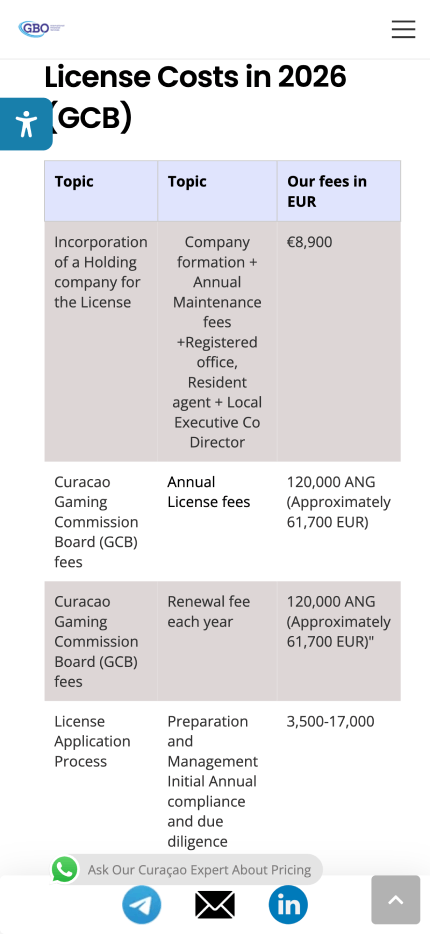
Choosing the wrong jurisdiction is one of the most expensive mistakes a new operator can make. A Curacao license costs less upfront but limits access to regulated European markets. A Malta Gaming Authority license carries more credibility but demands higher capital reserves and a longer application timeline. I've written a detailed comparison in How to Get an Online Gambling License — it covers costs, timelines, and the fine print for each major jurisdiction.
Major Licensing Jurisdictions at a Glance
| Jurisdiction | Estimated License Cost | Application Timeline | Key Advantage |
|---|---|---|---|
| Malta (MGA) | €25,000–€40,000+ | 6–12 months | Gold-standard reputation, EU market access |
| Curacao | US$17,000–$25,000 | 6–8 weeks | Fast, inexpensive, wide geo coverage |
| UK (UKGC) | £2,008–£120,764 | 4–6 months | Access to one of the world's largest markets |
| Isle of Man | £5,000–£50,000 | 6–12 months | Strong reputation, tax advantages |
| Gibraltar | £2,000+ | 6–18 months | Established hub, favorable tax regime |
| Kahnawake (Canada) | CA$25,000–$50,000 | 3–6 months | North American jurisdiction, indigenous sovereignty |
The table above gives ballpark figures — actual costs depend on the operator's structure and the number of product verticals being licensed.
Getting a Gambling License
I won't rehash the entire licensing process here since I've dedicated a full guide to it — How to Get an Online Gambling License. But the short version is this: apply for the jurisdiction that matches the target market. Don't chase the cheapest license if the goal is to serve players in regulated markets like Ontario, the UK, or any EU member state. Those markets require specific licenses, and operating without one carries severe penalties.
The licensing process itself involves submitting a detailed application, undergoing personal and corporate background checks, demonstrating technical compliance, and — in many cases — passing a live audit of the platform before going live. The entire cycle can take anywhere from six weeks (Curacao) to over a year (Malta or Gibraltar), depending on the complexity of the application and the regulator's backlog.
One thing I've learned from watching operators go through this: budget for legal counsel. A specialized iGaming lawyer costs between €200–€500 per hour, but the cost of a botched application — rejected after months of waiting — is far worse. The Malta Gaming Authority alone processed over 50 new license applications in 2023 according to its annual report, and rejection rates climb when applications arrive incomplete or poorly structured.
Choosing a Platform and Software Provider
The platform is the engine of the entire operation. It handles player accounts, game integration, bonus management, payment processing, reporting, compliance tools, and back-office administration. Getting this wrong means rebuilding under pressure once the casino is live — and I've seen more than one operator forced into exactly that situation.
There are three main approaches:
- White-label solution — A third-party provider supplies the entire platform, games, and often the license. The operator handles marketing and player acquisition. Lowest barrier to entry but the thinnest margins and least control. Monthly fees typically run from US$5,000 to $15,000 depending on the provider, plus a revenue share of 30–50%.
- Turnkey platform — The operator buys or leases a ready-made platform and operates it under their own license. More control than white-label but requires licensing and compliance infrastructure. Setup costs range from US$50,000 to $200,000.
- Custom-built platform — A development team builds the platform from scratch or heavily customizes an existing PAM (Player Account Management) system. Maximum control and flexibility, but the highest cost — typically US$200,000 to $500,000+ for initial development, plus ongoing maintenance.
For a deeper comparison of these approaches and what to look for in a provider, I've covered it in How to Choose the Right iGaming Software Provider.
What to Evaluate in a Platform Provider
- Game aggregation capabilities — how many studios are integrated, and how easily can new ones be added
- Payment gateway compatibility — does it support the methods players in the target market actually use
- Compliance tooling — built-in KYC/AML workflows, responsible gambling features, regulatory reporting
- Scalability — can the infrastructure handle traffic spikes during major sporting events or promotions
- API architecture — clean, documented APIs make integration faster and cheaper
- Back-office and CRM — real-time dashboards, player segmentation, automated bonus triggers
Selecting Game Providers and Content
Players don't care about platform architecture. They care about the games. And the game library is often the first thing a potential player evaluates — alongside the welcome bonus — when deciding whether to register.
The iGaming content ecosystem is massive. Major studios like Pragmatic Play, Evolution (live dealer), NetEnt, Microgaming, Play'n GO, and Hacksaw Gaming dominate the market, but hundreds of smaller studios produce niche content that can differentiate a new casino.
Most operators don't contract directly with every game provider. Instead, they use a game aggregator — a middleware layer that provides access to thousands of titles through a single API integration. Companies like SoftSwiss, EveryMatrix, and BetConstruct offer aggregation as part of their platform packages.
The content strategy should match the target market. Canadian players, for instance, tend to favor slots (especially high-volatility titles), live blackjack, and — increasingly — crash games. A new operator entering the Canadian market without a solid live dealer offering from Evolution or Pragmatic Play Live is leaving money on the table.
Licensing fees from game providers vary. Some studios charge a flat monthly integration fee (€1,000–€5,000), while others work on a revenue-share model — typically 10–20% of GGR generated by their titles. The aggregator route simplifies this by bundling dozens of studios under a single commercial agreement, but the aggregator takes its own cut on top. Operators need to model these costs carefully. A library of 2,000 titles sounds impressive until the content fees eat 25% of gross revenue.
One detail that catches new operators off guard: game certification. Most regulated jurisdictions require that every game offered on the platform carries an RNG (Random Number Generator) certificate from an approved testing lab. If a game isn't certified for the specific market being served, it can't go live there — even if it's certified elsewhere. That certification process adds time and cost to every new title added to the lobby.
Payment Processing Setup
Payments are where I've spent the most time in my analysis work, and I can say with confidence: this is where most first-time operators underestimate the complexity.
Online gambling is classified as a high-risk industry by every major card network and most banks. That means higher processing fees (typically 3–7% per transaction versus 1.5–3% for standard e-commerce), stricter onboarding requirements, and a constant risk of having the merchant account frozen or terminated if chargeback ratios exceed thresholds — usually 1% of total transactions.
A minimum viable payment stack for a new online casino typically includes:
- Credit and debit card processing (Visa, Mastercard) through a high-risk payment processor
- At least one e-wallet option (Skrill, Neteller, or MuchBetter)
- Interac for Canadian markets — it's non-negotiable. Roughly 60% of Canadian online casino deposits go through Interac
- Cryptocurrency options (Bitcoin, Ethereum, USDT) — increasingly expected, especially in markets where banking restrictions make fiat deposits difficult
- Bank transfers or pay-by-bank solutions for higher-value transactions
Each payment method has its own integration requirements, fee structures, and settlement timelines. I've broken down the full landscape — including chargeback reduction strategies — in iGaming Payment Solutions.
Website and App Development
The front end — the website and potentially a mobile app — is what players actually interact with. And while the underlying platform handles the heavy lifting, the user interface and experience determine whether a player sticks around past their first session.
Critical features every casino site needs on launch day:
- Fast, responsive design that works on mobile without a dedicated app
- Intuitive game lobby with filtering, search, and category navigation
- Clear registration flow — ideally under 60 seconds with minimal friction
- Visible responsible gambling tools (deposit limits, self-exclusion, session timers)
- A support interface — live chat is the industry standard. Email-only support is a red flag for players
- Multi-currency and multi-language support if serving more than one market
On the app front — most new operators skip a native mobile app at launch. A well-built progressive web app (PWA) covers the majority of mobile use cases without the expense and app-store compliance issues of native iOS and Android builds. Native apps make sense once the player base is large enough to justify the investment.
For a detailed walkthrough of the build process, check How to Build an Online Casino Website or App.
Launch Checklist and Go-Live
Going live isn't flipping a switch. The launch phase has its own set of requirements that — if missed — can result in regulatory action before the first player even deposits.
Pre-launch checklist:
- License granted and displayed on the website with the regulator's seal
- All games tested for RTP accuracy and RNG certification by an approved testing lab (GLI, eCOGRA, BMM Testlabs, iTech Labs)
- Payment processing live and tested with real transactions (not just sandbox)
- KYC/AML procedures tested end-to-end — including document verification and PEP/sanctions screening
- Responsible gambling tools activated and functional
- Terms and conditions, privacy policy, and bonus terms reviewed by legal counsel
- Customer support team trained and staffed for launch-day volume
- Marketing materials compliance-checked (no misleading claims, proper disclaimers)
- Server load testing completed — nothing kills a launch faster than downtime on day one
Soft launch strategy
Most experienced operators run a soft launch before going fully public. This means opening the platform to a limited audience — internal testers, invited players, or a specific geographic segment — to identify bugs, payment issues, or compliance gaps under real conditions. A two-to-four-week soft launch period is standard practice.
How Long the Process Takes
The honest timeline from "I've decided to start an online casino" to "accepting real-money deposits" looks something like this:
| Phase | Timeline |
|---|---|
| Business planning and market research | 1–2 months |
| Company incorporation and licensing application | 1–3 months (depending on jurisdiction) |
| License approval | 6 weeks – 12 months |
| Platform selection and contract negotiation | 1–2 months (can overlap with licensing) |
| Technical integration and development | 3–6 months |
| Testing, compliance audit, and soft launch | 1–2 months |
| Total (realistic range) | 8–18 months |
The fastest path — white-label with a Curacao license — can potentially compress this to four to six months. A custom-built platform with an MGA license is closer to 18 months.
Common 8 Mistakes to Avoid
I've tracked enough casino launches to spot the patterns that kill new operations. Here are the most common:
- Underestimating compliance costs. The license fee is just the entry ticket. Ongoing compliance — audits, regulatory reporting, responsible gambling programs, AML monitoring — runs five to six figures annually depending on the jurisdiction. Budget for it from day one.
- Choosing a payment provider based on price alone. The cheapest processor is often the one most likely to freeze the merchant account at the worst possible time. Reliability and relationship matter more than saving 0.5% per transaction.
- Launching with too thin a game library. Starting with 200 generic slots and no live dealer content doesn't cut it anymore. Players have too many options. A curated library of 1,000+ titles from reputable studios is the baseline expectation.
- Ignoring player retention from the start. Acquisition costs in iGaming are brutal — C$200 to C$500+ per depositing player in competitive markets. Operators who pour everything into acquisition without a retention strategy are building a leaky bucket. I've covered this in iGaming Player Retention.
- Skipping the soft launch. Going from zero to public launch without a controlled testing phase is a recipe for embarrassing bugs, payment failures, and angry players leaving one-star reviews before the operation has a chance to find its footing.
- Not planning for marketing spend. A casino with no players is just a server burning money. Marketing budgets for a new operator's first year should be in the range of C$100,000 to C$500,000+ depending on the target market. That number catches a lot of new operators off guard. I've detailed marketing strategies in How to Promote an Online Casino.
- Neglecting responsible gambling infrastructure. This isn't optional — it's a license condition in every reputable jurisdiction. But beyond compliance, it's a business risk. Operators who don't implement proper self-exclusion, deposit limits, and reality checks face regulatory fines and reputational damage that can sink a brand before it gains traction.
- Treating the terms and conditions as an afterthought. The T&Cs — especially bonus terms — are where most player disputes originate. Vague wagering requirements, unclear withdrawal caps, and hidden restrictions generate complaints, chargebacks, and regulatory scrutiny. Having an experienced iGaming lawyer draft these documents is not a luxury. It's a cost of doing business. If disputes do arise, I've outlined the player's side of the process in What to Do If an Online Casino Won't Pay.
FAQ
How much does it cost to start an online casino?
The range is wide — from roughly C$70,000 for a white-label setup with a Curacao license to C$700,000+ for a custom-built platform with an MGA license. The biggest line items are the platform, the license, and first-year marketing. I've broken down every cost category in How Much Does It Cost to Start an Online Casino?.
Can I start an online casino for free or with no money?
No. There's no legitimate path to launching a real-money gambling platform with zero capital. Even the cheapest white-label options require five-figure investments. Anyone selling a "free" casino startup is either selling a social casino (no real money) or running a scam.
Do I need a gambling license to start an online casino?
Yes — operating without one is illegal in virtually every jurisdiction and exposes the operator to criminal prosecution, asset seizure, and permanent blacklisting by payment processors. The type of license needed depends on the target market.
How long does it take to launch an online casino?
Realistically, 8 to 18 months from initial planning to accepting real-money deposits. The fastest white-label setups can compress this to four to six months, but that comes with trade-offs in control and margins.
Is starting an online casino profitable?
It can be — the house edge ensures that a well-run casino generates revenue. But profitability depends on player volume, acquisition costs, operational efficiency, and compliance overhead. According to H2 Gambling Capital research, the average iGaming operator takes 18 to 24 months to reach profitability, assuming adequate capitalization at launch.
What's the difference between starting an online casino and starting an iGaming business?
They overlap significantly, but "iGaming business" is a broader term that includes sports betting, poker, bingo, and esports wagering alongside casino products. The term also tends to imply a B2B or operator-level perspective rather than a consumer-facing one. I've covered the distinction in How to Start an iGaming Business.
Can I run an online casino from home?
The operation itself can be managed remotely — many iGaming startups run with distributed teams. But the business entity must be incorporated in an approved jurisdiction, and the technical infrastructure (servers, payment processing) needs to meet regulatory standards. "Running from home" doesn't mean running casually. The compliance obligations are the same whether the office is a WeWork or a spare bedroom.