I've spent years pulling apart the financial and compliance structures of online casinos, and the gambling license is always where it starts. Not the website, not the game library, not the marketing plan — the license. It's the single document that determines whether an operator is running a legitimate business or an illegal one. And the process of getting one is more opaque than it should be.
This guide covers how to get an online gambling license from the major jurisdictions — what each one costs, what the application demands, how long it takes, and the trade-offs between them. I've also included a section on how to verify online casino licenses, because the operator side of licensing is only half the picture. Players need to know how to spot the real thing.
Why a Gambling License Matters
Operating an online casino without a valid license is illegal in virtually every jurisdiction on the planet. That's the obvious part. But the license does more than keep the operator out of prison — it unlocks the entire business infrastructure.
- Payment processing access. No reputable payment provider — Visa, Mastercard, Interac, Skrill — will onboard an unlicensed gambling operator. The merchant account application gets rejected on the first screening. I've covered this in depth in iGaming Payment Solutions.
- Game provider partnerships. Studios like Evolution, Pragmatic Play, and NetEnt require operators to hold a valid license before granting API access. An unlicensed operator can't legally offer their content.
- Player trust. The license number displayed in the footer of a casino site isn't decorative. Experienced players check it. Affiliate review sites check it. And in regulated markets like Ontario or the UK, unlicensed operators are actively blocked or blacklisted by ISPs.
- Legal protection. A licensed operator has a defined legal framework for disputes, chargebacks, and regulatory complaints. An unlicensed one has nothing — and risks criminal prosecution on top of financial exposure.
The bottom line: there's no shortcut around licensing. Anyone exploring how to get an online gambling license should treat it as the first serious milestone, not a checkbox to rush through.
Major Licensing Jurisdictions Compared
Not all gambling licenses are created equal. The jurisdiction chosen shapes what markets the operator can serve, how much credibility the brand carries, and how heavy the ongoing compliance burden will be. Here's how the six most common jurisdictions stack up.
Malta Gaming Authority (MGA)
Malta is the gold standard in European iGaming regulation. The MGA has been licensing online operators since 2004, and its framework is the model that newer regulators tend to copy. An MGA license grants access to most EU markets (with some local licensing exceptions), and it carries serious weight with payment processors and game providers.
The trade-off is complexity. The MGA demands detailed business plans, proof of capital reserves, background checks on every director and shareholder, and a full technical audit of the gaming platform before approval. The process regularly takes 6–12 months — and that's if the application is clean.
Curacao eGaming
Curacao has historically been the fast-and-cheap option. A Curacao license can be obtained in as little as 6–8 weeks, and the cost is a fraction of what Malta or the UK charges. That speed comes with a reputation trade-off — Curacao-licensed operators are viewed with more skepticism by players, affiliates, and payment providers in regulated markets.
That said, Curacao has been tightening its regulatory framework. The jurisdiction introduced a new licensing law in 2023 that added stricter compliance requirements, KYC obligations, and player protection measures. Operators still flock to it for global market access, but the days of the completely hands-off Curacao license are fading.
UK Gambling Commission (UKGC)
The UKGC is one of the strictest regulators in the world — and it controls access to one of the world's largest regulated online gambling markets. The UK market alone generated approximately £5.7 billion in gross gambling yield for the remote sector in the year ending March 2024, according to the Gambling Commission's industry statistics. That's a massive addressable market, but the price of admission is significant.
UKGC license fees scale based on the operator's projected revenue, and ongoing compliance costs — including responsible gambling mandates, Source of Funds checks, and advertising restrictions — are among the heaviest in the industry. Operators targeting UK players without a UKGC license face criminal penalties and domain blocking.
Isle of Man Gambling Supervision Commission
The Isle of Man occupies a middle ground — strong regulatory reputation without quite the overhead of the UKGC or MGA. The jurisdiction has been licensing online gambling since 2001, and its Gambling Supervision Commission is well-regarded in the industry. Tax advantages (no corporate tax on gambling revenue for licensed operators) make it attractive for operators who want credibility without the Malta-level cost structure.
Gibraltar Regulatory Authority
Gibraltar is home to several of the industry's largest operators — Bet365, 888, and William Hill have all held Gibraltar licenses. The jurisdiction offers a favorable tax regime (1% of revenue, capped at £425,000 per year) and a well-established regulatory framework. But Gibraltar is selective — it tends to favor established operators over startups, and the application process can stretch to 18 months.
Kahnawake Gaming Commission (Canada)
Kahnawake is unique — a First Nations jurisdiction operating under indigenous sovereignty on Mohawk territory near Montreal. The commission has been licensing online gambling operators since 1999, making it one of the earliest online gambling regulators globally. For operators targeting North American markets, a Kahnawake license offers geographic relevance and a relatively streamlined application process.
The limitation is recognition. While Kahnawake licenses are legally valid, they don't carry the same international weight as MGA or UKGC credentials. Payment processors and EU-focused affiliates may require additional licensing.
Requirements by Jurisdiction
Each licensing authority has its own requirements, but there's a common baseline. Here's what every applicant needs to get a license for online gambling, regardless of jurisdiction — followed by the jurisdiction-specific demands.
Universal Requirements
- A registered corporate entity (most jurisdictions won't license a sole proprietor)
- Criminal background checks on all directors, officers, and significant shareholders
- Proof of sufficient capital to cover player funds and operational expenses
- AML/KYC policies and procedures documented in detail
- Responsible gambling policies including self-exclusion, deposit limits, and age verification
- A technical audit of the platform — RNG certification, data security, server location compliance
- A detailed business plan covering market strategy, financial projections, and staffing
Jurisdiction-Specific Requirements
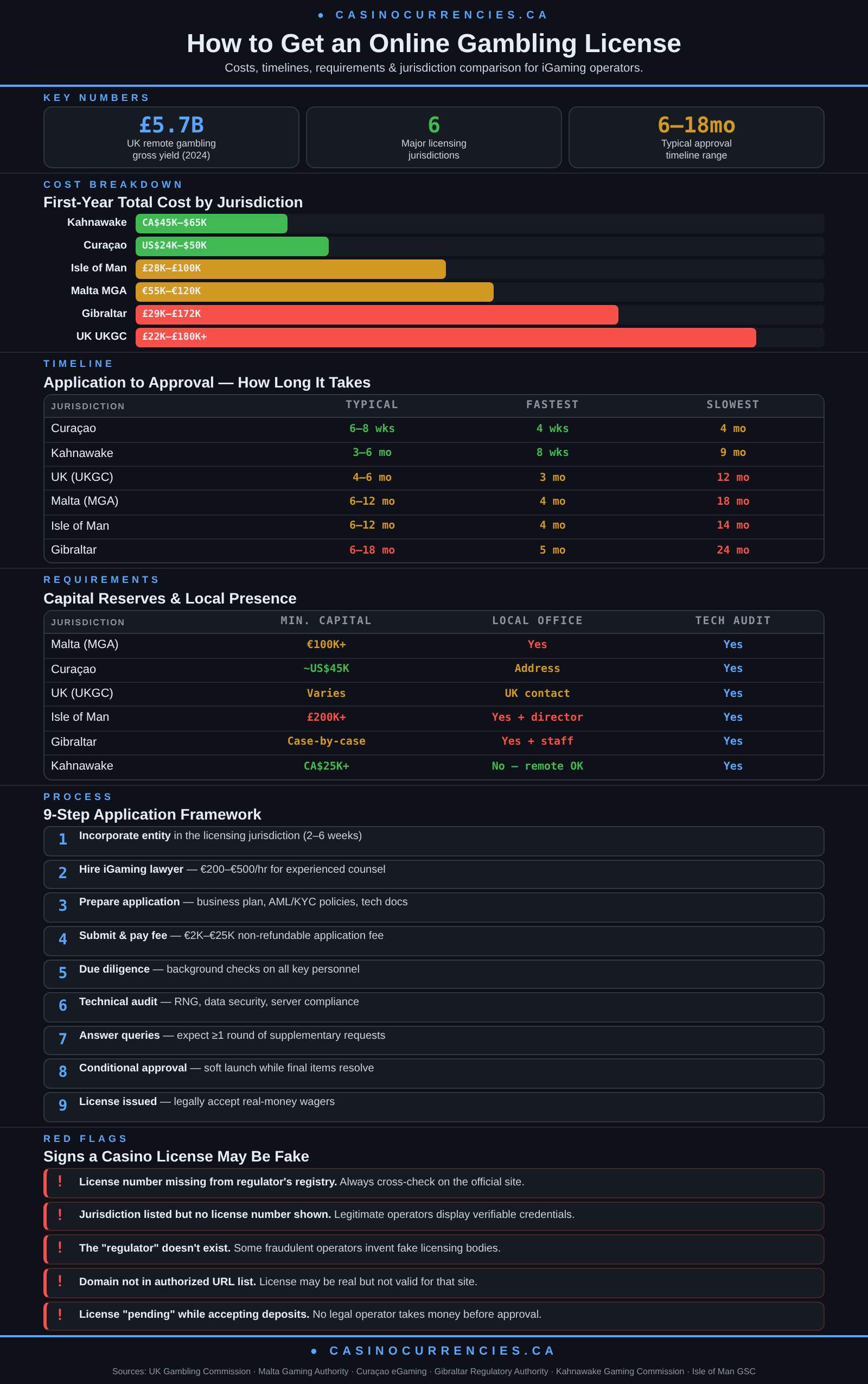
| Jurisdiction | Min. Capital Reserve | Company Structure | Technical Audit Required | Local Presence |
|---|---|---|---|---|
| Malta (MGA) | €100,000+ (varies by license type) | EU-registered company | Yes — by approved lab (e.g., eCOGRA, BMM) | Yes — physical office in Malta |
| Curacao | ~US$45,000 (minimum share capital under new law) | NV or BV entity | Yes — under new 2023 framework | Business address required |
| UK (UKGC) | Varies by scale | UK-registered or overseas with UK representation | Yes — by UKAS-accredited lab | Nominated UK contact |
| Isle of Man | £200,000+ (net assets) | Isle of Man-registered company | Yes | Yes — local director required |
| Gibraltar | Adequate capital (assessed case-by-case) | Gibraltar-registered company | Yes | Yes — physical office + local staff |
| Kahnawake | CA$25,000+ (application fees serve as bond) | Any structure, but must appoint authorized representative | Yes — by approved third party | No — remote operation allowed |
The capital reserves listed above are minimum thresholds. The actual amount required often depends on the number of product verticals being licensed — an operator seeking both casino and sports betting licenses will need higher reserves than one offering casino-only.
How to Apply for an Online Gambling License — Step by Step
The application process follows a broadly similar pattern across jurisdictions, with variations in timing and documentation depth. Here's the general framework I've seen operators follow:
- Incorporate the operating entity in the licensing jurisdiction (or an accepted jurisdiction). This step alone can take 2–6 weeks depending on local incorporation timelines.
- Engage a specialized iGaming lawyer. This isn't optional. Licensing applications are dense legal documents, and a single missing attachment or poorly worded section can add months to the timeline. Expect to pay €200–€500 per hour for experienced counsel.
- Prepare the application package. This typically includes the business plan, corporate structure diagrams, director/shareholder CVs and background check authorizations, financial projections, AML/KYC policies, responsible gambling framework, and technical documentation for the gaming platform.
- Submit the application and pay the initial fee. Most jurisdictions charge a non-refundable application fee separate from the license fee itself. Malta charges €5,000 upfront. Curacao's application costs around US$2,000–$5,000 under the new framework.
- Undergo due diligence. The regulator conducts background checks on all key personnel. This is where skeletons in the closet surface — criminal records, undisclosed financial liabilities, or connections to sanctioned entities will kill an application.
- Complete the technical compliance audit. An approved testing laboratory audits the platform's RNG, game fairness, data protection, and server infrastructure. Labs like eCOGRA, GLI, BMM Testlabs, and iTech Labs are common across jurisdictions.
- Address regulator queries. Expect follow-up questions. Every application I've seen generates at least one round of supplementary information requests. Responding promptly keeps the timeline from stretching.
- Receive conditional approval. Some jurisdictions issue conditional licenses that allow a soft launch while final compliance items are resolved.
- Pay the license fee and receive the formal license. The operator can now legally accept real-money wagers in the licensed jurisdiction.
Costs Breakdown — How Much Does an Online Gambling License Cost?
This is the question I get asked most. Here's the honest breakdown of how much an online gambling license costs when everything is added up — not just the headline fee, but the real total cost of obtaining and maintaining a license.
| Jurisdiction | Application Fee | Annual License Fee | Legal & Consulting | Technical Audit | Total First-Year Estimate |
|---|---|---|---|---|---|
| Malta (MGA) | €5,000 | €25,000–€40,000 | €15,000–€50,000 | €10,000–€25,000 | €55,000–€120,000 |
| Curacao | US$2,000–$5,000 | US$12,000–$20,000 | US$5,000–$15,000 | US$5,000–$10,000 | US$24,000–$50,000 |
| UK (UKGC) | Included in license fee | £2,008–£120,764 (revenue-based) | £10,000–£40,000 | £10,000–£20,000 | £22,000–£180,000+ |
| Isle of Man | £5,000 | £5,000–£50,000 | £10,000–£30,000 | £8,000–£15,000 | £28,000–£100,000 |
| Gibraltar | £2,000 | £2,000–£100,000 (revenue-based) | £15,000–£50,000 | £10,000–£20,000 | £29,000–£172,000 |
| Kahnawake | CA$25,000 (includes bond) | CA$10,000 | CA$5,000–$20,000 | CA$5,000–$10,000 | CA$45,000–$65,000 |
These figures are estimates based on industry data and conversations with operators who've been through the process. Actual costs vary based on the complexity of the operation, number of product verticals, and choice of legal counsel.
The ongoing annual compliance costs — regulatory reporting, audit renewals, responsible gambling programs, AML monitoring software — add another €20,000–€100,000 per year depending on the jurisdiction and scale. Anyone asking how much to license a casino online should factor in these recurring costs, not just the upfront fees.
For a full financial picture, including platform, content, marketing, and staffing on top of licensing, I've laid it all out in How Much Does It Cost to Start an Online Casino?.
Timeline — From Application to Approval
Speed varies dramatically. Here's what I've tracked as realistic timelines for each major jurisdiction:
| Jurisdiction | Typical Timeline | Fastest Case | Slowest Case |
|---|---|---|---|
| Malta (MGA) | 6–12 months | 4 months | 18 months |
| Curacao | 6–8 weeks | 4 weeks | 4 months |
| UK (UKGC) | 4–6 months | 3 months | 12 months |
| Isle of Man | 6–12 months | 4 months | 14 months |
| Gibraltar | 6–18 months | 5 months | 24 months |
| Kahnawake | 3–6 months | 8 weeks | 9 months |
The biggest factor in timeline delays isn't the regulator — it's the applicant. Incomplete applications, slow responses to information requests, and platforms that fail their first technical audit are the most common reasons for extended timelines. Operators who have their documentation, legal counsel, and platform ready before applying tend to land on the faster end of these ranges.
How to Verify an Online Casino License
This section is for players — and for operators who want to understand how their license will be scrutinized.
Knowing how to verify online casino licenses is a basic skill that every gambler should have. A license number in a website footer means nothing if it can't be confirmed against the regulator's official registry. Here's the verification process for each major jurisdiction:
- Malta (MGA): Visit the MGA's public register of licensees. Search by company name or license number. Every active MGA license is listed with the licensee's corporate details and the URLs authorized to operate under that license.
- UK (UKGC): The Gambling Commission maintains a public register searchable by operator name, license number, or trading name. It also shows any regulatory actions or conditions attached to the license.
- Curacao: Historically harder to verify — Curacao operated under a master license system where sub-licensees weren't always publicly listed. The new regulatory framework is improving transparency, but verification still requires checking with the specific master license holder (Antillephone, Cyberluck, etc.) or the operator directly.
- Isle of Man: The Gambling Supervision Commission publishes a list of license holders on its government website.
- Gibraltar: Licensed operators are listed on the Gibraltar Regulatory Authority's website.
- Kahnawake: The commission publishes an authorized client provider listing on its official site.
Red Flags That a License May Be Fake
- The license number doesn't appear in the regulator's official registry
- The website lists a jurisdiction but provides no license number or link to verification
- The "regulator" doesn't exist — some fraudulent operators invent fake licensing bodies
- The license is listed but the domain running the casino isn't among the authorized URLs
- The operator claims a license is "pending" or "in process" while already accepting deposits
If any of these apply, I'd steer clear. An operator that can't prove its license legitimacy isn't worth the risk. For broader safety guidance, check out How to Stay Safe Gambling Online.
Country-Specific Notes
India
India's online gambling landscape is fragmented. There's no single national licensing framework for online casinos — gambling regulation falls under state jurisdiction. States like Goa, Sikkim, and Meghalaya have some form of gambling legislation, but none offer a comprehensive online casino license comparable to Malta or the UK. Most operators serving Indian players hold Curacao or MGA licenses and operate offshore. A few states have explored regulatory frameworks for online gaming (distinct from gambling), but the legal picture remains complicated and evolving.
United States
The U.S. regulates online gambling at the state level. As of 2026, the states that hold active online casino licensing frameworks include New Jersey, Pennsylvania, Michigan, West Virginia, Connecticut, Delaware, and Rhode Island. Each state has its own licensing authority, application process, and fee structure — and a license in one state doesn't authorize operation in another. The Interstate Wire Act and varying state laws make multi-state operation a complex legal exercise requiring separate applications and compliance programs for each jurisdiction.
United Kingdom
As covered above, the UKGC is mandatory for any operator targeting UK players. The licensing framework is one of the most comprehensive globally, with strict requirements around responsible gambling, advertising standards, and player fund segregation. The Gambling Act 2005 (and its ongoing review under the 2023 White Paper on gambling reform) continues to tighten operator obligations. Any operator exploring how to obtain an online gambling license for the UK market should budget for significantly higher compliance costs than most other jurisdictions.
Canada
Canada's iGaming landscape shifted significantly when Ontario launched its regulated market through iGaming Ontario (iGO) in April 2022. Operators targeting Ontario players must register with the Alcohol and Gaming Commission of Ontario (AGCO) and enter a commercial agreement with iGO. Other provinces maintain provincial monopolies (Loto-Quebec, BCLC, PlayAlberta), and while offshore operators still serve Canadian players widely, the regulatory trend is toward provincially regulated markets. I've broken this down further in Starting an Online Casino by Country.
FAQ
How long does it take to get an online gambling license?
It depends entirely on the jurisdiction. Curacao can issue a license in 6–8 weeks. Malta's MGA typically takes 6–12 months. Gibraltar can stretch to 18 months or longer. The biggest delays come from incomplete applications and failed technical audits — not the regulator's processing speed.
Can I operate an online casino without a license?
Legally, no. Unlicensed operation is a criminal offense in most jurisdictions and cuts off access to payment processors, game providers, and legitimate marketing channels. Even in markets with weaker enforcement, the risks — asset seizure, domain blocking, criminal charges — far outweigh any savings.
What license do I need for an online casino?
It depends on the target market. Operators serving EU players typically need an MGA or local license. UK players require a UKGC license. Canadian players in Ontario need AGCO/iGO registration. For global markets without specific licensing requirements, Curacao or Kahnawake licenses provide broad coverage — though with less regulatory credibility. My full guide to starting an online casino maps out which license fits which strategy.
How much does an online gambling license cost in total?
Including application fees, the license itself, legal counsel, and the technical audit, first-year costs range from about CA$30,000 (Kahnawake or Curacao) to over CA$250,000 (UKGC for a large operator). Annual renewal and compliance costs add another CA$25,000–$130,000+ depending on the jurisdiction.
How can I check if an online casino's license is legitimate?
Every reputable regulator maintains a public register of licensed operators. Visit the regulator's official website — MGA, UKGC, Gibraltar Regulatory Authority, Kahnawake Gaming Commission — and search for the operator's name or license number. If the casino isn't listed, or if the domain isn't authorized under that license, the license claim is fraudulent.
Which US states allow online casino licensing?
As of 2026, New Jersey, Pennsylvania, Michigan, West Virginia, Connecticut, Delaware, and Rhode Island have active online casino licensing frameworks. Each state runs its own application process with its own fees, technical standards, and compliance requirements. A license in one state does not authorize operation in another.