


I got into affiliate marketing from the finance side, not the SEO side. My background was corporate financial analysis, and when I started CasinoCurrencies.ca in 2021, I had to learn how casino affiliate marketing actually worked — the commission structures, the tracking tech, the politics of casino partnerships. Three years of running this operation taught me more about the business than any course ever could.
This is the honest breakdown of how to be an online casino affiliate, what kind of money is realistic, and where most newcomers go wrong.
What Casino Affiliate Marketing Actually Is
Casino affiliate marketing is a performance-based model. An affiliate sends traffic to a casino. When that traffic converts — a player signs up, deposits, and plays — the affiliate earns a commission. That's the skeleton. The muscle and fat around it get complicated fast.
The casino doesn't pay for impressions or clicks. It pays for results. That risk-transfer is why the model works: operators get guaranteed ROI on their marketing spend, and affiliates get a cut of revenue they helped generate.
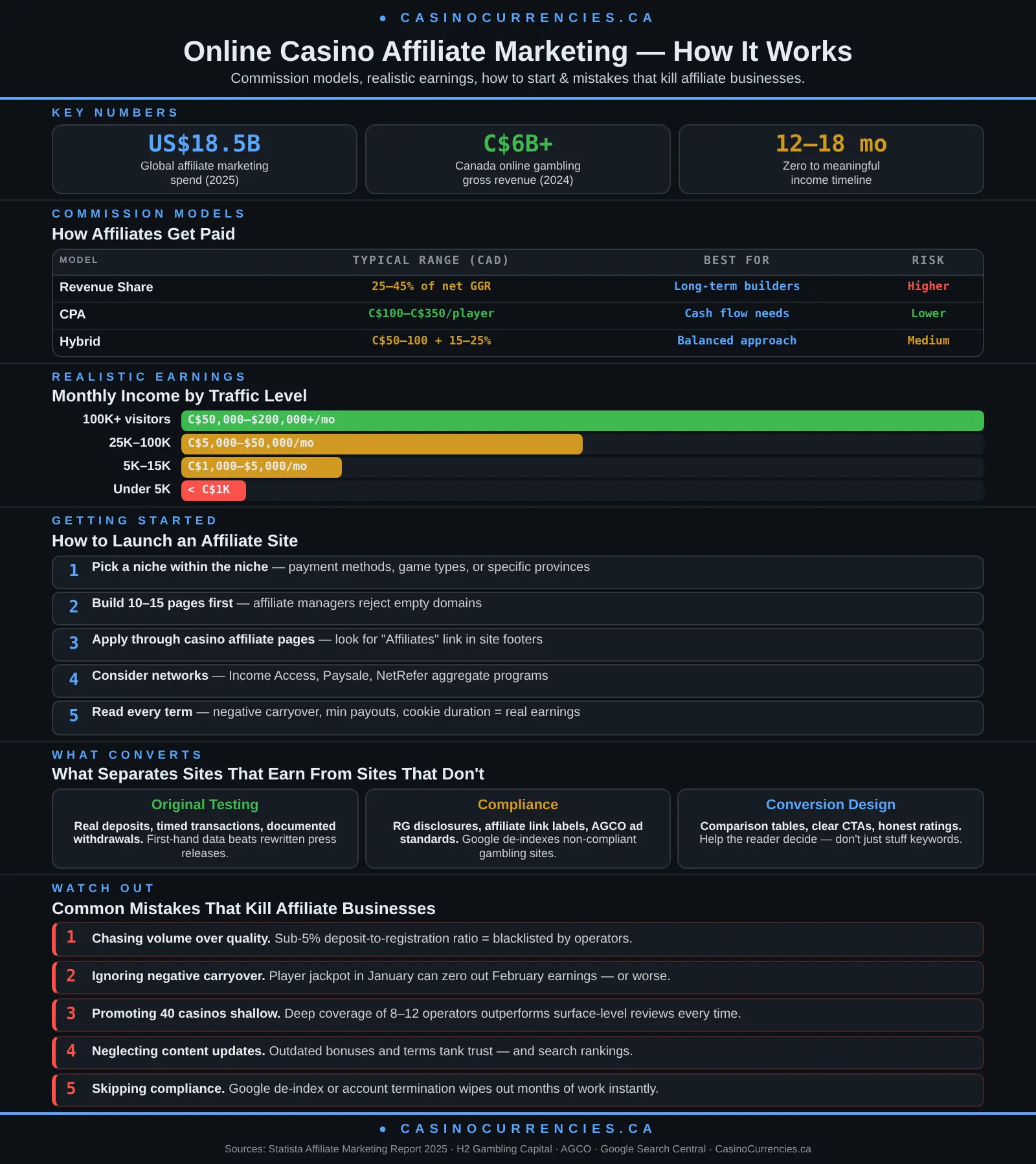
I've tracked this industry long enough to know it's one of the highest-paying affiliate verticals out there. According to Statista's 2025 affiliate marketing report, the global affiliate marketing industry hit over $18.5 billion USD in spending. iGaming captures a disproportionate slice because the lifetime value of a single depositing player can run into thousands of dollars.
That's the upside. The downside is competition. Every SEO professional and their cousin has tried building a casino affiliate site at some point. The barrier to entry is low. The barrier to earning real money is high.
How Affiliate Commissions Work
Not all affiliate deals are equal. I've negotiated dozens of them, and the structure of the commission changes everything about how profitable a partnership actually is.
Revenue Share
The casino pays a percentage of the net revenue generated by players the affiliate referred. Typical rates range from 25% to 45%, though I've seen deals as high as 50% for high-volume partners.
The catch — and it's a big one — is "net revenue." Casinos define this differently. Some deduct platform fees, payment processing costs, bonuses, and even licensing fees before calculating the affiliate's share. A 40% revenue share deal with aggressive deductions can pay less than a 30% deal with clean terms.
I always read the full revenue calculation clause before signing. Always.
CPA (Cost Per Acquisition)
A flat fee per qualifying player. Typical CPA rates for Canadian traffic run between C$100 and C$350 per depositing player, depending on the casino and the player's country. Some high-value markets push beyond C$500.
CPA is simple and predictable. The risk is leaving money on the table — if a referred player becomes a whale who deposits C$50,000 over two years, the affiliate still gets the one-time flat fee.
Hybrid
A combination of a smaller CPA upfront plus ongoing revenue share. Something like C$75 per player plus 20% lifetime rev share. This hedges both sides. I find hybrid deals tend to be the fairest for newer affiliates who need cash flow but don't want to give up long-term upside.
| Commission Model | Typical Range (CAD) | Best For | Risk Level |
|---|---|---|---|
| Revenue Share | 25%–45% of net revenue | Long-term builders | Higher — depends on player LTV |
| CPA | C$100–C$350 per player | Cash flow needs | Lower — fixed, predictable |
| Hybrid | C$50–C$100 CPA + 15%–25% rev share | Balanced approach | Medium |
How Much Online Casino Affiliates Realistically Earn
Here's where the industry hype meets cold reality. Marketing blogs love throwing around six-figure monthly income numbers. And yes — top-tier affiliates with established sites pulling 100,000+ monthly organic visitors absolutely earn C$50,000 to C$200,000 per month. Some earn more.
But most affiliates? I've spoken with dozens at iGaming conferences. The median affiliate running a casino review site with moderate traffic — say 5,000 to 15,000 monthly visitors — earns between C$1,000 and C$5,000 monthly. That's before hosting costs, content expenses, and link-building budgets.
The H2 Gambling Capital data from 2024 pegged Canada's online gambling gross revenue at over C$6 billion, which means the affiliate ecosystem feeding that revenue handles serious volume. But the slice per affiliate depends entirely on traffic quality and conversion rates.
Building from zero to meaningful income typically takes 12 to 18 months of consistent content work. Anyone telling a different story is selling something.
How to Join an Affiliate Program
Getting accepted into a program is straightforward — most operators want affiliates. The real question is which programs are worth joining.
Steps I'd follow if I were starting over:
- Pick a niche within the niche. Don't try to rank for "best online casinos." Target specific payment methods, specific game types, or specific provinces. My own site focuses on payment systems, and that specialization is why it works.
- Build a real site first. Most affiliate managers reject applications from domains with no content. Have at least 10 to 15 published pages before applying.
- Apply directly through casino affiliate pages. Nearly every licensed casino runs a program. Look for the "Affiliates" or "Partners" link in their site footer.
- Consider affiliate networks. Platforms like Income Access, Paysale, and NetRefer aggregate multiple casino programs under one dashboard. Easier tracking and consolidated payments.
- Read the terms. Negative carryover clauses, minimum payment thresholds, cookie durations — these details determine actual earnings.
I've covered related ground on how to promote an online casino, which walks through marketing channels that work well for casino brands and their partners.
Building an Affiliate Site That Actually Converts
The grind of building a casino affiliate site isn't glamorous. It's keyword research, content production, technical SEO, and slow organic growth. I know — I lived through it.
What separates sites that earn from sites that gather dust:
- Original testing and data. I deposit real money, time transactions, test withdrawal speeds, and document everything. Search engines and readers can tell the difference between firsthand experience and rewritten press releases.
- Compliance from day one. Include responsible gambling disclosures. Link to problem gambling resources. Google's gambling content policies are strict, and regulators in provinces like Ontario (AGCO) have advertising standards that apply to affiliates, not just operators.
- Technical SEO basics. Fast load times, mobile-first design, clean URL structures. According to Google's Search Central documentation, sites demonstrating first-hand expertise rank better — exactly what iGaming affiliate content needs.
- Transparent editorial standards. Disclose affiliate relationships. I mark every affiliate link on my site. Not because regulators require it in every jurisdiction — but because trust is the only real asset in this business.
- Conversion-focused design. Clear CTAs, comparison tables, honest ratings. The site needs to help the reader make a decision, not just stuff keywords.
For the broader business perspective on running an affiliate operation at scale, the deep-dive on iGaming affiliate programs covers setting up programs from the operator side and what separates high-earning affiliates from the rest.
US and Cross-Border Considerations
Running a casino affiliate site as a US resident or targeting US traffic adds layers of complexity. Online gambling regulation in the US is state-by-state. Only a handful of states have fully legalized iGaming — New Jersey, Pennsylvania, Michigan, West Virginia, Connecticut, and Delaware among them.
If a US-based affiliate promotes offshore casinos to US players, the legal footing gets shaky. Most established affiliate programs specify which markets the affiliate is authorized to promote. I've seen programs terminate accounts over geo-targeting violations.
For Canadian affiliates — which is my wheelhouse — the landscape is clearer. Ontario's regulated market is the gold standard right now. Affiliates promoting AGCO-licensed operators in Ontario need to follow the Registrar's Standards for advertising, which include rules about bonus claims and responsible gambling messaging.
The smart move is knowing the regulations in every market where traffic originates. Ignorance doesn't hold up as a defense when a regulator comes knocking.
I covered the broader regulatory picture in the piece on how to get an online gambling license, which breaks down major jurisdictions and what compliance looks like from the operator side.
Common Mistakes That Kill Affiliate Businesses
After watching dozens of affiliates launch and fold, the patterns are clear:
- Chasing volume over quality. Sending low-quality traffic that doesn't convert burns operator relationships fast. One casino manager told me they blacklist affiliates who deliver sub-5% deposit-to-registration ratios.
- Ignoring negative carryover. Some rev-share deals carry forward months where players won. If referred players hit a big jackpot in January, the affiliate's February earnings can go to zero — or worse, owe a balance. Read the terms.
- Spreading too thin. Promoting 40 casinos with surface-level reviews doesn't work. Deep coverage of 8 to 12 operators outperforms shallow coverage of 40 every time.
- Neglecting content updates. Casino terms change. Bonuses expire. A review with outdated information tanks trust — and search rankings.
- Skipping compliance. Google's gambling ad policies, provincial advertising standards, and affiliate program rules all have teeth. Getting a site de-indexed or an affiliate account terminated wipes out months of work instantly.
FAQ
How much do online casino affiliates make in Canada?
It ranges enormously. Smaller sites with 5,000–15,000 monthly visitors typically earn C$1,000–C$5,000 per month. Established sites with six-figure traffic can clear C$50,000+ monthly. Commission structure — revenue share vs CPA vs hybrid — directly affects the numbers.
Do I need a license to be a casino affiliate in Canada?
There's no federal affiliate license requirement in Canada. But in Ontario, affiliates promoting AGCO-registered operators must comply with the Registrar's Standards for Internet Gaming. Other provinces have varying rules. Stay current on regulations or get a compliance advisor.
How long does it take to start earning as a casino affiliate?
Expect 12 to 18 months before seeing meaningful income from a new site built on organic search. Paid traffic can accelerate results — but it also accelerates losses if conversions don't cover ad spend.
What's the difference between casino affiliate marketing and iGaming affiliate marketing?
Casino affiliate marketing focuses on online casino products — slots, table games, live dealer. iGaming affiliate marketing is the broader category that includes sports betting, poker, bingo, and lottery alongside casino. The commission models are similar, but the audiences and content strategies differ.
Can I get an online casino sponsorship as an affiliate?
Large-traffic affiliates sometimes negotiate sponsorship deals — fixed monthly fees, co-branded content, or exclusive bonus codes in exchange for premium placement. This typically requires proving consistent high-quality traffic. Start with standard affiliate terms and negotiate up as volume grows.
Where should I advertise my online casino affiliate site?
SEO is the primary channel — organic search traffic converts best for casino content. Paid options include niche ad networks like PropellerAds and ExoClick that accept gambling content. Social media advertising is heavily restricted for gambling, so content marketing and email lists tend to outperform paid social.