

I've spent the better part of five years dissecting payment flows and revenue structures in the online gambling industry. And if there's one business model that consistently generates questions - from operators and content creators alike - it's iGaming affiliate marketing. The concept sounds simple: send players to a casino, get paid when they deposit and play. The reality involves tracking pixels, compliance landmines, fraud rings, and commission structures that can either make a full-time income or quietly bleed money through hidden deductions.
This is the honest breakdown of how iGaming affiliate programs work, what the money actually looks like, and where both sides - operators and affiliates - tend to get burned.
What iGaming Affiliate Marketing Actually Involves
At its core, iGaming affiliate marketing is a performance-based partnership. An operator (the casino, sportsbook, or poker site) pays a third party (the affiliate) for driving qualified traffic that converts into depositing players. The affiliate promotes the operator's brand through content sites, comparison pages, social media, email lists, or paid media - and earns a commission based on the agreed model.
But here's what the simple explanation misses: iGaming affiliate programs sit at the intersection of financial services regulation and digital marketing. Affiliates aren't just marketers - in many jurisdictions, they're treated as licensed intermediaries. The UK Gambling Commission, for instance, holds operators responsible for everything their affiliates publish. Malta's MGA has similar compliance expectations baked into operator license conditions.
That regulatory layer changes everything about how these programs operate compared to, say, Amazon Associates or a SaaS referral program.
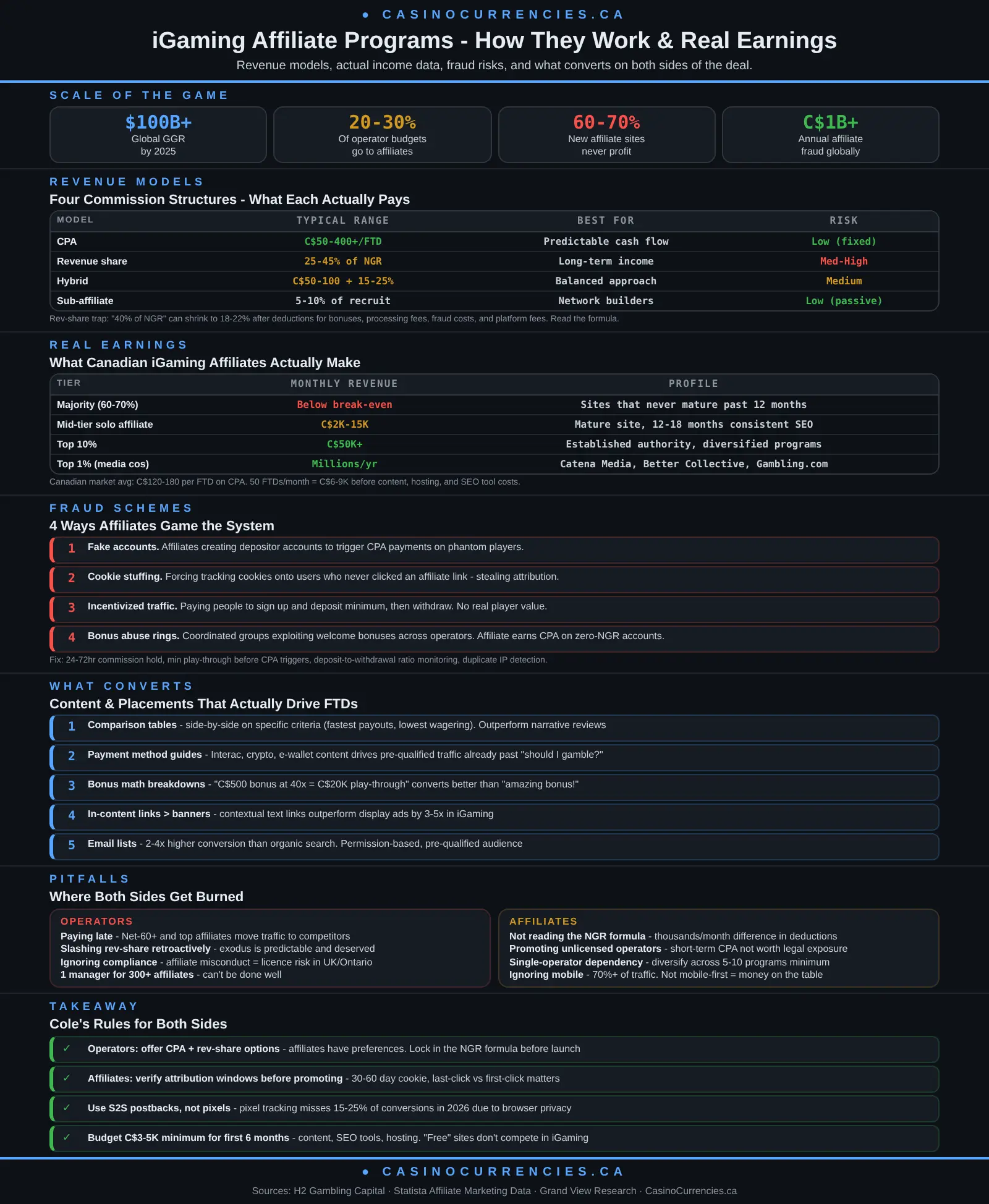
The global iGaming affiliate market generates billions annually. According to H2 Gambling Capital's market data, the worldwide online gambling market exceeded US$100 billion in gross gaming revenue by 2025, and affiliates capture an estimated 20-30% of operator marketing budgets. In a market this size, even a mid-tier affiliate operation can pull serious revenue - if the fundamentals are right.
Revenue Models Explained: CPA, Revenue Share, Hybrid, and Sub-Affiliate
How do iGaming affiliate programs work in terms of payment? There are four standard commission structures, and each one creates different incentive dynamics.
Cost Per Acquisition (CPA)
The operator pays a flat fee for every player who meets a defined action - typically a first deposit above a minimum threshold. CPA rates in iGaming range from C$50 to C$400+ per qualified depositor, depending on the market, the operator's margins, and the player's geographic tier.
CPA is clean and predictable. I get paid, the deal closes, and neither party tracks that player's lifetime activity. The downside for affiliates: if a player turns out to be a whale who deposits C$50,000 over the next two years, the affiliate still earned that one-time C$150 fee.
Revenue Share
The operator pays a percentage of the net gaming revenue (NGR) generated by referred players - for the lifetime of those players. Standard rev-share rates sit between 25% and 45%.
This is where things get interesting and - if the contract isn't read carefully - where affiliates get crushed. NGR calculations vary wildly between programs. Some deduct payment processing fees, bonuses, jackpot contributions, platform fees, and administrative costs before calculating the affiliate's share. A "40% revenue share" can shrink to an effective 18-22% after all those deductions.
I've reviewed contracts where the operator's definition of NGR included a deduction for "fraud costs" - a vague line item that could absorb almost anything.
Hybrid
A combination of a smaller upfront CPA plus an ongoing revenue share. For example: C$75 CPA + 20% rev-share. This is often the sweet spot for affiliates who want immediate cash flow without completely sacrificing long-term earnings.
Sub-Affiliate Commissions
Some programs pay a percentage of earnings generated by affiliates the original affiliate recruited into the program. Rates typically run 5-10% of the sub-affiliate's commissions. It's a way to build passive income, though the numbers rarely justify making it a primary strategy.
| Revenue Model | Typical Range | Best For | Risk Level |
|---|---|---|---|
| CPA | C$50 - C$400+ per depositor | Affiliates wanting predictable cash flow | Low (fixed payment) |
| Revenue Share | 25% - 45% of NGR | Long-term income builders | Medium-High (depends on NGR formula) |
| Hybrid | C$50-100 CPA + 15-25% rev-share | Balanced approach | Medium |
| Sub-Affiliate | 5% - 10% of recruited affiliate earnings | Network builders | Low (passive income layer) |
How Much iGaming Affiliates Actually Earn
This is where most guides either lie or hedge. Here's what my data shows from tracking affiliate earnings disclosures and industry reports over the past four years.
A solo content affiliate running a single review site in a competitive market like Canada or the UK typically earns between C$2,000 and C$15,000 per month after the site matures (12-18 months of consistent content and SEO work). The top 10% break C$50,000 monthly. The top 1% - large media operations like Catena Media, Better Collective, or Gambling.com Group - generate tens of millions annually.
But those headline numbers hide the failure rate. Based on Statista's data on affiliate marketing industry trends, roughly 60-70% of new affiliate sites in competitive verticals never reach profitability. iGaming is among the most competitive verticals that exist.
The math that matters: average revenue per first-time depositor (FTD) across the Canadian market sits around C$120-180 on a CPA basis. An affiliate site converting 50 FTDs per month earns C$6,000-9,000 before expenses. Content creation, hosting, SEO tools, and potentially paid traffic eat into that quickly.
I've seen operators advertise "earn up to C$500 per player" - and technically, some high-roller markets justify those numbers. But the median is closer to C$120-150 for Canadian traffic, and building a pipeline of 50+ monthly FTDs takes real investment.
For Operators: How to Set Up an Affiliate Program
Running an iGaming business without an affiliate channel is like opening a restaurant on a street with no foot traffic. Affiliates drive an estimated 40-60% of new player acquisitions for mid-size operators. Here's the setup process I've seen work.
Step 1: Choose Your Affiliate Platform
The platform handles tracking, reporting, commission calculations, and affiliate management. The major options include:
- Income Access - one of the oldest in the space, strong reporting, but rigid and expensive as operations scale
- NetRefer - solid mid-market solution with decent API flexibility
- Cellxpert - newer entrant with modern UI and real-time dashboards
- MyAffiliates - cost-effective for smaller operators
- Custom-built - only viable if the development budget and internal team justify it
Step 2: Define Commission Structures
Decide on CPA rates, rev-share percentages, and hybrid options. I'd recommend offering at least two models - affiliates have preferences based on their traffic quality and business model. Lock in the NGR formula before launching. Ambiguity here destroys affiliate trust faster than slow payments.
Step 3: Create Affiliate Resources
Affiliates need banners, landing pages, tracking links, game data feeds, and promotional content. The operators who retain their best affiliates provide real-time reporting dashboards and dedicated affiliate managers - not a shared support@ inbox.
Step 4: Compliance and Contracts
Every affiliate agreement must include responsible gambling requirements, advertising standards compliance, brand usage guidelines, and termination conditions. In regulated markets like Ontario or the UK, the operator is liable for affiliate misconduct. This isn't optional paperwork - it's license protection.
For a deeper dive on launching an iGaming operation that affiliates want to promote, I covered the foundational steps in How to Start an iGaming Business.
Managing Affiliates: Tracking, Compliance, and Fraud Prevention
The operational grind of affiliate program management is where most operators either build a competitive advantage or quietly hemorrhage money.
Tracking Integrity
Every affiliate click generates a tracking event - typically via a pixel fire, a cookie, or a server-to-server postback. The industry standard has shifted toward server-to-server (S2S) postbacks because browser-based tracking is increasingly unreliable. Safari's Intelligent Tracking Prevention, Chrome's third-party cookie deprecation, and ad blockers all degrade pixel-based attribution.
If the tracking breaks, affiliates don't get credited, and they leave. Or worse - they get double-credited through cookie stuffing, and the operator pays for phantom conversions.
Compliance Monitoring
Operators need to audit affiliate content regularly. I've reviewed programs where affiliates were publishing misleading bonus claims, targeting self-excluded players, or running ads in jurisdictions where the operator wasn't licensed. Each of those violations puts the operator's license at risk.
Smart operators run monthly content audits. The bare minimum: quarterly spot-checks with automated keyword monitoring on affiliate sites.
Fraud Detection
Affiliate fraud in iGaming is a C$1 billion+ annual problem globally. Common schemes include:
- Fake accounts - affiliates creating depositor accounts to trigger CPA payments
- Cookie stuffing - forcing tracking cookies onto users who never clicked an affiliate link
- Incentivized traffic - paying people to sign up and deposit the minimum, then withdrawing
- Bonus abuse rings - coordinated groups exploiting welcome bonuses across multiple operators, with the affiliate earning commissions on accounts that never generate real NGR
The fix is a combination of duplicate IP detection, deposit-to-withdrawal ratio monitoring, player behavior analysis, and - critically - not paying CPA until a minimum play-through threshold is met. A 24-hour hold on commission attribution catches most low-effort fraud.
Why Some Operators Outgrow Platforms Like Income Access
Income Access has been a reliable workhorse in iGaming affiliate management for over a decade. But I've tracked a clear pattern: operators who scale past 500+ active affiliates or who need granular API integrations for their CRM and BI tools often hit the platform's limitations.
The typical pain points include rigid reporting structures, limited real-time data access, slow feature development cycles, and pricing models that become expensive at volume. Operators at that scale tend to migrate to NetRefer, Cellxpert, or custom-built solutions that integrate directly with their player management platform.
The migration itself is painful - re-tagging every affiliate link, re-establishing tracking baselines, and convincing affiliates to update their links. I've seen operators lose 10-20% of affiliate traffic during a platform migration simply because smaller affiliates don't bother updating dead links.
The takeaway: pick a scalable platform from the start, or budget for a costly migration later. I covered platform selection criteria in detail in How to Choose the Right iGaming Software Provider.
For Affiliates: Which Offers Convert and What Placements Work
Not all traffic converts equally. After analyzing conversion data across dozens of Canadian-facing operators, here's what consistently performs.
Content That Converts
- Honest casino reviews with specific data - payout speeds, bonus terms with the wagering requirement spelled out, game counts by provider. Generic "this casino is great" content doesn't convert informed players.
- Comparison tables - side-by-side operator comparisons on specific criteria (fastest withdrawals, lowest wagering requirements, best live dealer selection) consistently outperform narrative reviews for conversion rate.
- Payment method guides - content about depositing with Interac, using cryptocurrency, or understanding e-wallet options drives highly qualified traffic because these readers are already past the "should I gamble online" stage.
- Bonus breakdowns - not hype, but math. "This C$500 bonus has a 40x wagering requirement, meaning C$20,000 in play-through before withdrawal" converts better than "amazing C$500 bonus!"
Placements That Work
In-content contextual links outperform banner ads by 3-5x in iGaming. A well-placed text link inside a relevant review paragraph generates more clicks than a flashy 728x90 banner that readers have trained themselves to ignore.
Email remains underrated. Affiliates with permission-based email lists see conversion rates 2-4x higher than organic search traffic - because the audience is pre-qualified and engaged.
For perspective on the broader marketing landscape operators navigate, my breakdown of How to Promote an Online Casino covers the channels and restrictions involved.
Outreach: Who Handles It and How to Do It Well
On the operator side, affiliate outreach is typically handled by an affiliate manager - either in-house or through an agency. The best affiliate managers I've worked with treat it like business development, not customer support. They proactively identify high-potential affiliate sites, negotiate custom deals for top performers, and maintain genuine relationships rather than sending monthly "new bonus offer!" blasts.
On the affiliate side, outreach means approaching operators with a value proposition. That means traffic data, conversion metrics, audience demographics, and a clear content plan. Walking into an affiliate manager's inbox with "I have a gambling site and want to promote your casino" gets deleted. Leading with "I run a Canadian payment methods comparison site with 40,000 monthly organic visitors, and my Interac deposit guide ranks #3 nationally - here's my conversion data from three competing programs" gets a reply.
Cold LinkedIn outreach works in this industry - iGaming is relationship-driven, and most affiliate managers actively use LinkedIn for networking. The approach matters: personalized messages referencing the operator's recent product launches or market expansions convert far better than template pitches.
Conferences like iGB Affiliate events, SBC Summit, and SiGMA are where the biggest deals happen face-to-face. I covered conference strategy in detail in How to Network and Grow at iGaming Conferences.
Tracking Conversions Properly
Attribution is the backbone of affiliate marketing. If tracking fails, the entire economic model collapses. Here's what both sides need to understand.
Server-to-Server Postbacks
S2S postbacks send conversion data directly from the operator's server to the affiliate platform's server - bypassing the browser entirely. This is now the gold standard because it's immune to ad blockers, cookie restrictions, and browser privacy features.
The setup requires the operator's tech team to configure API calls that fire when specific player actions occur (registration, first deposit, qualifying deposit). Each postback includes the affiliate's tracking ID, the player's unique token, and the conversion value.
Pixel-Based Tracking
A JavaScript or image pixel fires in the player's browser when they complete an action. It's simpler to implement but increasingly unreliable. I'd estimate pixel-based tracking misses 15-25% of conversions in 2026 due to browser privacy measures.
Attribution Windows
Most iGaming affiliate programs use a 30-60 day cookie window. If a player clicks an affiliate link but doesn't register for 45 days, does the affiliate get credit? Depends on the program. Some use last-click attribution, others first-click. A few sophisticated programs use multi-touch attribution that splits credit across touchpoints.
The practical advice: affiliates should always verify attribution windows before promoting an operator, and operators should pick a model and stick with it. Changing attribution rules mid-program is the fastest way to lose affiliate trust.
Common Pitfalls on Both Sides
For Operators
- Paying late - nothing kills an affiliate program faster. Net-30 is standard. Net-60 is tolerable. Anything beyond that, and top affiliates move their traffic to competitors.
- Changing commission terms retroactively - I've seen operators slash rev-share rates on existing affiliates without notice. The resulting exodus is predictable and deserved.
- Ignoring compliance - letting affiliates publish whatever they want is a ticking license bomb, especially in regulated markets like Ontario.
- Underfunding affiliate management - one person managing 300+ affiliate relationships can't do it well. Budget for proper staffing or outsource to a specialized agency.
For Affiliates
- Not reading the NGR formula - the difference between a "40% rev-share" with clean NGR and one loaded with deductions can be thousands of dollars monthly.
- Promoting unlicensed operators - the short-term commissions aren't worth the reputational damage or potential legal exposure. I covered how licensing works in How to Get an Online Gambling License.
- Over-relying on a single operator - if that program changes terms or shuts down, the affiliate's entire income disappears overnight. Diversification across 5-10 programs is standard risk management.
- Ignoring mobile optimization - over 70% of iGaming traffic is mobile. Affiliate sites that aren't mobile-first are leaving money on the table.
- Forgetting about tax obligations - affiliate income is taxable. In Canada, it's reported as business or self-employment income. Keeping clean records from day one saves headaches during tax season.
For affiliates coming from the casino content side rather than the B2B angle, my guide on Online Casino Affiliate Marketing covers the individual-focused earning path.
FAQ
How do iGaming affiliate programs work differently from regular affiliate marketing?
The core mechanic is the same - performance-based commissions for driving conversions. The differences are regulatory oversight (affiliates operate under gambling advertising rules), the revenue share model (lifetime player value tracking), and the compliance requirements. In regulated markets, operators are legally responsible for their affiliates' advertising claims.
How much do iGaming affiliates realistically earn?
A mature solo affiliate site in a competitive market like Canada typically generates C$2,000 to C$15,000 per month. The top 10% exceed C$50,000 monthly. But roughly 60-70% of new affiliate sites never reach profitability, and most successful sites take 12-18 months to mature.
What's better for affiliates - CPA or revenue share?
It depends on traffic quality. High-volume affiliates with lower average player values prefer CPA for predictable cash flow. Affiliates who drive fewer but higher-value players benefit more from revenue share - but only if the NGR formula is transparent and fair. Hybrid deals often offer the best risk-adjusted return.
Can I start an iGaming affiliate site with no money?
Technically, a basic WordPress site with free hosting can be set up for next to nothing. Practically, competing in iGaming SEO without budget for content creation, SEO tools, and potentially some paid promotion is extremely difficult. A realistic minimum starting investment for a competitive affiliate site is C$3,000-5,000 for the first six months.
How do operators prevent affiliate fraud?
The standard toolkit includes duplicate IP detection, deposit-to-withdrawal ratio monitoring, delayed commission attribution (24-72 hour holds), minimum play-through requirements before CPA payments trigger, and regular manual review of affiliate account patterns. Sophisticated operators also use player behavior analytics to flag accounts that look like incentivized signups rather than genuine players.
Why do some operators outgrow affiliate platforms like Income Access?
At scale (500+ active affiliates), operators often need deeper API integrations with their CRM and business intelligence tools, more flexible reporting, real-time data access, and pricing models that don't scale linearly with volume. The migration to platforms like NetRefer, Cellxpert, or custom solutions is common - but costly, as re-tagging affiliate links and rebuilding tracking baselines can temporarily reduce traffic by 10-20%.