The single most common question I get from aspiring operators — more than licensing, more than game selection, more than marketing — is how much does it cost to start an online casino. The answer is frustratingly wide: anywhere from roughly C$70,000 on the low end to well over C$700,000 for a custom-built operation. That range isn't a cop-out. It reflects the massive gap between a white-label setup running on someone else's infrastructure and a fully bespoke platform built from the ground up.
I've tracked the finances behind dozens of casino launches since 2021. What follows is the real cost breakdown — every major line item, stripped of the sales pitches that platform vendors love to hide behind.
The Quick Answer — What's the Minimum Investment?
Here's the honest range based on the three main launch models:
- White-label: C$70,000–$150,000 (first year, all in)
- Turnkey platform: C$150,000–$350,000
- Custom-built: C$350,000–$700,000+
Those figures include licensing, platform costs, game content, payment integration, basic marketing, and initial staffing. They don't include the cost of doing it wrong and having to rebuild — which, based on what I've seen, happens to about one in three first-time operators who cut corners on their platform or licensing.
The model chosen determines everything downstream. A white-label operator trades margin and control for speed. A custom build trades time and capital for ownership. I've laid out the full process in How to Start an Online Casino Business, but this article focuses purely on the money.
Licensing Costs — The Entry Ticket
No legitimate online casino operates without a gambling license, and the cost to obtain one varies wildly by jurisdiction. I've detailed the full licensing process and requirements in How to Get an Online Gambling License, but here's the financial picture.
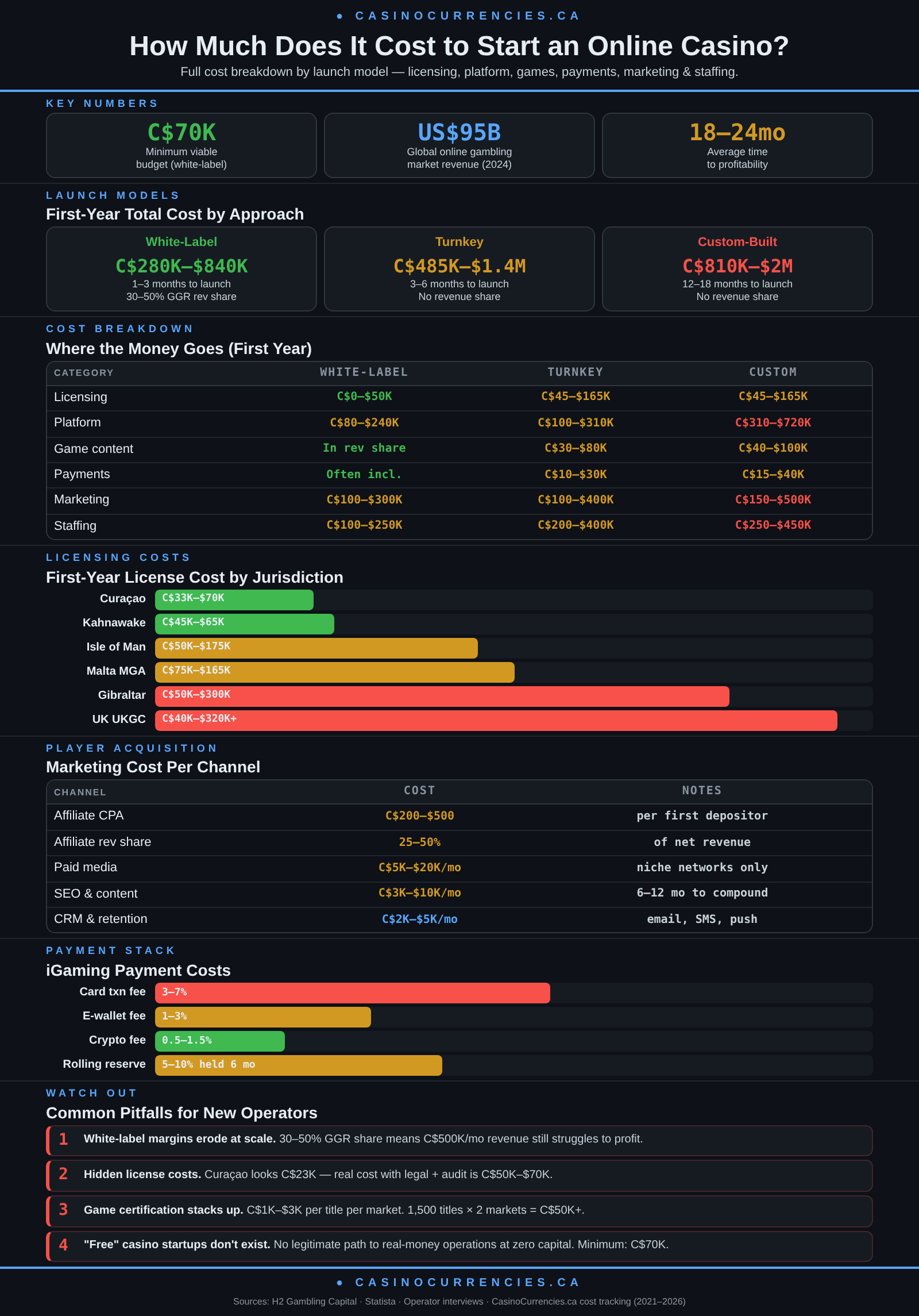
| Jurisdiction | First-Year License Cost (all-in) | Annual Renewal |
|---|---|---|
| Curacao | C$33,000–$70,000 | C$16,000–$28,000 |
| Kahnawake | C$45,000–$65,000 | C$10,000–$15,000 |
| Malta (MGA) | C$75,000–$165,000 | C$35,000–$55,000 |
| Isle of Man | C$50,000–$175,000 | C$10,000–$70,000 |
| UK (UKGC) | C$40,000–$320,000+ | Revenue-based |
| Gibraltar | C$50,000–$300,000+ | Revenue-based (capped) |
Those first-year figures bundle the application fee, the license fee itself, legal counsel (C$7,000–$70,000 depending on jurisdiction complexity), and the mandatory technical audit (C$7,000–$35,000). The numbers I quoted aren't theoretical — they're based on what operators I've interviewed actually spent.
The mistake I see most often: operators compare headline license fees and pick the cheapest jurisdiction without accounting for legal and audit costs. A Curacao license looks like a bargain at C$23,000 in direct fees. But once legal counsel, the technical audit under the tightened 2023 framework, and compliance setup are factored in, the real first-year cost to set up an online casino license sits closer to C$50,000–$70,000.
And these are recurring costs. Annual compliance — regulatory reporting, audit renewals, responsible gambling monitoring, AML software — adds another C$25,000–$140,000 per year depending on the jurisdiction and scale of the operation.
Platform and Software Costs
The platform is the single largest capital expenditure for most operators. It's the engine that runs player accounts, game integration, bonuses, payments, back-office reporting, and compliance tools. Getting this decision wrong is expensive — not just in the initial spend, but in the rebuilding costs when the platform can't scale or doesn't support a needed payment method.
White-label solutions are the fastest and cheapest path to market. A provider supplies the entire platform, game library, and sometimes even the license. The operator focuses on branding and player acquisition. Monthly fees run C$7,000–$20,000, with the provider typically taking 30–50% of net gaming revenue on top. First-year platform costs: roughly C$80,000–$240,000 including the revenue share.
The catch? Thin margins. If the revenue share runs at 40% and monthly fees eat another C$10,000, the operator needs to generate significant volume just to break even. I've seen white-label operators generating C$500,000 in monthly GGR and still struggling with profitability because the split leaves too little on the table.
Turnkey platforms offer a better margin structure. The operator buys or leases a ready-built platform and operates it under their own license. Setup costs range from C$70,000 to C$280,000, with monthly hosting and maintenance fees of C$3,000–$10,000. No revenue share — the operator keeps what they earn, minus standard operating costs.
Custom-built platforms are the premium route. A development team builds the platform from scratch or heavily customizes a Player Account Management (PAM) system. Initial development runs C$280,000 to C$700,000+, with 12–18 months of build time before launch. Monthly maintenance and hosting add another C$5,000–$20,000. I've covered the build process in detail in How to Build an Online Casino Website or App.
For guidance on evaluating providers, including what to look for in PAM systems, game aggregators, and CRM tools, see How to Choose the Right iGaming Software Provider.
Game Content Licensing Fees
Players don't care about back-end architecture. They care about the game library. And game content isn't free — even when an operator uses a game aggregator that bundles hundreds of studios under one API integration.
Game licensing costs break down into two models:
- Flat integration fees: Some studios charge C$1,400–$7,000 per month for API access, regardless of how much revenue their titles generate.
- Revenue share: More commonly, studios take 10–20% of the GGR generated by their games. This aligns incentives — the studio earns more when the operator's players play more — but it can eat into margins fast when a casino offers thousands of titles from dozens of providers.
Game aggregators simplify the process by bundling content from multiple studios under a single commercial agreement. Companies like SoftSwiss, EveryMatrix, and BetConstruct handle the integration and take their own cut — typically an additional 5–10% of GGR — on top of the studios' individual revenue shares.
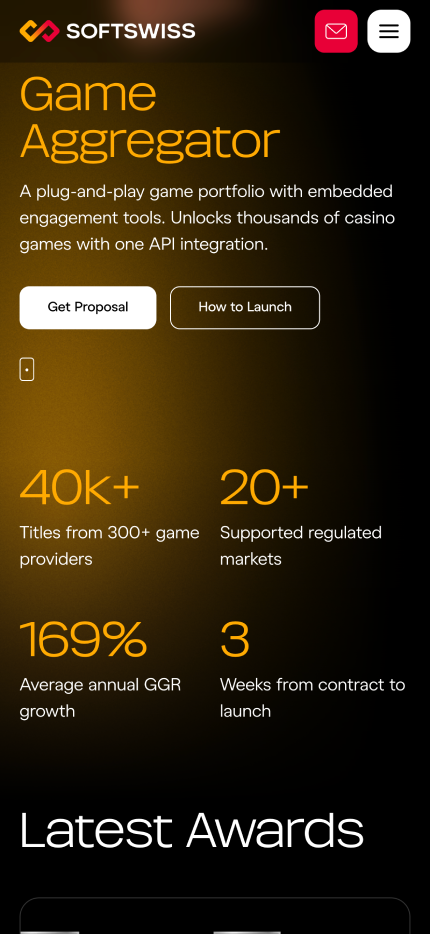
A practical first-year budget for game content: C$30,000–$100,000, depending on the number of studios, whether a direct integration or aggregator route is chosen, and the volume of play. That figure scales with the business — higher GGR means higher content costs in absolute terms, but lower costs as a percentage of revenue.
One cost that catches new operators off guard: game certification. In regulated markets, every game title needs an RNG certificate from an approved testing lab for that specific jurisdiction. Certifying a single game costs C$1,000–$3,000 per market. An operator launching with 1,500 titles across two regulated jurisdictions could face certification costs exceeding C$50,000 — often absorbed by the game provider or aggregator, but not always. Read the contract carefully.
Payment Gateway Integration Costs
Payments in iGaming aren't like payments in standard e-commerce. The industry is classified as high-risk by every major card network. That means higher processing fees, stricter onboarding, and the ever-present threat of merchant account freezes if chargeback ratios spike above the typical 1% threshold.
The essential payment stack for a new casino — Visa/Mastercard processing, at least one e-wallet (Skrill or Neteller), Interac for Canadian players, and ideally a crypto option — costs roughly:
- Integration and setup fees: C$7,000–$25,000 (varies by provider and number of methods)
- Monthly gateway fees: C$1,500–$5,000
- Per-transaction fees: 3–7% per card transaction, 1–3% for e-wallets, 0.5–1.5% for crypto
- Rolling reserves: Most high-risk processors hold 5–10% of processed volume in reserve for 6 months. On C$500,000 in monthly deposits, that's C$25,000–$50,000 tied up at any given time
First-year payment costs — including setup, monthly fees, and transaction processing on a moderate volume of C$200,000–$500,000 in monthly deposits — land in the range of C$50,000–$150,000. For a deeper look at the payment landscape and chargeback reduction, I've covered it in iGaming Payment Solutions.
Marketing Budget — The Line Item Most Operators Underestimate
Here's where the reality check hits hardest. A casino with no players is just a server burning cash. And acquiring players in competitive markets like Canada costs serious money.
Industry benchmarks for first-depositing player acquisition costs (CPA) sit between C$200 and C$500+ in markets like Canada, the UK, and Australia. An operator targeting 1,000 first-time depositors in year one — a modest goal — needs a marketing budget of C$200,000–$500,000 just for acquisition.
That budget breaks down roughly as:
- Affiliate marketing commissions: 25–50% of net revenue per referred player, or C$100–$400 CPA — the backbone of most casino marketing. I've detailed how affiliate programs work in Online Casino Affiliate Marketing.
- Paid media: Limited options due to advertising restrictions. Google, Facebook, and most mainstream ad networks ban gambling ads. Operators use niche networks like ExoClick, RichAds, and PropellerAds — budgets of C$5,000–$20,000 per month are common for mid-tier operators.
- SEO and content: C$3,000–$10,000 per month for an agency or in-house team. Results take 6–12 months but compound over time. I've broken down the full marketing playbook in How to Promote an Online Casino.
- CRM and retention campaigns: Email, SMS, push notifications, and loyalty programs. Budget C$2,000–$5,000 per month for tools and execution.
A realistic first-year marketing budget for a new operator: C$100,000–$500,000. The low end applies to operators with strong affiliate relationships and organic traffic. The high end reflects paid acquisition in competitive markets.
Staffing and Operational Costs
A new online casino doesn't need a massive team on day one, but it does need certain roles filled — either in-house or outsourced.
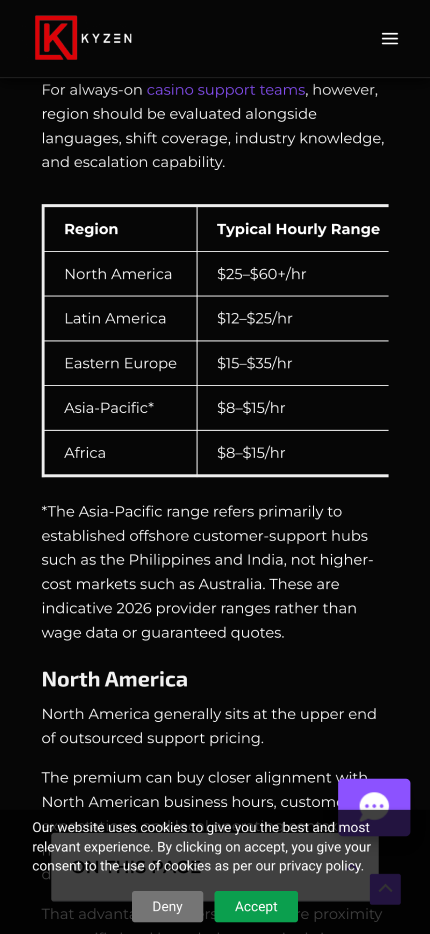
- Customer support: 3–5 agents for 24/7 coverage. In-house cost: C$120,000–$250,000 annually. Outsourced to a specialized iGaming support provider: C$60,000–$150,000.
- Compliance officer: Mandatory for most licenses. C$70,000–$120,000 annually, or outsourced at C$3,000–$8,000 per month.
- Marketing/CRM manager: C$60,000–$100,000 annually.
- VIP/account management: Often combined with support initially. Add C$50,000–$80,000 when player volume justifies it.
- IT/platform management: C$60,000–$120,000 annually, or handled by the platform provider if using white-label/turnkey.
First-year staffing costs for a lean operation: C$200,000–$450,000. White-label operators can push the lower end since the platform provider handles technical operations and sometimes support.
Can an Online Casino Be Started for Free?
I see this question constantly — how to start an online casino for free, how to start an online casino with no money. The answer is blunt: no. There is no legitimate path to launching a real-money online casino with zero capital.
The absolute minimum viable budget — a Curacao-licensed white-label with skeleton marketing — still requires roughly C$70,000. That's not a comfortable number, but it's the floor for an operation that can legally accept deposits, process withdrawals, and stay on the right side of regulators.
Anyone advertising a "free" casino startup is selling one of three things:
- A social casino (play-money only, no real gambling)
- A fraudulent scheme that will collapse when the first player requests a withdrawal
- A setup fee disguised as "free" with aggressive revenue-sharing that makes the operator a silent partner in their own business
The "no money down" pitch is the iGaming equivalent of a "no money down" real estate course. The platform still costs money. The license still costs money. The first batch of players still costs money to acquire. Capital requirements exist because regulators demand that operators have enough reserves to cover player balances — a protection mechanism that exists for good reason.
If the budget genuinely doesn't stretch to C$70,000, this isn't the right business yet. Build capital elsewhere first.
Cost Comparison — White-Label vs Turnkey vs Custom
| Cost Category | White-Label | Turnkey | Custom-Built |
|---|---|---|---|
| Licensing (first year) | C$0–$50,000* | C$45,000–$165,000 | C$45,000–$165,000 |
| Platform (first year) | C$80,000–$240,000 | C$100,000–$310,000 | C$310,000–$720,000 |
| Game content | Included in rev share | C$30,000–$80,000 | C$40,000–$100,000 |
| Payment integration | Often included | C$10,000–$30,000 | C$15,000–$40,000 |
| Marketing (first year) | C$100,000–$300,000 | C$100,000–$400,000 | C$150,000–$500,000 |
| Staffing (first year) | C$100,000–$250,000 | C$200,000–$400,000 | C$250,000–$450,000 |
| Total First Year | C$280,000–$840,000 | C$485,000–$1,385,000 | C$810,000–$1,975,000 |
| Revenue share to provider | 30–50% of GGR | None | None |
| Time to launch | 1–3 months | 3–6 months | 12–18 months |
Some white-label providers include their license in the package — the operator runs under the provider's license rather than obtaining their own. This saves upfront cost but limits control and portability.
The white-label route is the cheapest to start but the most expensive to scale. Once monthly GGR exceeds C$200,000–$300,000, the revenue share paid to the provider often exceeds what it would cost to run an independent turnkey operation. Most successful operators I've tracked started white-label, proved the concept, then migrated to their own license and platform within 18–24 months.
FAQ
How much money do I need to start an online casino?
The minimum realistic investment is around C$70,000–$150,000 for a white-label operation with a Curacao license. A turnkey setup runs C$150,000–$350,000. A fully custom-built casino costs C$350,000–$700,000+ before marketing spend. First-year all-in budgets, including marketing and staffing, range from C$280,000 to nearly C$2 million.
How much does it cost to build an online casino from scratch?
Custom platform development alone costs C$280,000–$700,000+, with 12–18 months of build time. Add licensing (C$45,000–$165,000), game content integration (C$40,000–$100,000), payment setup (C$15,000–$40,000), and marketing (C$150,000–$500,000) for the full picture. The total first-year cost for a ground-up build typically exceeds C$800,000.
What's the cheapest way to start an online casino?
A white-label solution with a Curacao or Kahnawake license offers the lowest barrier to entry — roughly C$70,000–$150,000 all in. The trade-off is thin margins (30–50% revenue share to the provider), limited brand control, and restricted access to regulated markets that demand their own licenses.
Can I start an online casino with no money?
No. Real-money gambling operations require a gambling license, a certified platform, payment processing agreements, and capital reserves to cover player balances. There is no free or zero-capital path to a legitimate operation. Minimum realistic investment starts at C$70,000.
How long until an online casino becomes profitable?
Industry data from H2 Gambling Capital suggests the average iGaming operator reaches profitability within 18–24 months — assuming adequate capitalization at launch and effective player acquisition. Operators who underfund marketing or choose expensive licensing jurisdictions without the player volume to justify them often take longer.
Is investing in an online casino worth it?
The global online gambling market generated roughly US$95 billion in 2024, according to Statista, with projections exceeding US$130 billion by 2028. The opportunity is real. But profit margins depend on player volume, acquisition costs, licensing overhead, and operational discipline. It's a capital-intensive business with high rewards at scale — not a passive income play.