

I've spent years tracking how igaming payments work - from deposit to withdrawal, through every fraud flag, chargeback dispute, and compliance headache in between. And here's the blunt truth: payment processing is where most new operators hit a wall they didn't see coming. Licensing is hard. Marketing is expensive. But getting money in and out of player accounts reliably, legally, and profitably? That's the operational grind that quietly kills iGaming startups faster than a bad ad campaign ever could.
This article breaks down the payment landscape as I've seen it from both the analyst's desk and the operator's trenches - what works, what doesn't, and what nobody tells new operators until it's too late.
Why Payment Processing in iGaming Is Fundamentally Harder Than in E-Commerce
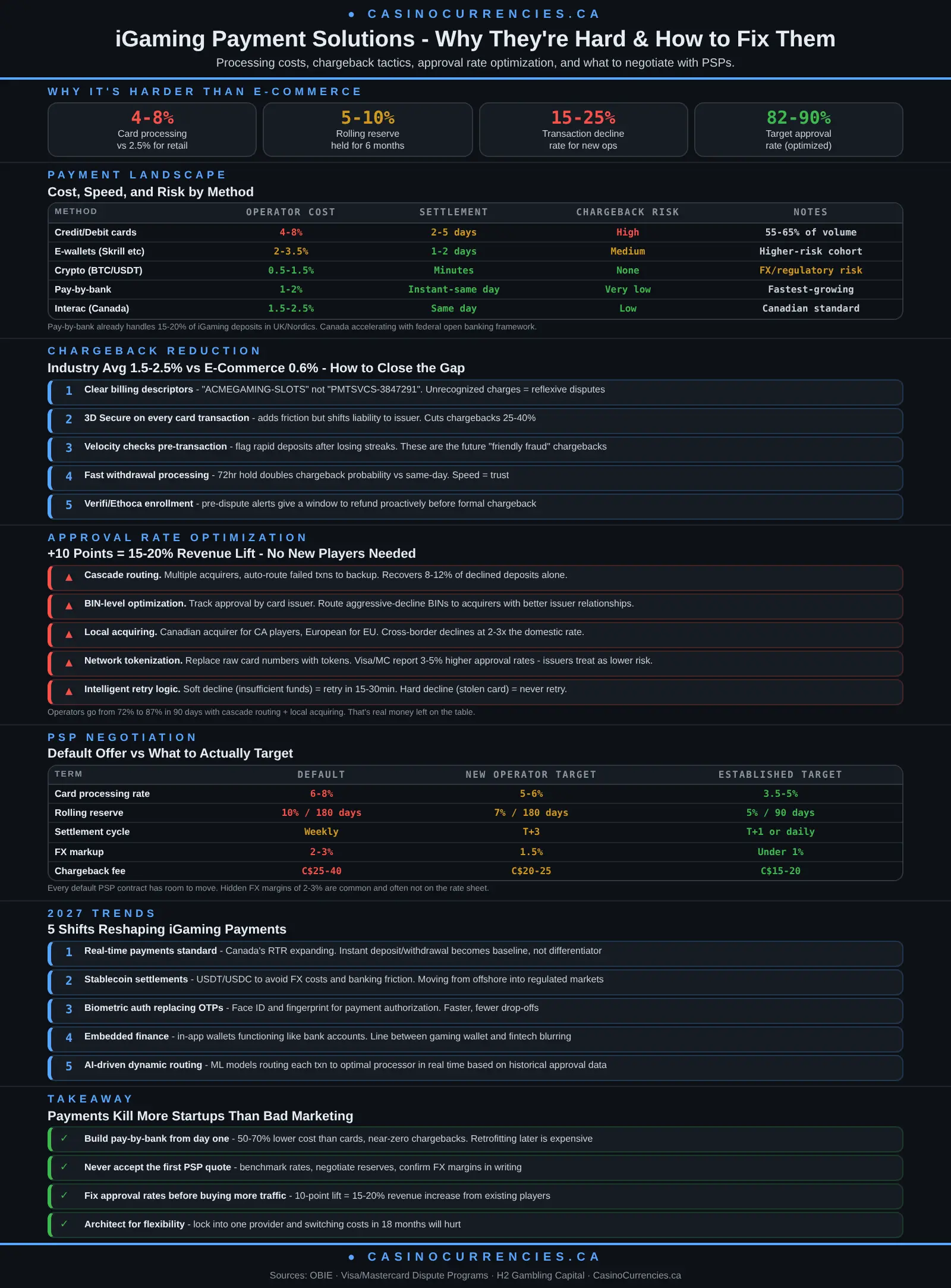
Let me put this in perspective. A standard e-commerce merchant selling shoes applies for a merchant account and typically gets approved within days. An iGaming operator? That same application triggers enhanced due diligence, higher reserve requirements, rolling reserves of 5-10% held for six months, and a processing rate that can run 4-8% per transaction instead of the 2.5% a shoe store pays.
The reason is simple: iGaming sits in what the payments industry classifies as a "high-risk" merchant category. The chargeback ratios are higher. The regulatory complexity is enormous - a single operator might need to comply with anti-money laundering (AML) rules across three or four jurisdictions simultaneously. And acquiring banks know that if a regulator shuts down an operator, those pending settlements evaporate.
Here's the cascade effect I've seen play out multiple times:
- New operators underestimate processing costs by 30-50% in their business plans
- They accept the first payment provider that says yes - often with punishing terms
- Transaction decline rates hit 15-25%, and they lose players who never come back after a failed deposit
- Chargebacks spike in month three, and the acquiring bank raises reserves or terminates the account entirely
If I had to name the single biggest reason iGaming startups fail within 18 months, it wouldn't be a bad game library or weak SEO. It's cash flow disruption from payment processing failures. For context on the full cost picture, my breakdown of how much it costs to start an online casino covers the licensing and platform side - but payment setup costs deserve their own hard look.
The Current Payment Landscape - Cards, E-Wallets, Crypto, Pay-by-Bank
The payment methods available to iGaming operators have expanded dramatically. But more options doesn't automatically mean better conversion. Each method carries its own cost structure, settlement timeline, and regulatory baggage.
Credit and debit cards still dominate deposit volume - roughly 55-65% of transactions in Canada and Europe. But card payments carry the highest chargeback exposure and the strictest acquirer requirements. Several UK banks blocked gambling transactions on credit cards entirely after the UKGC credit card ban took effect in April 2020. Canadian operators haven't faced the same blanket restriction yet, but individual banks increasingly flag or decline gaming-coded transactions.
E-wallets like Skrill, Neteller, and MuchBetter act as an intermediary layer - the player deposits to the e-wallet from their bank, then transfers to the casino. This reduces direct exposure to card chargebacks. Processing fees typically run 2-3.5%, with faster settlement. The downside: e-wallet users tend to be bonus hunters and higher-risk players, which inflates chargeback rates at the cohort level.
Cryptocurrency deposits - Bitcoin, Ethereum, USDT - bypass traditional acquiring banks entirely. No chargebacks. Near-instant settlement. Lower fees. But crypto introduces volatility risk unless the operator converts immediately to stablecoins or fiat, and most regulators haven't issued clear guidance on crypto-to-fiat flows within iGaming.
Pay-by-bank (Open Banking) is the fastest-growing category I've tracked. Open banking APIs let players authorize payments directly from their bank account - no card number, no e-wallet middleman. Transaction costs run 50-70% lower than card processing. The Open Banking Implementation Entity (OBIE) reports over 11 million open banking users in the UK alone, and Canadian adoption is accelerating now that the federal framework is in place.
| Payment Method | Typical Operator Cost | Settlement Speed | Chargeback Risk | Regulatory Complexity |
|---|---|---|---|---|
| Credit/Debit Cards | 4-8% | 2-5 business days | High | High |
| E-Wallets (Skrill, Neteller) | 2-3.5% | 1-2 business days | Medium | Medium |
| Cryptocurrency | 0.5-1.5% | Minutes to hours | None | Uncertain |
| Pay-by-Bank | 1-2% | Same day to instant | Very low | Medium (growing) |
| Interac (Canada) | 1.5-2.5% | Same day | Low | Medium |
How Cashless Payments Work in iGaming
The term "cashless" in iGaming covers everything from digital wallets to tokenized card-on-file systems. But the mechanics differ from standard retail cashless payment in one critical way: iGaming platforms must hold player funds in segregated accounts.
Here's the typical flow for how igaming payments work on the cashless side:
- Player initiates deposit - selects method, enters amount, authenticates (3D Secure for cards, bank redirect for open banking, wallet login for e-wallets)
- Payment gateway routes the transaction - sends it to the appropriate acquiring bank based on routing rules (geography, BIN range, risk score)
- Authorization and settlement - the acquiring bank authorizes. Funds move to the operator's merchant account, minus processing fees and rolling reserve holdback
- Player account credited - happens in seconds, though actual settlement to the operator can take days
- Withdrawal request - player requests a payout, operator runs KYC/AML checks, then initiates the transfer back through the original deposit method or an approved alternative
The friction points I've consistently seen are in routing logic (step 2) and withdrawal processing (step 5). Routing directly impacts approval rates. Withdrawals generate the most player complaints because operators use KYC delays as a compliance buffer that feels like a stalling tactic.
Understanding how to choose the right iGaming software provider matters here because the PAM (Player Account Management) system dictates how smoothly these payment flows actually run.
Chargebacks - Why They're So Costly and How to Reduce Them
Chargebacks are the tax that iGaming operators pay for existing in a high-risk category. The industry average chargeback rate hovers around 1.5-2.5%, compared to roughly 0.6% for general e-commerce. That might sound like a small gap, but the consequences are severe. Visa and Mastercard both run dispute monitoring programs that flag merchants exceeding threshold ratios - cross those lines and the fines, increased reserves, or outright termination follow fast.
Concrete steps to reduce chargebacks in iGaming:
- Aggressive descriptor clarity - Use recognizable billing descriptors. "ACMEGAMING-SLOTS" is better than "PMTSVCS-3847291." Players who don't recognize a charge on their statement file disputes reflexively
- Pre-transaction velocity checks - Flag accounts making rapid successive deposits, especially after a losing streak. These are the deposits most likely to result in "friendly fraud" chargebacks later
- 3D Secure on every card transaction - Yes, it adds friction. But it shifts liability to the issuing bank and cuts chargeback rates by 25-40% on average
- Quick, visible withdrawal processing - The faster a player gets their money, the less likely they are to dispute a deposit. A 72-hour withdrawal hold doubles chargeback probability compared to same-day processing in my experience
- Real-time alerts and Verifi/Ethoca enrollment - These services notify operators of disputes before they become formal chargebacks, giving a window to issue refunds proactively
Growing Approved Transaction Volume
Approval rates - the percentage of attempted deposits that actually go through - are the metric most operators overlook until it's costing them C$50,000+ per month in lost revenue. A 10% improvement in approval rate can translate to a 15-20% revenue increase without acquiring a single new player.
Practical tactics for growing approved volume:
- Cascade routing - Set up multiple acquiring banks and route failed transactions to a backup processor automatically. This alone can recover 8-12% of initially declined deposits
- BIN-level optimization - Track approval rates by card issuer (BIN range). Some banks decline iGaming transactions more aggressively. Route those BINs to acquirers with better relationships with those issuers
- Local acquiring - Use a Canadian acquirer for Canadian players, a European acquirer for European players. Cross-border transactions decline at 2-3x the rate of domestic ones
- Network tokenization - Replace raw card numbers with network tokens. Visa and Mastercard report 3-5% higher approval rates for tokenized transactions because issuers treat them as lower risk
- Retry logic - Implement intelligent retry rules. A soft decline (insufficient funds, temporary hold) can succeed on retry 15-30 minutes later. A hard decline (stolen card, blocked merchant category) should never be retried
These aren't theoretical suggestions. I've watched operators go from 72% approval rates to 87% within 90 days just by implementing cascade routing and local acquiring - that's real money left on the table.
Pay-by-Bank - The Case for Operators
Pay-by-bank is the payment method I'm most bullish on for iGaming. The economics are compelling: lower processing costs, near-zero chargeback risk, and instant settlement in many markets. The player experience is also cleaner - no entering card numbers, no maintaining a separate e-wallet account.
For operators evaluating this method or trying to pitch it internally, here are the practical arguments:
- Cost reduction - Processing fees 50-70% lower than card payments directly improve margins on every transaction
- Chargeback elimination - Bank transfers are irrevocable once confirmed. This removes the single largest source of payment-related losses
- Faster onboarding - Open banking APIs can pull account verification data during the deposit flow, streamlining KYC
- Higher deposit limits - Players aren't constrained by card limits, which means higher average deposit values
The challenge is player adoption. In markets where open banking infrastructure is mature (UK, Netherlands, Nordics), pay-by-bank already handles 15-20% of iGaming deposits. In Canada, adoption is earlier-stage but growing as the federal open banking framework rolls out. Operators launching now should build pay-by-bank integration from day one rather than retrofitting later.
Fraud Prevention Tools - An Honest Assessment
I've tested several fraud prevention platforms, and the reality is that no single tool solves everything. Accertify - one of the more commonly discussed options in iGaming circles - handles transaction-level risk scoring and device fingerprinting. It's solid for operators processing high card volumes, but it's expensive for smaller operators, and the integration timeline runs 8-12 weeks.
Alternatives worth evaluating: Sift has strong machine learning models and scales well for operators with significant transaction data. Kount (Equifax) is established in iGaming with one of the largest device identity networks for bot detection and multi-accounting. Forter automates approve/decline decisioning but requires confidence in the model since manual review drops significantly. Many mid-size operators build in-house rules engines on top of their PAM system - lower cost, but missing the cross-network intelligence third-party tools provide.
The honest take: spend time on the basics first (velocity checks, 3D Secure, descriptor management) before investing C$100K+ annually in an enterprise fraud platform. Most chargeback reduction comes from operational discipline, not software.
How Payment Methods Are Evolving
Payment trends I'm tracking that will reshape how igaming payments work over the next 2-3 years:
- Real-time payments becoming standard - Canada's RTR (Real-Time Rail) system is expanding. Instant deposit and withdrawal will become a baseline expectation, not a differentiator
- Crypto stablecoin settlements - Operators settling in USDT or USDC to avoid FX costs and banking friction. Already common offshore, now moving into regulated markets
- Biometric authentication - Face ID and fingerprint replacing passwords and OTPs for payment authorization
- Embedded finance - Operators offering in-app wallets that function like bank accounts. The line between a gaming wallet and a fintech product is blurring
- AI-driven dynamic routing - Machine learning models routing each transaction to the optimal processor in real time based on historical approval data and risk profile
Operators building payment stacks today should architect for flexibility. Lock into a single provider or method and the switching costs in 18 months will hurt. For broader industry context, my overview of how to start an iGaming business covers the strategic planning that should happen before payment infrastructure decisions.
Choosing a Payment Provider - What to Negotiate
Not all payment service providers (PSPs) are equal, and the default contract they send is never the best deal available. Here's what to push on:
- Processing rates - Start by benchmarking. If a PSP quotes 6% for card processing, that's the opening number. Operators with clean history and decent volume should target 4-5%
- Rolling reserves - Standard is 5-10% held for 6 months. Negotiate the percentage down or the release timeline shorter - some providers will do 90-day reserves for established operators
- Settlement frequency - Daily settlement is worth paying slightly more for. Weekly settlement ties up working capital that new operators desperately need
- Currency conversion - If accepting multi-currency deposits, confirm whether FX conversion happens at the PSP or acquiring bank level, and what markup applies. I've seen hidden FX margins of 2-3% that weren't in the rate sheet
- Termination clauses - Read these carefully. Some PSPs hold reserves for 6-12 months after termination. Others have exclusivity clauses that prevent adding competing providers for cascade routing
- Integration support - A PSP with solid API docs and responsive technical support saves weeks of development time. Ask for sandbox access before signing anything
| Negotiation Point | Default Offer | Target for New Operators | Target for Established |
|---|---|---|---|
| Card processing rate | 6-8% | 5-6% | 3.5-5% |
| Rolling reserve | 10% / 180 days | 7% / 180 days | 5% / 90 days |
| Settlement cycle | Weekly | T+3 (daily possible) | T+1 or daily |
| FX markup | 2-3% | 1.5% | Under 1% |
| Chargeback fee | C$25-40 per dispute | C$20-25 | C$15-20 |
FAQ
Why is payment processing considered the biggest operational challenge for iGaming operators?
iGaming falls under "high-risk" merchant classification, which means higher processing fees (4-8% vs. 2.5% for standard e-commerce), mandatory rolling reserves, enhanced compliance requirements across multiple jurisdictions, and elevated chargeback exposure. A single failed acquiring relationship can halt deposits entirely.
What's the most cost-effective payment method for iGaming operators in Canada?
Pay-by-bank through open banking APIs currently offers the best cost-to-conversion ratio - processing fees of 1-2%, near-zero chargeback risk, and instant settlement. Interac also performs well in the Canadian market at 1.5-2.5%. Card payments remain the highest-volume channel but carry the steepest costs.
How can an operator reduce chargeback rates below the Visa/Mastercard monitoring thresholds?
The most effective combination is mandatory 3D Secure authentication on all card transactions, clear billing descriptors, enrollment in pre-dispute alert services (Verifi or Ethoca), fast withdrawal processing to reduce "friendly fraud," and velocity checks that flag suspicious deposit patterns before authorization.
Is cryptocurrency a viable primary payment method for licensed iGaming operators?
As a primary method, no - most regulated jurisdictions require fiat currency reporting and AML compliance that crypto complicates. As a supplementary option, crypto (especially stablecoins) reduces processing costs and eliminates chargebacks. Operators need robust conversion-to-fiat workflows and clear compliance documentation for their licensing authority.
What approval rate should an iGaming operator target for card deposits?
Industry benchmark for optimized operators is 82-90%. Anything below 75% signals routing or acquirer issues that need immediate attention. A 10-point improvement in approval rates can translate to a 15-20% revenue lift from the existing player base - no additional marketing spend required.
How long does it take to integrate a new payment provider?
For a well-documented PSP with standard APIs, 4-8 weeks from contract signing to live transactions. Enterprise fraud prevention tools like Accertify add another 8-12 weeks. Operators should run parallel testing in sandbox environments before switching live traffic to minimize disruption.