
Marketing an iGaming brand is nothing like marketing a SaaS product or an e-commerce store. I've spent years analyzing operator budgets, and the pattern is always the same - high acquisition costs, restricted ad channels, and compliance rules that shift faster than most teams can adapt. The global iGaming market crossed $107 billion in 2025, growing at roughly 11.5% year-over-year. That kind of money attracts fierce competition. And fierce competition means operators can't afford to waste a single marketing dollar.
This guide breaks down every major iGaming marketing channel I've tested and tracked - from SEO and paid media to email automation and AI-driven personalization. The goal isn't theory. It's practical steps to improve igaming marketing ROI without lighting the budget on fire.
The iGaming Marketing Reality: Restricted Channels, High CPAs, Heavy Compliance
Here's what most first-time operators don't expect: Google Ads, Facebook, and Instagram either ban gambling content outright or restrict it behind licensing requirements and geo-targeting walls. That immediately cuts off the two largest digital ad platforms on the planet.
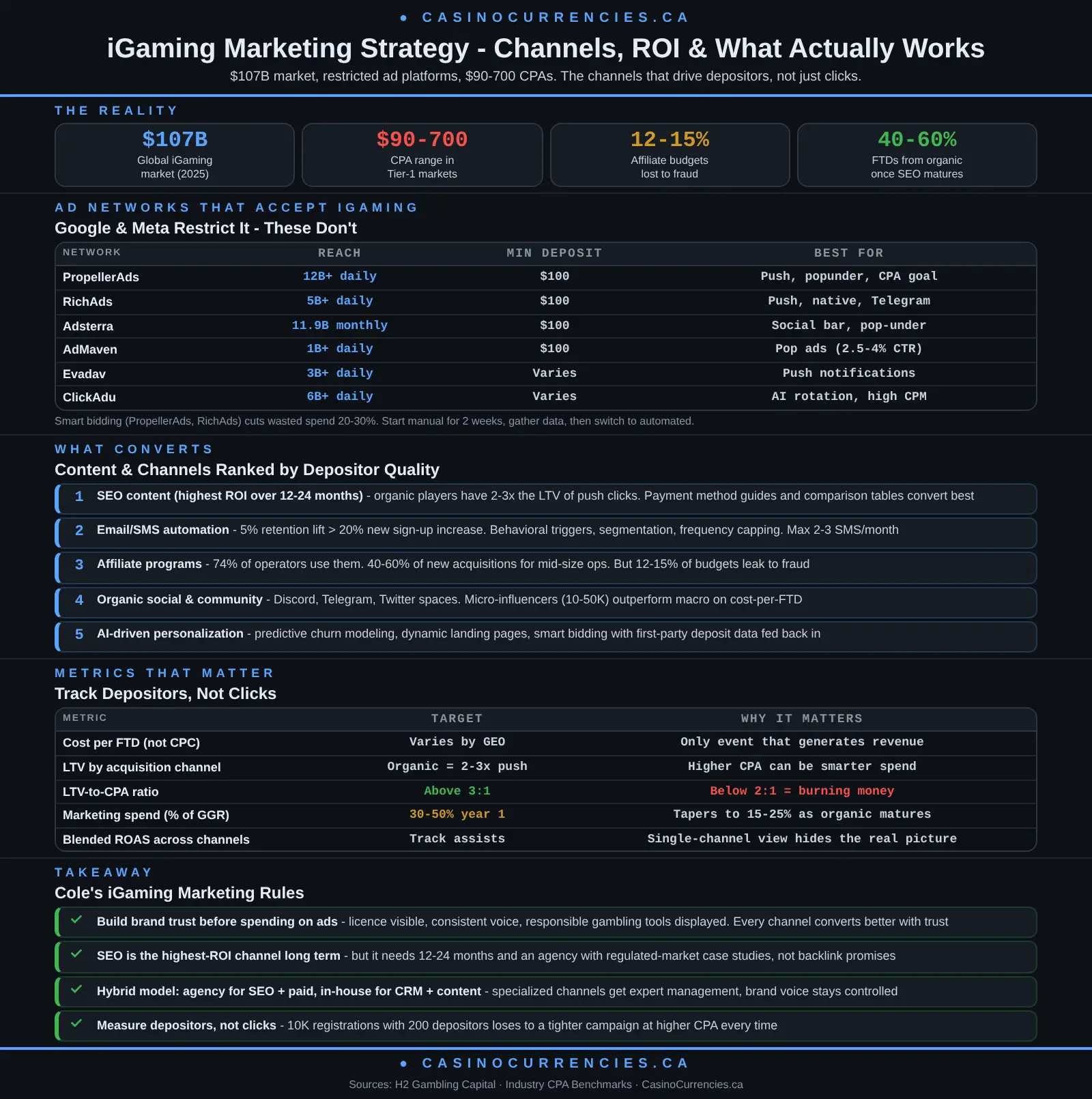
Then there's the cost. CPA rates in Tier-1 markets like the UK range from $90 on the low end to $700+ for high-intent SEO and PPC traffic. In Tier-3 markets - Nigeria, parts of Southeast Asia - rates drop to $5-$35, but lifetime value tends to follow. And according to industry benchmarks, 12-15% of affiliate marketing budgets are lost to fraud alone. That's not a rounding error. That's a structural tax on every campaign.
The operators who figure out how to optimize igaming marketing spend aren't the ones with the biggest budgets. They're the ones who stop spraying money across channels and start measuring what actually drives depositing players - not just clicks.
Building a Strong iGaming Brand Before Spending on Ads
I've watched operators dump six figures into paid traffic before they even had a logo that looked professional. Bad move. Brand trust is the multiplier that makes every other channel more effective.
How to build a trustworthy igaming brand comes down to three things:
- A clear identity. What makes this operator different from the 349 active brands competing in the UK market alone? If the answer is "better bonuses," that's not an identity - that's a race to the bottom.
- Visible licensing and compliance. Players check. Regulators check. Affiliates check. Display the license, link to the regulator's verification page, and don't bury the responsible gambling tools.
- Consistent content voice. Every touchpoint - landing pages, email subject lines, social posts, support chat - should sound like the same brand. Disjointed messaging erodes trust faster than a bad payout experience.
Building a strong igaming brand isn't a one-month project. But skipping it means every acquisition dollar works harder than it should.
SEO for iGaming - How to Pick an Agency and What to Expect
Organic search is the highest-ROI channel in iGaming over a 12-24 month horizon. I've seen operators pull 40-60% of their first-time depositors from organic once the content machine is running. But iGaming SEO is a specialty. Generic digital agencies struggle because they don't understand gambling compliance, link-building restrictions, or how to structure content clusters around player intent.
When deciding how to pick an igaming SEO agency, here's what I look for:
- Portfolio in regulated markets. Ask for case studies in the UK, Ontario, or Malta - not just grey-market wins that could vanish with one regulatory change.
- Content-led strategy. If the pitch is mostly about backlinks and technical audits, keep looking. Content is what ranks in this vertical.
- Realistic timelines. Anyone promising page-one rankings in 90 days for competitive iGaming keywords is either lying or planning tactics that'll get the site penalized.
- Transparent reporting. Monthly traffic numbers mean nothing without conversion data. Insist on seeing organic FTD (first-time deposit) attribution.
I covered the broader casino promotion playbook in How to Promote an Online Casino, but the operator-level SEO game demands deeper specialization.
Paid Media - Which Ad Networks Actually Accept iGaming
This is where operators either find their groove or hemorrhage cash. The question of which online ad platforms allow igaming has a shorter answer than most people expect from mainstream platforms - but a surprisingly long list when looking at specialized networks.
Ad Networks That Work for iGaming
| Network | Daily/Monthly Reach | Min. Deposit | Best For |
|---|---|---|---|
| PropellerAds | 12B+ daily impressions | $100 | Push, popunder, CPA goal optimization |
| RichAds | 5B+ daily impressions, 220 countries | $100 | Push, native, Telegram ads |
| Adsterra | 11.9B monthly impressions, 248 GEOs | $100 | Social bar, pop-under, native |
| AdMaven | 1B+ daily impressions | $100 | Pop ads (2.5-4% CTR), interstitial |
| Evadav | 3B+ daily impressions, 250+ countries | Varies | Push notifications, consent-based |
| ClickAdu | 6B+ daily impressions | Varies | AI-based rotation, high CPM |
Choosing an ad network for an igaming business isn't about picking the biggest one. It's about matching the network's traffic quality to the operator's target GEO and player profile. I've seen operators waste thousands on push traffic in markets where email converts three times better.
Smart bidding features - available on PropellerAds, RichAds, and others - let operators set a target CPA and let the algorithm optimize toward depositing players rather than raw clicks. Learning how to use smart bid for igaming campaigns can cut wasted spend by 20-30% in my experience, but it requires feeding the algorithm enough conversion data to learn. Start with a manual campaign, gather baseline data for two weeks, then switch to automated bidding.
For a broader look at the affiliate side of paid traffic, I broke down the economics in iGaming Affiliate Marketing. Around 74% of operators use affiliates - and for good reason.
Social Media Marketing - What Works and What Gets Banned
Social media marketing for iGaming is a minefield. Meta's policies restrict gambling ads to licensed operators in approved jurisdictions, and even then, the targeting options are limited. TikTok bans gambling ads entirely in most markets. Twitter/X allows them in some regions with pre-approval.
So how to do igaming social media marketing without getting banned?
- Organic content over paid. Build communities around the brand - Discord servers, Telegram groups, Twitter spaces - where the audience opts in. Paid social in iGaming has terrible unit economics compared to organic community building.
- Influencer partnerships - carefully. Micro-influencers in the gambling space (10K-50K followers) often outperform macro-influencers on cost-per-FTD. But compliance is critical. Every post needs proper disclosures, and the influencer can't target minors or make earnings guarantees.
- LinkedIn for B2B. Knowing how to use LinkedIn to book igaming meetings is an underrated skill. Operators, affiliates, and platform providers all live on LinkedIn. Direct outreach with a clear value proposition - not generic "let's connect" spam - books meetings. I've covered networking tactics in more detail in How to Network & Grow at iGaming Conferences.
Content Marketing - What Moves the Needle
Not all content is created equal. Learning how to create igaming content that actually drives deposits - not just pageviews - means focusing on bottom-of-funnel intent.
The content types I've seen convert best:
- Casino and game reviews with real data (RTP, withdrawal times, bonus math)
- Payment method guides targeting players searching "best [payment method] casinos" - these pages consistently have high conversion intent
- Comparison tables that let players filter by what matters to them (min deposit, license, payout speed)
- Regulatory updates that build authority and attract links naturally
Top-of-funnel "what is online gambling" content drives traffic but rarely converts directly. It feeds the SEO flywheel. The money pages are the ones matching transactional intent. I laid out the full iGaming industry entry point in What Is iGaming? - that kind of content builds topical authority that lifts every other page on the site.
Email and SMS Automation - The Retention Engine
Acquisition gets the headlines, but retention drives the margin. I've analyzed operator data where a 5% improvement in retention lifted revenue more than a 20% increase in new sign-ups. The full retention playbook is in iGaming Player Retention, but the automation layer deserves its own discussion.
To automate igaming email campaigns effectively, the system needs three things: behavioral triggers, player segmentation, and frequency capping.
Behavioral triggers fire messages based on actions - a player who deposited but didn't play within 48 hours gets a different email than one who's been inactive for 30 days. Segmentation groups players by value tier, game preference, deposit frequency, and risk profile. Frequency capping prevents the number-one automation sin: burning out the list with daily blasts.
SMS automation follows similar logic but demands even more restraint. Players tolerate fewer text messages than emails. Two to three SMS touches per month is the ceiling for most segments. The operators who've figured out how to automate igaming sms marketing well use it for time-sensitive offers - flash bonuses, tournament reminders, verification nudges - not general newsletters.
Common igaming campaign management tools in this space include Optimove, Braze, and Xtremepush. Each handles segmentation, multi-channel orchestration, and real-time triggers. The price tags vary wildly, so operators scaling igaming marketing operations need to match the tool to their current player volume, not where they hope to be in two years.
Bonus Offer Automation - Triggers, Personalization, Abuse Prevention
Automating bonus offers sounds simple until fraud enters the picture. Knowing how to automate igaming bonus offers means balancing generosity against abuse.
The basics: trigger bonuses based on lifecycle stage (welcome, reactivation, loyalty milestone) and player value. A high-roller who deposits C$5,000 monthly shouldn't receive the same C$10 free-spin offer as a casual player. Personalization lifts redemption rates - I've seen 15-25% improvements when bonuses match the player's preferred game category.
But abuse prevention is just as important. Multi-account detection, wagering requirement enforcement, and geo-based offer restrictions aren't optional. Operators who skip these steps end up subsidizing bonus hunters instead of rewarding genuine players.
AI in iGaming Marketing - Practical Applications Today
The hype around AI in marketing is thick. But the practical question - how to use AI in igaming marketing right now - has real answers.
- Predictive churn modeling. Machine learning identifies players likely to leave before they do, triggering retention offers at the right moment.
- Dynamic content personalization. AI adjusts landing page elements, banner creatives, and even game recommendations in real time based on player behavior patterns.
- Smart bidding and budget allocation. Platforms like PropellerAds and RichAds already use ML-driven bidding. Operators layering their own models on top - feeding first-party deposit data back into the ad platform - see materially better CPA performance.
- Fraud detection. AI spots multi-accounting, bonus abuse, and affiliate fraud faster than manual review ever could.
The operators who treat AI as a practical tool - not a magic wand - are the ones seeing actual ROI improvements.
Marketing to Millennials and Gen Z
The playbook for reaching younger demographics looks different. Learning how to market igaming to millennials and Gen Z means meeting them where they already are - mobile-first (80% of online gamblers use smartphones), social-native, and deeply skeptical of traditional advertising.
What resonates:
- Gamification beyond the games. Leaderboards, challenges, social features, and achievement systems that make the platform sticky.
- Transparency. This demographic fact-checks claims. Fake reviews, inflated RTP promises, and hidden terms get called out publicly.
- Crypto and alternative payments. Younger players expect modern payment options. I explored the full payments landscape in iGaming Payment Solutions.
- Short-form content. Thirty-second clips, memes, and community-driven content outperform polished corporate videos.
Choosing a Marketing Agency vs. Building In-House
The decision on how to choose a reliable igaming marketing agency versus building an internal team depends on stage and budget.
Agency pros: Faster ramp-up, existing ad network relationships, regulatory knowledge baked in. Agencies like Growth-onomics, Mediacle, and Raketech specialize in iGaming - and specialization matters. A generic digital shop won't understand why a Facebook campaign got flagged or how to structure content for gambling SERP features.
In-house pros: Better data control, tighter brand alignment, lower long-term cost at scale. Once an operator has enough volume, bringing core functions (SEO, CRM, paid media management) in-house makes financial sense.
The hybrid model works best for most mid-stage operators: agency for SEO and paid media, in-house for CRM/email and content creation. That way the specialized channels get expert management while the brand voice stays controlled.
Measuring ROI and Optimizing Spend
The whole point of this exercise is the bottom line. Improving igaming marketing ROI requires tracking the right metrics - and most operators track the wrong ones.
Metrics that matter:
- Cost per first-time deposit (CPA/FTD) - not cost per click, not cost per registration. The deposit is the only event that generates revenue.
- Player lifetime value (LTV) by acquisition channel - an organic player acquired through SEO content typically has 2-3x the LTV of a push notification click. Spending more per organic acquisition is often the smarter play.
- LTV-to-CPA ratio - anything above 3:1 is healthy. Below 2:1, the channel is burning money unless there's a strategic reason to keep it running.
- Blended ROAS across channels - looking at any single channel in isolation hides the assist effects. A player might see a push ad, Google the brand, and deposit through organic. Attribution modeling matters.
Finding the right audience for igaming ads isn't a one-time exercise. It's a continuous loop: test, measure depositor quality, adjust targeting, repeat. The operators who improve igaming marketing ROI over time are the ones who treat every campaign as a data collection exercise - not a bet.
For anyone still building out the business fundamentals alongside the marketing engine, I covered the operational foundation in How to Start an iGaming Business.
FAQ
What's a realistic CPA for iGaming player acquisition?
It varies dramatically by market. Tier-1 markets like the UK run $90-$700+ per first-time depositor depending on the traffic source. Tier-3 markets in LATAM and Africa can be as low as $5-$35. The key metric isn't the CPA itself - it's the LTV-to-CPA ratio.
Which ad platforms allow iGaming advertising?
Specialized networks like PropellerAds, RichAds, Adsterra, AdMaven, Evadav, and ClickAdu all accept iGaming. Google and Meta allow it only in approved jurisdictions with valid licensing documentation. Most operators rely on the specialized networks for scale.
Is it better to hire an iGaming marketing agency or build in-house?
Early-stage operators benefit from agencies with existing network relationships and compliance experience. As player volume grows, bringing CRM, email, and content in-house reduces costs. A hybrid model - agency for SEO and paid, in-house for retention - works well for mid-stage operators.
How can AI improve iGaming marketing performance?
Practical applications include predictive churn modeling, dynamic content personalization, smart bidding on ad platforms, and fraud detection. AI works best when fed first-party data - deposit events, player behavior, churn signals - rather than relying on third-party lookalike audiences.
How much should an iGaming operator budget for marketing?
Most operators allocate 30-50% of gross gaming revenue to marketing in year one, tapering to 15-25% as organic channels mature. The exact split depends on market maturity, competitive density, and whether the operator is building brand awareness or optimizing for immediate deposits.
What's the biggest mistake operators make with iGaming marketing?
Chasing volume over quality. I've seen operators celebrate 10,000 registrations that produced 200 depositors. A tighter campaign targeting high-intent audiences at a higher CPA almost always outperforms a broad, cheap campaign on a cost-per-depositor basis.