
Building a casino is one thing. Getting players through the door is an entirely different grind — and it's where most new operators hemorrhage cash before they've even figured out their retention strategy. I've watched half a dozen promising operations fold in their first year, not because the product was bad, but because the marketing plan was either nonexistent or built on assumptions that don't survive contact with reality.
The hard truth about how to promote an online casino: nearly every major advertising channel either bans or heavily restricts gambling content. Google Ads, Meta, TikTok — all of them have walls around iGaming. That doesn't mean marketing is impossible. It means the playbook is different from anything in standard e-commerce, and the operators who figure that out early are the ones still standing after year two.
Here's what I've seen work — and what burns money.
Why Online Casino Marketing Plays by Different Rules
Before spending a single dollar on promotion, every operator needs to internalize one fact: gambling advertising is regulated separately from the gambling product itself. Holding a valid online gambling license doesn't automatically grant permission to advertise everywhere. Most jurisdictions impose their own rules on what marketing claims are allowed, where ads can run, and what disclaimers must appear.
In the UK, the Advertising Standards Authority (ASA) enforces strict codes — no targeting minors, no implying gambling improves social status, no misleading bonus claims. Ontario's Alcohol and Gaming Commission (AGCO) rolled out its own advertising standards in 2022 that ban athlete endorsements in most contexts. And the European Commission has been pushing member states toward tighter harmonization since its 2023 gambling recommendations.
The practical impact? An operator can't just throw money at a Facebook campaign and see what sticks. Every ad creative, landing page, and influencer post needs compliance review before it goes live. The cost of getting this wrong isn't just a rejected ad — it's a fine, a license review, or both.
That reality shapes the entire marketing strategy. The channels that work for online casino marketing tend to be the ones with fewer gatekeepers: organic search, affiliate partnerships, content, email, and a handful of ad networks built specifically for the gambling vertical.
SEO Strategy for Online Casinos
Search engine optimization is the single most cost-effective long-term channel to market an online casino. The upfront investment is significant — quality iGaming SEO isn't cheap — but the compounding returns outpace every other channel once the site builds domain authority.
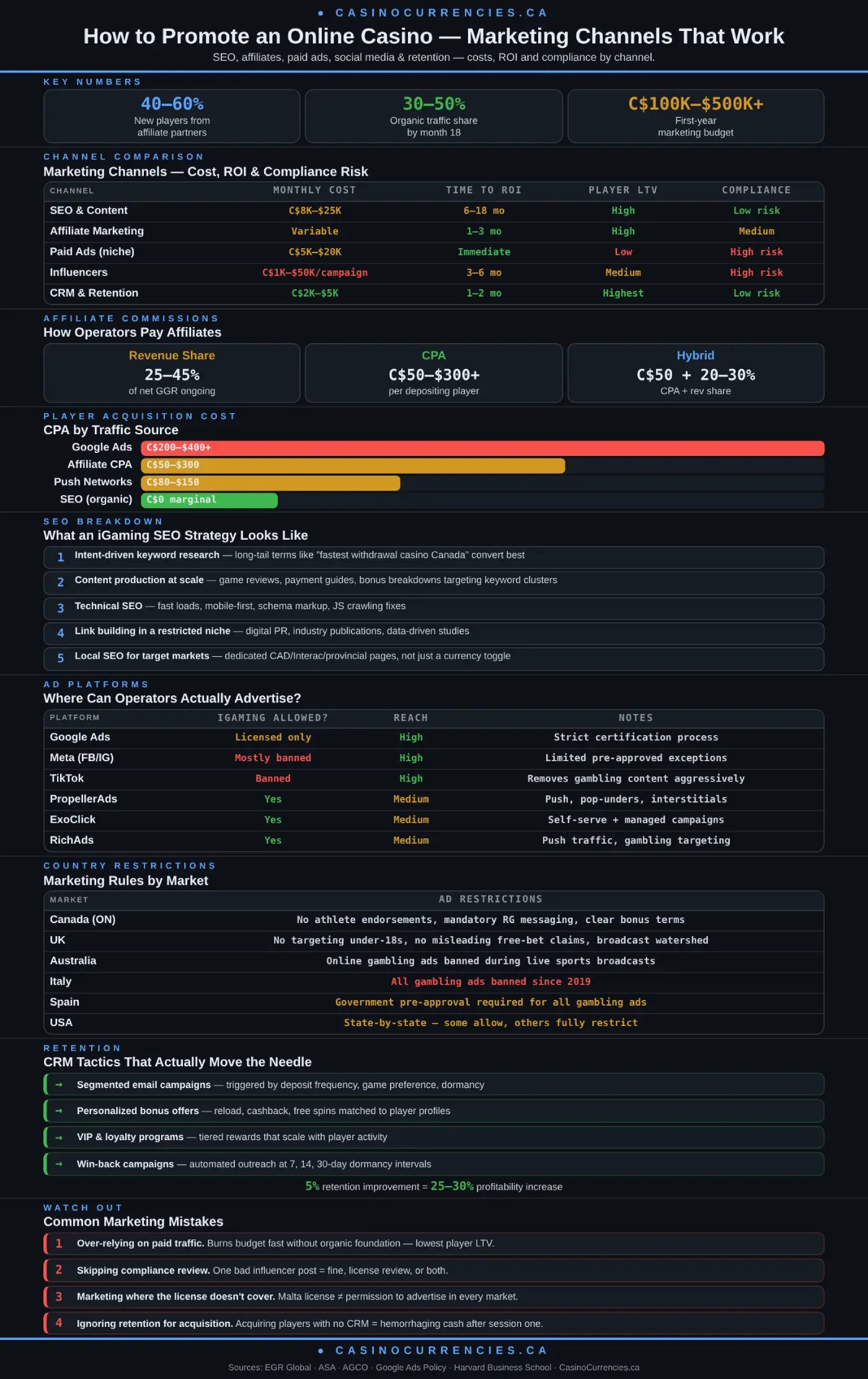
I've tracked the organic traffic profiles of dozens of operators, and the pattern is consistent. Sites that invest seriously in SEO start seeing meaningful organic traffic around month six to eight. By month 18, organic search typically accounts for 30–50% of new player registrations at operators who commit to it.
What an iGaming SEO strategy actually looks like:
- Keyword research focused on player intent. Not just "best online casino" but long-tail terms like "fastest withdrawal casino Canada" or "low wagering bonus slots." These convert better because the searcher is closer to a decision.
- Content production at scale. Game reviews, payment method guides, bonus breakdowns, strategy articles. Each piece targets a specific keyword cluster and links back to the core casino pages.
- Technical SEO fundamentals. Fast page loads, mobile-first design, clean URL structure, proper schema markup for reviews and FAQs. Gambling sites tend to be JavaScript-heavy, which creates crawling challenges if not handled properly.
- Link building in a restricted niche. Most mainstream sites won't link to a gambling operator. That pushes operators toward digital PR, industry publications, data-driven studies, and affiliate partnerships for backlink acquisition.
- Local SEO for market-specific pages. An operator targeting Canadian players needs dedicated landing pages for Canadian-specific content — Interac deposits, CAD bonuses, provincial regulations — not just a generic international site with a currency toggle.
The budget? A serious iGaming SEO campaign — content, technical optimization, and link building combined — runs C$8,000 to C$25,000 per month depending on the competitiveness of the target market. That's not a number I made up. It comes from tracking agency quotes and in-house team costs across the industry. For a deeper breakdown of broader marketing ROI, I've covered the operator-level perspective in iGaming Marketing — Strategy, Channels & Automation.
Affiliate Marketing — The Industry's Workhorse Channel
If SEO is the long game, affiliate marketing is the engine that keeps revenue flowing while organic rankings build. Roughly 40–60% of new player acquisitions at mid-tier online casinos come through affiliate partners, according to EGR Global's affiliate market data. That number alone explains why every serious operator runs an affiliate program.
The model is straightforward: affiliates — typically review sites, comparison portals, and content creators — send players to the casino. The operator pays a commission based on one of three structures:
| Commission Model | How It Works | Typical Range |
|---|---|---|
| Revenue Share | Affiliate earns a % of the net revenue from referred players | 25–45% of net GGR |
| CPA (Cost Per Acquisition) | Flat fee per depositing player | C$50–C$300+ per player |
| Hybrid | Smaller CPA upfront + ongoing revenue share | C$50 CPA + 20–30% rev share |
Setting up an affiliate program requires an affiliate management platform (Income Access, Cellxpert, or Scaleo are common choices), clear commission terms, compliant marketing materials for affiliates to use, and — critically — someone to actively manage the program. Affiliates don't just appear. They need onboarding, performance tracking, and relationship management.
I've written a dedicated deep-dive on the affiliate side in Online Casino Affiliate Marketing — How It Works & How to Start. For operators looking at the B2B angle, iGaming Affiliate Programs covers program setup and management at scale.
Paid Advertising — What's Allowed and Where to Advertise
Here's where it gets tricky. The biggest ad platforms — Google, Meta, YouTube — all restrict or outright ban gambling ads in most regions. Google Ads does allow gambling advertisers in certain licensed markets (UK, certain U.S. states, parts of Europe) but requires a lengthy certification process and limits ad formats. Meta banned gambling ads globally in 2018, then partially reopened with strict pre-approval requirements that most new operators can't meet.
So where can an operator actually advertise gambling sites online?
Ad networks that accept iGaming:
- PropellerAds — push notifications, pop-unders, interstitials. High volume, low cost, but traffic quality varies.
- ExoClick — strong in adult and gambling verticals. Offers self-serve and managed campaigns.
- RichAds — push and pop traffic with gambling-specific targeting options.
- JEMP (formerly TrafficJunky) — programmatic display with iGaming-friendly policies.
- Programmatic DSPs — platforms like AdLib or Bucksense allow gambling advertisers but require pre-approval and compliance documentation.
The CPAs on these networks are lower than mainstream platforms, but so is the average traffic quality. I've seen operators achieve C$80–C$150 CPA on push notification campaigns, versus C$200–C$400+ through Google Ads in licensed markets. The catch? Conversion rates from push traffic tend to be lower, and player lifetime value from these channels often underperforms organic or affiliate-sourced players.
Paid advertising works best as a supplement to organic and affiliate channels — not as the primary acquisition strategy. The operators I've seen burn through their marketing budget fastest are the ones who relied too heavily on paid traffic without building the organic foundation underneath.
Social Media and Influencer Partnerships
Social media for gambling brands is a minefield. Most platforms enforce policies that make it difficult — sometimes impossible — to run a standard social presence for an online casino. Instagram and TikTok are particularly aggressive about removing gambling content, even organic posts that don't include paid promotion.
That said, some operators have found traction through:
- YouTube — Casino streaming and game review content. Channels like Roshtein and ClassyBeef built massive audiences reviewing slot gameplay. The key is disclosing sponsorship relationships and following local advertising codes.
- Twitch — Live casino streaming was huge until Twitch banned unlicensed gambling content in 2022. Licensed operators in regulated markets can still stream, but the reach shrank considerably.
- Telegram and Discord — Community-building channels that sit outside mainstream platform restrictions. Many operators use private Telegram groups for VIP engagement and exclusive promotions.
- X (Twitter) — More permissive than Meta or TikTok for gambling content, though enforcement is inconsistent.
Influencers who promote online gambling — particularly on YouTube and Twitch — charge anywhere from C$1,000 to C$50,000+ per campaign depending on audience size and engagement rates. The risk here isn't just cost. It's compliance. An influencer post that violates the advertising standards of the operator's licensed jurisdiction can trigger regulatory action against the operator, not just the influencer. Every influencer partnership needs a contract that specifies exactly what can and can't be said, plus a pre-approval workflow for all content before it goes live.
Content Marketing and CRM Retention
Acquisition gets the headlines, but retention determines profitability. The cost to start an online casino is steep enough that operators can't afford to lose players after a single session. Content marketing and CRM — customer relationship management — work together to keep players engaged long after that first deposit.
Content marketing for a gambling platform includes blog articles, game guides, strategy content, tournament calendars, and industry news. This content serves dual purposes: it feeds the SEO strategy discussed earlier, and it keeps existing players returning to the site between sessions.
CRM retention tactics that actually move the needle:
- Segmented email campaigns — triggered by player behavior (deposit frequency, preferred games, dormancy periods), not blasted to the entire database.
- Personalized bonus offers — reload bonuses, cashback, and free spins targeted to individual player profiles rather than generic one-size-fits-all promotions.
- VIP and loyalty programs — tiered reward structures that increase in value as the player's activity grows.
- Push notifications — mobile and browser-based alerts for new game launches, exclusive promotions, or tournament entries.
- Win-back campaigns — automated outreach to dormant players at 7, 14, and 30-day intervals with tailored incentives.
The data I've tracked consistently shows that a 5% improvement in player retention can increase profitability by 25–30% — a figure that aligns with research from Harvard Business School on customer retention economics. I've covered retention strategies in more depth in iGaming Player Retention.
Country-Specific Marketing Restrictions
Where to market an online casino isn't just a strategic choice — it's a legal one. Different countries impose wildly different rules on how gambling platforms can advertise, and operators who ignore these boundaries risk more than wasted ad spend.
| Country/Region | Key Restrictions |
|---|---|
| Canada (Ontario) | AGCO standards: no athlete endorsements, mandatory responsible gambling messaging, bonus terms must be clear |
| United Kingdom | ASA-enforced codes: no targeting under-18s, no misleading free-bet claims, watershed rules for broadcast |
| Australia | Banned online gambling ads during live sports broadcasts (2018 amendment to the Broadcasting Services Act) |
| Philippines | PAGCOR regulates ad content; operators must be locally licensed to advertise |
| United States | State-by-state: some states allow gambling ads, others restrict or ban them entirely. US citizens face limited options for promoting offshore gambling |
| European Union | Varies by member state — Italy banned all gambling ads in 2019, Spain requires government pre-approval, Netherlands limits online ads |
For operators asking which countries allow online casino marketing — the answer changes constantly. Italy's blanket ban and Spain's restrictions represent one end of the spectrum. The UK and certain Canadian provinces sit closer to the permissive end, though with heavy conditions. Keeping a compliance officer updated on regulatory changes across target markets isn't optional — it's a core operating cost.
And one more thing worth flagging: promoting an online gambling website from a jurisdiction that bans it — even if the casino itself is licensed elsewhere — can create legal exposure. I've seen operators based in Malta get into trouble for running ad campaigns targeting markets where their license didn't authorize operations. The license covers the casino. The marketing still has to follow local law.
FAQ
What's the most effective way to promote an online casino?
A combination of SEO and affiliate marketing consistently outperforms other channels in long-term ROI. Paid ads on gambling-friendly networks supplement acquisition, but organic traffic and affiliate referrals tend to deliver higher player lifetime value.
Can I advertise an online casino on Google or Facebook?
Google allows gambling ads in specific licensed markets through its gambling certification program, but the approval process is strict. Meta (Facebook/Instagram) has largely banned gambling advertising, with limited exceptions for pre-approved advertisers in certain jurisdictions.
How much does online casino marketing cost?
First-year marketing budgets for a new operator typically range from C$100,000 to C$500,000+. SEO alone runs C$8,000–C$25,000 per month, affiliate commissions add variable costs per acquired player, and paid traffic campaigns require separate budgets. A more complete cost breakdown is available in How Much Does It Cost to Start an Online Casino?.
How do I increase turnover at my online casino?
Focus on three areas: acquiring higher-value players through targeted SEO and affiliate partnerships, improving deposit frequency through CRM-driven promotions and loyalty programs, and expanding the game library to keep session lengths high. Turnover growth is a retention problem as much as an acquisition one.
Are there countries where I can freely market my online casino?
No country offers completely unrestricted gambling advertising. Even relatively permissive markets like the UK and Ontario impose detailed advertising standards. The operator's license dictates which markets can be served, and local advertising laws in each target country add another layer of compliance.
How do influencers promote online gambling, and is it worth it?
Influencers — primarily on YouTube and Twitch — promote casinos through sponsored gameplay streams, reviews, and social media posts. Costs range from C$1,000 to C$50,000+ per campaign. It can be worth it for brand awareness, but the compliance risks are significant. Every piece of influencer content needs pre-approval to avoid regulatory violations.