
Picking an iGaming software provider is the single decision that locks in an operator's ceiling. I've watched startups burn through six figures on a platform that couldn't handle their first traffic spike - and I've seen scrappy operators launch on a mid-tier turnkey solution and scale to eight-figure GGR inside 18 months. The difference wasn't luck. It was due diligence.
After spending years analyzing operator back-ends, reviewing contract terms, and interviewing CTOs who've been through multiple platform migrations, I've built a framework for how to choose an iGaming software provider without getting buried in vendor sales decks. This guide covers every layer of the tech stack - from player account management to CRM to game aggregation - so the decision is based on data, not demos.
What iGaming Software Actually Includes
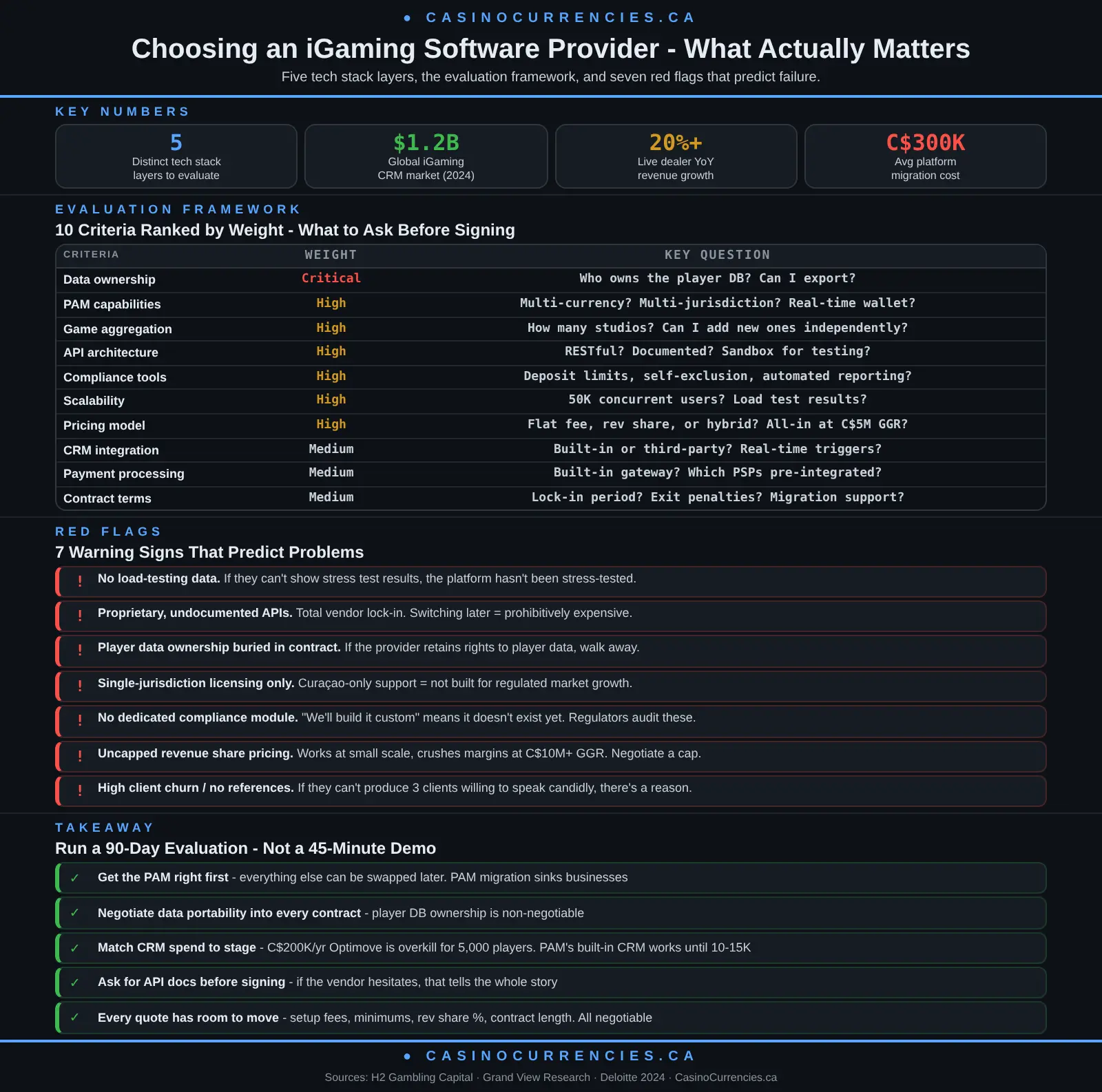
The phrase "iGaming software" gets thrown around like it's a single product. It isn't. A full operator tech stack has at least five distinct layers, and most vendors only cover two or three of them. Here's the breakdown:
- PAM (Player Account Management): The core platform that handles player registration, wallets, KYC verification, bonus engines, and regulatory reporting. This is the backbone.
- Game Aggregator: The middleware that connects an operator to hundreds of game providers through a single API integration rather than building dozens of individual connections.
- Back-Office Software: Reporting dashboards, risk management tools, fraud detection, and operational controls for the day-to-day running of the business.
- CRM Platform: Player segmentation, automated campaigns, lifecycle marketing, and retention tools. Some PAM providers bundle a basic CRM; most serious operators bolt on a specialist.
- Payment Gateway: The layer that processes deposits and withdrawals across cards, e-wallets, bank transfers, and crypto. I've covered this in depth in my iGaming Payment Solutions guide.
The critical mistake I see new operators make is assuming one vendor handles everything. Some do - companies like EveryMatrix, SoftSwiss, and BetConstruct offer end-to-end solutions. But "end-to-end" often means "adequate at everything, exceptional at nothing." Understanding which layers matter most to a specific business model is step one.
PAM Explained - The Layer That Makes or Breaks an Operation
If there's one thing I tell every operator I consult with, it's this: get the PAM right and everything else can be swapped later. Get it wrong and migration costs alone can sink the business.
A PAM solution is the central nervous system of an iGaming operation. It manages player accounts, processes transactions, enforces bonus terms, runs KYC and AML checks, and generates the compliance reports that licensing authorities demand. Every other component - games, payments, CRM - plugs into the PAM.
The best iGaming PAM providers I've evaluated share a few traits. They offer multi-jurisdictional licensing support out of the box. They handle real-time wallet management without lag at scale. And - this is the part most vendors gloss over - they don't hold player data hostage if the operator decides to leave.
I've seen contracts where the PAM provider technically owns the player database. That's a deal-breaker. If the relationship sours or the provider gets acquired, the operator loses access to their own customers. Always negotiate data portability into the contract before signing.
For operators just starting an iGaming business, a white-label PAM bundled with a turnkey platform is the fastest path to launch. But for anyone planning to scale past C$5 million in annual GGR, investing in a standalone PAM - something like GR8 Tech, Altenar, or EveryMatrix's platform - gives far more control over the player experience and regulatory compliance.
Key Evaluation Criteria: What Actually Matters
Sales demos are designed to impress. I've sat through presentations where everything looked slick - until I asked about uptime SLAs, or how the platform handles concurrent users during a major sporting event. The demo fell apart fast.
Here's the evaluation framework I use when assessing how to choose the best iGaming software:
Game Library and Content Providers
The platform needs to aggregate content from the top iGaming content providers - Pragmatic Play, Evolution Gaming, NetEnt, Play'n GO, and Microgaming at minimum. But raw game count is a vanity metric. What matters is the mix: slots, live dealer, table games, crash games, and regional favourites. A platform offering 8,000 slots but no live dealer content is missing the fastest-growing vertical in the industry. Live dealer revenue grew over 20% year-over-year across regulated European markets according to H2 Gambling Capital's 2024 market data.
API Flexibility
How do iGaming API integrations work on this platform? Can the operator add a new game provider without the vendor doing custom development? Is the API RESTful and well-documented, or is it a proprietary black box? I always ask for API documentation before signing a contract. If the vendor hesitates, that's a red flag.
Scalability
Can the platform handle 50,000 concurrent users during a Champions League final? What about 200,000? I've reviewed post-mortems from operators whose platforms crashed during peak events - the revenue loss was bad, but the player trust damage was worse. Ask for load-testing results. If they don't have them, they haven't tested.
Compliance and Responsible Gambling Tools
Any platform operating in regulated markets needs built-in tools for deposit limits, self-exclusion, reality checks, and automated regulatory reporting. The MGA, UKGC, and Ontario's AGCO all have specific technical standards. I covered the licensing landscape in detail in my online gambling license guide - cross-reference those requirements against what the platform actually delivers.
CRM Platforms for iGaming - The Retention Engine
A PAM gets players in the door. A CRM keeps them. The iGaming CRM market alone was valued at over US$1.2 billion globally in 2024 according to Grand View Research's CRM industry analysis. And the best CRM iGaming platforms I've tested go far beyond email blasts.
What separates a good iGaming CRM from a generic marketing tool is real-time event triggering. A player deposits C$500, loses it in 20 minutes, and goes silent. A basic CRM sends a promotional email three days later. A purpose-built iGaming CRM detects the drop-off in real time, triggers a personalized bonus offer within minutes, and tracks whether that intervention actually brought the player back.
The leading platforms in this space include Optimove (strong on predictive analytics and micro-segmentation), Fast Track (built specifically for iGaming with deep PAM integrations), and Salesforce with an iGaming-specific configuration layer. Cloud-based CRM benefits iGaming brands by eliminating on-premise infrastructure costs, enabling remote team access across jurisdictions, and scaling compute resources during peak campaigns without hardware provisioning.
But here's the honest take - a C$200,000/year CRM subscription is overkill for an operator with 5,000 active players. I've seen startups spend more on their CRM than on their entire game content budget. Match the tool to the stage. For early-stage operators, many PAM platforms include a basic CRM module. It's not Optimove, but it works until the player base justifies the upgrade.
Content Providers vs. Platform Providers - Understanding the Supply Chain
This distinction confuses a lot of new operators, so I'll make it plain.
Platform providers (also called B2B iGaming solutions providers) supply the technology: PAM, back office, game aggregator, and sometimes CRM and payment processing. Think EveryMatrix, SoftSwiss, BetConstruct, Digitain. They don't make games. They build the infrastructure games run on.
Content providers are the studios that actually create the games. Pragmatic Play builds slots. Evolution runs live dealer tables. Hacksaw Gaming designs crash and instant-win titles. These studios distribute their content through the platform provider's game aggregator - or directly via their own APIs.
The relationship looks like this: a content provider builds a slot game, integrates it into an aggregator's API, and every operator running that aggregator gets access. Some of the top iGaming content providers work with multiple aggregators, which means the same game might be available on competing platforms. That's actually good for operators - it reduces vendor lock-in on the content side.
I always tell operators to check the aggregator's content portfolio against their target market. A platform strong on European slots but weak on Asian-style games won't serve an operator targeting the Southeast Asian diaspora in Canada. Match the library to the audience, not to the press release.
Kiosk and Retail Tech - Bridging Land-Based and Online
This section is niche, but it matters for a growing segment. Operators running land-based venues - bars with VLTs, retail sportsbook locations, or brick-and-mortar casinos - increasingly want a unified tech stack that covers both the physical floor and the online platform.
The leading iGaming kiosk operators include companies like Betpoint Group, SBTech (now part of DraftKings), and Scientific Games. These systems let a player walk into a venue, place a bet on a kiosk terminal, and have that activity reflected in the same account they use on their phone. Same wallet, same loyalty points, same responsible gambling controls.
For Canadian operators specifically, this is relevant as provinces like Ontario expand regulated sports betting. An operator that can serve players both in-venue and online - through a single PAM - has a structural advantage. But the technology integration is complex. I've seen projects where the kiosk hardware vendor and the PAM provider spent six months arguing over whose API should be the master system. Clarify the integration architecture before signing either contract.
Red Flags When Vetting a Provider
After evaluating dozens of iGaming software providers, I've compiled a shortlist of warning signs that consistently predict problems down the road:
- No load-testing data available. If they can't show stress test results, assume the platform hasn't been stress-tested.
- Proprietary, undocumented APIs. This creates total vendor lock-in. Switching later becomes prohibitively expensive.
- Player data ownership clauses buried in the contract. Read the fine print. If the provider retains rights to player data, walk away.
- Single-jurisdiction licensing support. If the platform only works for Curaçao-licensed operators, it's not built for growth into regulated markets like Ontario, Malta, or the UK.
- No dedicated compliance module. Responsible gambling tools can't be an afterthought. Regulators audit these systems, and "we'll build it custom" means it doesn't exist yet.
- Revenue share pricing with no cap. Some providers take a percentage of GGR instead of - or on top of - a flat license fee. That works at small scale but crushes margins at C$10M+ GGR. Negotiate a cap or a declining percentage tier.
- High client churn. Ask for references. Talk to current clients, not just the showcase accounts. If the provider can't produce three references willing to speak candidly, there's a reason.
iGaming Software Provider Comparison Framework
I use this table when doing side-by-side evaluations. It's not about finding the "best" - it's about finding the best fit for a specific operator's model, budget, and target markets.
| Criteria | Weight | Questions to Ask |
|---|---|---|
| PAM Capabilities | High | Multi-currency? Multi-jurisdiction? Real-time wallet? Data portability? |
| Game Aggregation | High | How many content providers integrated? Can I add new ones independently? |
| API Architecture | High | RESTful? Documented? Sandbox environment for testing? |
| CRM Integration | Medium | Built-in or third-party? Real-time triggers? Segmentation depth? |
| Compliance Tools | High | Deposit limits, self-exclusion, reality checks, automated reporting? |
| Scalability | High | Concurrent user capacity? Load test results? CDN and infrastructure? |
| Payment Processing | Medium | Built-in gateway or third-party? Which PSPs are pre-integrated? |
| Pricing Model | High | Flat fee, revenue share, or hybrid? What's the all-in cost at C$5M GGR? |
| Data Ownership | Critical | Who owns the player database? Can I export it if I leave? |
| Contract Term | Medium | Lock-in period? Exit penalties? Migration support? |
For a deeper dive into building the technical side of an online casino, I've covered platform architecture, mobile considerations, and development trade-offs separately.
Making the Final Decision
Choosing an iGaming software provider isn't a one-meeting decision. I recommend running a 90-day evaluation process: 30 days of research and shortlisting, 30 days of demos and reference checks, and 30 days of contract negotiation. The operators I've seen succeed take this timeline seriously. The ones who sign on a conference floor after a 45-minute pitch? They're the ones migrating platforms 18 months later - at five times the original cost.
According to Deloitte's 2024 report on global gambling market trends, the global online gambling market is projected to exceed US$130 billion by 2027. That growth means more vendors entering the space, more feature claims, and more noise. A structured evaluation framework - like the one above - cuts through it.
And one final piece of advice: always negotiate. Every iGaming software provider quote I've ever reviewed had room to move. Setup fees, monthly minimums, revenue share percentages, contract length - all of it is negotiable, especially for operators bringing a credible business plan to the table. The vendor needs operators as much as operators need the vendor. Don't forget that leverage.
FAQ
What is an iGaming PAM solution and why is it needed?
A PAM (Player Account Management) solution is the core platform that handles player registration, wallets, KYC/AML verification, bonus management, and regulatory reporting. Every licensed online gambling operation needs one - it's the single system that ties together games, payments, and compliance into a unified backend. Without a PAM, an operator is manually stitching together disconnected tools, which breaks under any real player volume.
How do iGaming API integrations work?
Most modern iGaming platforms use RESTful APIs that allow different systems - game providers, payment processors, CRM tools - to communicate through standardized data calls. A game aggregator's API, for instance, lets an operator add a new slot provider by connecting to the aggregator's single endpoint rather than building a custom integration from scratch. Good API architecture means new features and providers can be added in days, not months.
What are the best CRM iGaming platforms?
The top-tier options I've evaluated are Optimove (predictive analytics and micro-segmentation), Fast Track (purpose-built for iGaming with deep PAM integration), and Salesforce with an iGaming configuration. The best fit depends on operator size - early-stage operations can start with the CRM module built into their PAM, then upgrade once the player base passes 10,000-15,000 active users.
How much does iGaming software typically cost?
Costs range dramatically. A white-label turnkey solution might run C$30,000-C$80,000 in setup fees plus a monthly revenue share of 5-15% of GGR. A standalone PAM license from a premium provider can cost C$150,000-C$500,000 upfront with lower ongoing percentages. I've broken down the full cost picture in my cost to start an online casino guide.
Can I switch iGaming software providers after launching?
Technically, yes. Practically, it's painful and expensive. Platform migrations typically take 3-6 months, cost C$100,000-C$300,000 in development and integration work, and risk player data loss if the original provider doesn't cooperate with data export. This is exactly why getting the initial decision right matters so much - and why data portability clauses in the original contract are non-negotiable.
Who are the leading iGaming kiosk operators?
Companies like Betpoint Group, the DraftKings/SBTech stack, and Scientific Games (now Light & Wonder) lead in retail-to-online integration. These kiosk systems connect physical betting terminals to the same PAM that powers an operator's online platform. For Canadian operators exploring the retail angle as provincial markets expand, this omnichannel capability is becoming a competitive differentiator.