
I've spent four years tracking payment disputes across the iGaming industry, and here's what most guides won't tell upfront: a chargeback is not a magic refund button. It's a financial dispute mechanism with real consequences on both sides - and filing one against an online casino is a very different animal than disputing a double charge at a restaurant.
That said, there are situations where disputing online casino charges is the right move. Fraud happens. Unauthorized transactions happen. And sometimes a licensed operator simply refuses to process a legitimate withdrawal. I've documented all three scenarios across hundreds of player cases on CasinoCurrencies.ca, and the success rate depends almost entirely on knowing the rules before filing.
This is the full breakdown - when a chargeback works, when it backfires, and exactly how to file one in Canada.
What a Chargeback Actually Is (And Why It's Not a Refund)
A chargeback is a forced reversal of a payment initiated through a card issuer or bank - not through the merchant. It exists because payment networks like Visa and Mastercard built consumer protection into their systems decades ago. The original intent was simple: if someone stole a credit card and ran up charges, the cardholder shouldn't be stuck paying.
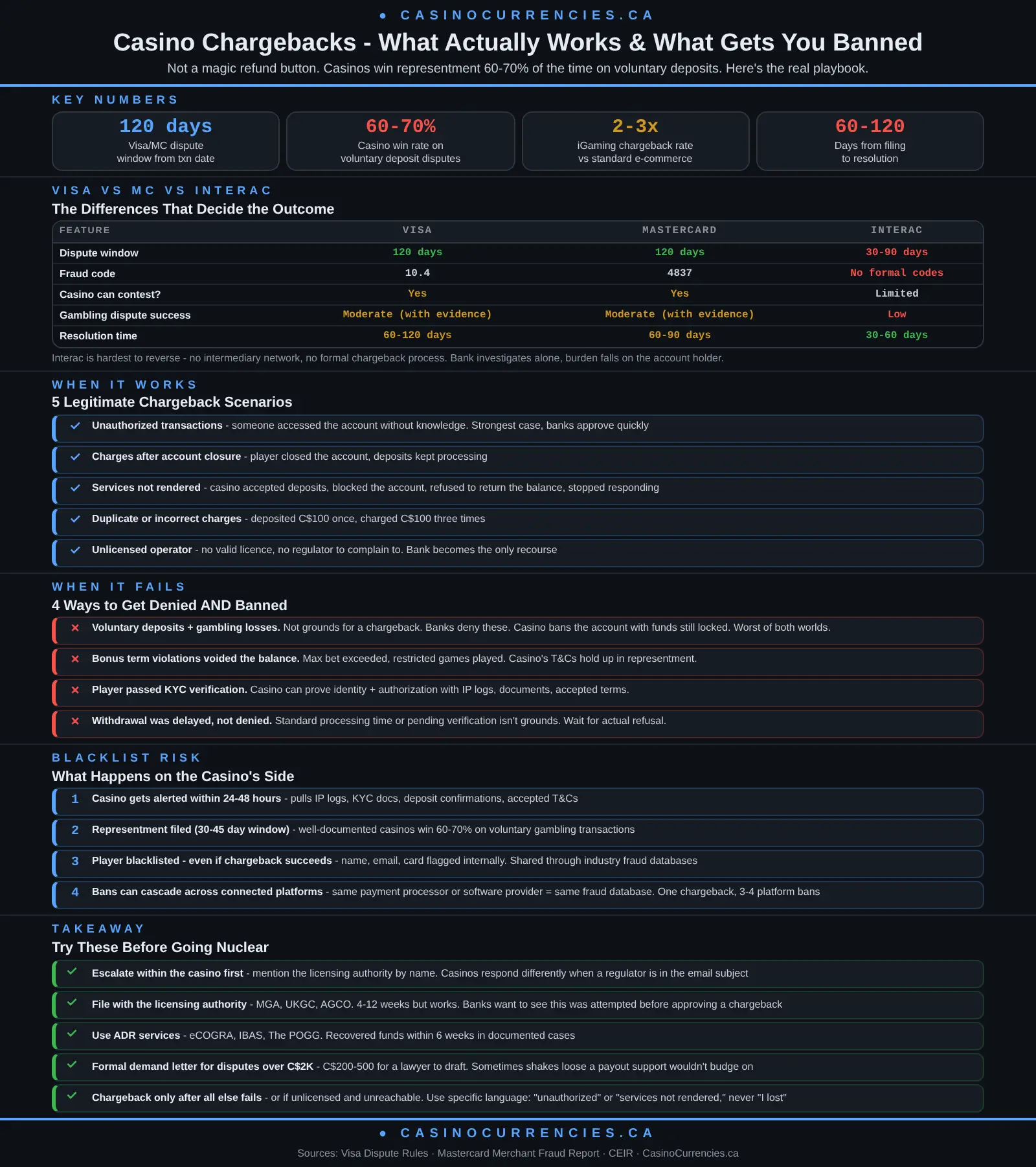
But chargebacks have expanded far beyond stolen cards. Today, Visa processes roughly 1.5 billion dispute transactions globally per year, and the online gambling sector accounts for a disproportionate share. A 2023 Mastercard report on merchant fraud found that iGaming and digital entertainment merchants experience chargeback rates 2–3x higher than standard e-commerce.
Here's the critical distinction: a refund is voluntary - the casino agrees to return funds. A chargeback bypasses the casino entirely. The bank pulls the money back, and the casino has to fight to keep it. That's why casinos treat chargebacks so seriously, and why filing one has consequences I'll cover below.
When Disputing Online Casino Charges Is Legitimate
Not every chargeback is "friendly fraud." I've reviewed cases where the dispute was absolutely justified:
- Unauthorized transactions - Someone accessed an account and made deposits without the cardholder's knowledge. This is the strongest chargeback case and banks approve it quickly.
- Charges after account closure - The player closed their casino account, yet deposits kept processing. I've seen this happen with subscription-style billing on certain platforms.
- Services not rendered - A casino accepted deposits but blocked the account without explanation, refused to return the balance, and stopped responding to support tickets. If the casino won't pay legitimate winnings, and every other avenue has been exhausted, a chargeback becomes a valid last resort.
- Duplicate or incorrect charges - The player deposited C$100 once but was charged C$100 three times. Transaction logs don't match.
- Unlicensed operators - The casino had no valid gambling license and turned out to be operating illegally. Regulatory bodies can't help here because there's no regulator to complain to - the bank becomes the only recourse.
These are the scenarios where I've seen Canadian players successfully dispute online gambling charges with a high approval rate.
When a Chargeback Will Fail - And Get Banned
And here's the part that gets uncomfortable. A significant percentage of casino chargebacks are what the industry calls "friendly fraud" - the player made voluntary deposits, lost the money, and now wants it back. Banks and card networks have gotten extremely good at spotting this pattern.
A chargeback will almost certainly fail if:
- The deposits were voluntary and the player simply lost. Gambling losses aren't grounds for a chargeback - period.
- The player violated bonus terms (wagering requirements, max bet limits) and had winnings voided as a result. The casino's terms of service typically hold up in these disputes.
- The player passed KYC verification, meaning the casino can prove identity and authorization.
- The withdrawal was delayed - not denied - due to standard processing times or pending verification.
Truth is, I've watched players file chargebacks out of frustration over slow withdrawals, only to have the dispute denied and their casino account permanently closed with funds still locked. It's the worst of both worlds.
Step-by-Step: Filing a Dispute With a Canadian Bank or Card Issuer
If the situation is legitimate, here's the process I've mapped out from tracking dozens of Canadian cases:
Step 1: Gather Documentation First
Before calling the bank, collect everything:
- Transaction records (bank statements showing the charges)
- Screenshots of the casino account showing the deposit history
- Any communication with the casino's support team (emails, live chat transcripts)
- Evidence of the issue - unauthorized access alerts, duplicate charge receipts, or proof that the casino is unlicensed
- A timeline of events
Step 2: Contact the Bank's Dispute Department
Call the number on the back of the card - not the general customer service line. Ask specifically for the disputes or claims department. Most Canadian banks (RBC, TD, Scotiabank, BMO, CIBC) have dedicated chargeback teams.
Explain the situation clearly. Use specific language: "unauthorized transaction," "services not rendered," or "merchant not as described." Avoid saying "I gambled and lost" - that's not a dispute, and the representative will flag it immediately.
Step 3: File the Formal Dispute
The bank will open a case and assign a reference number. For credit cards, the chargeback window is typically 120 days from the transaction date under Visa and Mastercard rules. For debit cards and Interac, the timeline is shorter - usually 90 days, and some banks impose a 30-day window for Interac e-Transfer disputes.
Step 4: Wait for Investigation
The bank contacts the payment processor, which contacts the casino. The casino has 30–45 days to respond with evidence (called "representment"). If the casino provides proof that the transactions were authorized - IP logs, KYC documents, accepted terms of service - the bank may side with the casino.
The whole process can take 60–120 days from filing to resolution.
Visa vs Mastercard vs Interac - The Differences That Matter
| Feature | Visa | Mastercard | Interac e-Transfer |
|---|---|---|---|
| Dispute window | 120 days | 120 days | 30–90 days (bank-dependent) |
| Chargeback reason codes | 10.4 (fraud), 13.1 (services not rendered) | 4837 (fraud), 4853 (services dispute) | No formal chargeback - bank-mediated |
| Casino can contest? | Yes - representment process | Yes - representment process | Limited - depends on bank investigation |
| Success rate for gambling disputes | Moderate (with evidence) | Moderate (with evidence) | Low - Interac disputes are harder to reverse |
| Timeline to resolution | 60–120 days | 60–90 days | 30–60 days |
One thing I've noticed consistently: Interac e-Transfer disputes are the hardest to win. Because Interac operates as a direct bank-to-bank transfer, there's no intermediary payment network with formal chargeback procedures like Visa or Mastercard. The bank essentially has to investigate on its own, and the burden of proof falls heavily on the account holder.
What the Casino Does When It Receives a Chargeback
Casinos don't just absorb chargebacks - they fight them. Here's the process from the operator side, which I've documented through conversations with iGaming payment solution providers:
- Alert notification - The casino's payment processor notifies them of the dispute within 24–48 hours.
- Evidence gathering - The casino pulls IP logs, login records, KYC verification documents, deposit confirmations, and any accepted terms of service.
- Representment - The casino submits a response packet to the card network arguing the charges were legitimate. A well-documented casino wins representment roughly 60–70% of the time on voluntary gambling transactions.
- Blacklisting - Regardless of outcome, the player's name, email, and card details are flagged internally. Many casinos share chargeback data through industry databases like the Visa Merchant Purchase Inquiry (VMPI) system.
The Blacklist Risk - How Casinos Share Chargeback Data
This is the part most chargeback guides skip. File a chargeback - even a successful one - and the casino will almost certainly ban the account. But the consequences can extend further.
iGaming operators use shared fraud databases. A chargeback at one casino can result in account closures or deposit blocks at other casinos using the same payment processor. I've tracked cases where a single chargeback led to bans across three or four connected platforms operating on the same software provider's network.
For Canadian players, this means a chargeback on a Curacao-licensed site could theoretically affect accounts at other sites sharing that same payment gateway - even sites with different brands.
Legal Grey Areas in Canada
Canadian consumer protection law creates some interesting tension with online casino terms of service. Provincial consumer protection acts - like Ontario's Consumer Protection Act, 2002 or British Columbia's Business Practices and Consumer Protection Act - give consumers rights that a casino's terms of service can't override.
But here's the catch: most offshore casinos aren't incorporated in Canada. They operate under Curacao, Malta, or Kahnawake licenses. Enforcing Canadian consumer protection law against a company based in Malta is, practically speaking, very difficult. The legal options exist on paper - I've covered them in detail in Can You Sue an Online Casino? - but the cost-benefit analysis rarely works out for disputes under C$5,000.
For Ontario-licensed operators registered with the AGCO, the picture is different. These operators are subject to Canadian jurisdiction, and chargebacks carry more weight because the operator has a local regulatory obligation. Reporting the operator to the appropriate authority can also accelerate resolution.
Try These Alternatives Before Going Nuclear
A chargeback should be the last step, not the first. I've seen players resolve disputes faster - and without burning bridges - by working through these channels:
- Escalate within the casino - Ask for a supervisor or manager. Reference the licensing authority in the complaint. Casinos respond differently when a regulator's name is in the email subject line.
- File a complaint with the licensing authority - The MGA, UKGC, and AGCO all have formal complaint procedures. Resolution takes 4–12 weeks, but it works - especially with MGA-licensed operators.
- Use an ADR service - eCOGRA, IBAS, and The POGG handle player-operator disputes as neutral third parties. I've tracked eCOGRA resolutions that recovered player funds within 6 weeks.
- Send a formal demand letter - A letter from a lawyer (or a well-written one citing specific regulatory obligations) sometimes shakes loose a payout that support wouldn't budge on. It costs C$200–500 for a lawyer to draft one - worth it for disputes over C$2,000.
Only after all of these have failed - or if the casino is unlicensed and unreachable - should a chargeback be the play.
FAQ
Can I dispute online gambling charges if I voluntarily deposited the money?
Generally, no. Voluntary deposits made with a verified account are not eligible for chargebacks under Visa or Mastercard rules. Banks will deny these disputes, and the casino will ban the account. The only exception is if something else went wrong - duplicate charges, blocked withdrawals, or an unlicensed operator.
How long do I have to file a chargeback against an online casino?
For Visa and Mastercard, the standard window is 120 days from the transaction date. Interac e-Transfers have shorter windows - typically 30 to 90 days depending on the bank. Don't wait until the last week; gather documentation early.
Will filing a chargeback get me banned from all online casinos?
It will get banned from that specific casino, almost guaranteed. Beyond that, casinos sharing the same payment processor or fraud database may also restrict the account. It's not universal, but the risk is real - I've documented cases where a single chargeback triggered bans across multiple platforms.
Is it illegal to chargeback an online casino in Canada?
Filing a legitimate chargeback isn't illegal. Filing a fraudulent one - disputing charges that were knowingly authorized - is considered fraud and can result in the bank closing the account, credit score damage, and in extreme cases, criminal charges. Banks track chargeback patterns and flag serial filers.
What's the difference between a chargeback and a refund from a casino?
A refund is voluntary - the casino agrees to return the money. A chargeback is forced - the bank reverses the transaction without the casino's consent. Refunds don't carry penalties; chargebacks result in fees for the casino (typically C$25–100 per chargeback) and usually trigger an account ban for the player.
Can I chargeback an Interac e-Transfer to an online casino?
It's much harder. Interac e-Transfers don't have the same formal chargeback infrastructure as Visa or Mastercard. The bank investigates directly, and reversal rates are significantly lower. If possible, use credit card deposits for the stronger consumer protection - but only deposit what can be afforded to lose.