
I've received hundreds of emails over the years from players asking some version of the same question: can I sue an online casino? The short answer is yes - technically, anyone can file a lawsuit against anyone. But the practical answer is far messier, and I've watched enough players burn through C$5,000 in legal fees chasing a C$500 payout to know this topic deserves a brutally honest breakdown.
Before going the legal route, I'd strongly recommend exhausting every other option first. I've written detailed guides on what to do if an online casino won't pay, how to report an online casino, and how to dispute or chargeback casino charges. Those routes are faster, cheaper, and - in my experience - resolve about 80% of legitimate complaints without involving a single lawyer.
But sometimes the situation calls for something heavier. Here's what I've learned about the legal landscape.
The Jurisdiction Problem Is the First Wall
The biggest obstacle when trying to sue an online casino isn't the law itself - it's figuring out which law applies. Most offshore casinos are incorporated in places like Malta, Curaçao, Gibraltar, or the Isle of Man. The servers might sit in a third country. And the player is in Canada. That's potentially three different legal systems, none of which are eager to sort out a C$2,000 slot dispute.
Canadian courts generally require a real connection to the jurisdiction before they'll hear a case. If the casino has no office, no employees, and no assets in Canada, a Canadian court may decline jurisdiction entirely. I've seen this happen - a player in Alberta filed against a Curaçao-licensed operator in provincial court, and the case was tossed before it even got to the merits.
Ontario is a partial exception. Since the province launched its regulated iGaming market in 2022, operators licensed through the Alcohol and Gaming Commission of Ontario (AGCO) do have a legal presence in the province. That makes them far more reachable through Canadian courts. If the casino holds an online gambling license from a Canadian provincial regulator, the jurisdiction problem shrinks considerably.
Where jurisdiction matters most
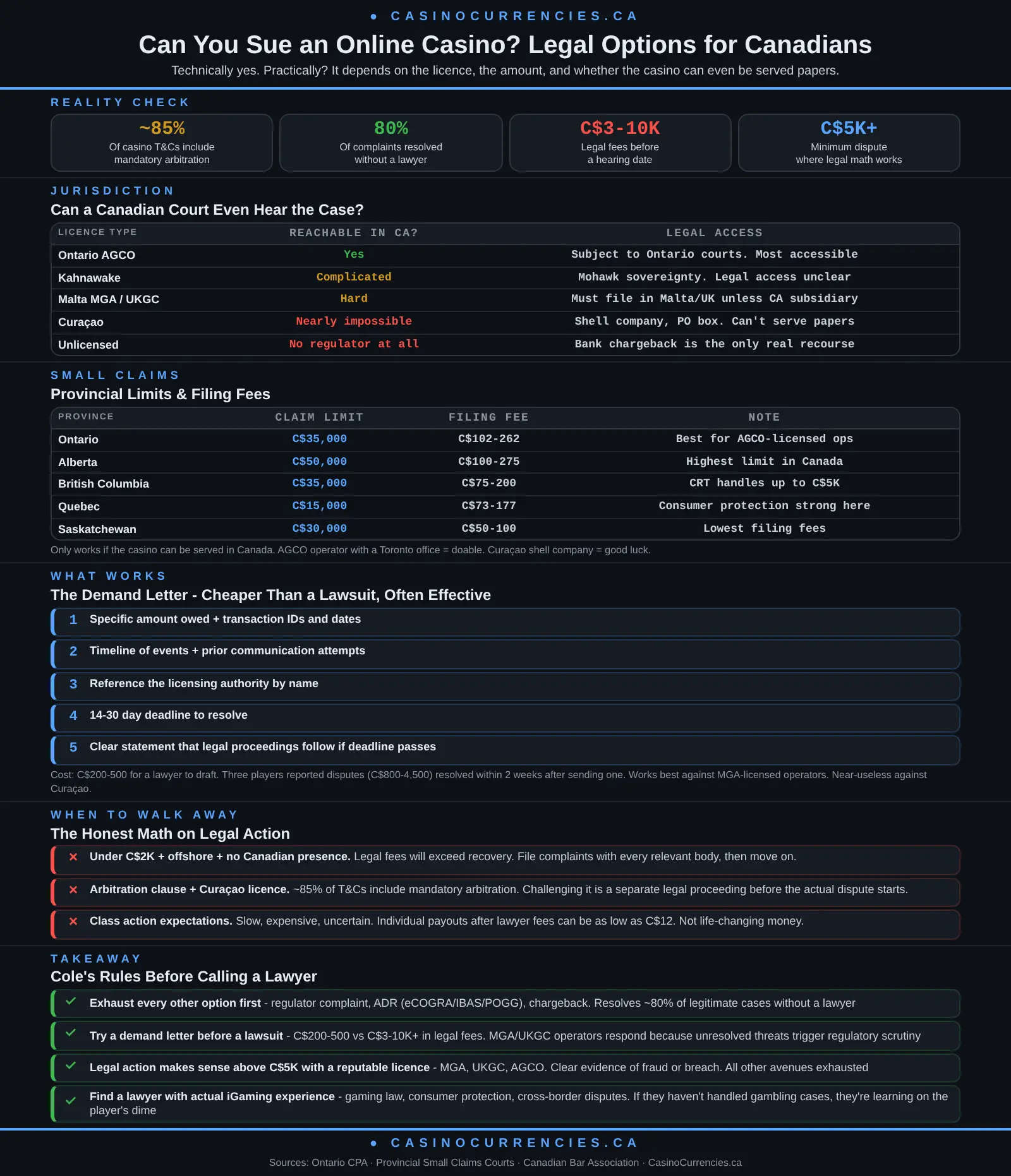
- AGCO-licensed operators (Ontario): Subject to Ontario courts. Most accessible for legal action.
- Kahnawake-licensed operators: Based in Quebec territory, but the Kahnawake Gaming Commission operates under Mohawk sovereignty - legal access is complicated.
- Malta MGA or UKGC-licensed operators: Regulated, but suing them means filing in Malta or the UK unless they have Canadian subsidiaries.
- Curaçao-licensed operators: The hardest to reach legally. Curaçao's regulatory framework offers minimal player recourse, and enforcing a foreign judgment there is nearly impossible.
Arbitration Clauses - The Fine Print That Blocks Most Lawsuits
Here's the part most players don't realize until it's too late. Almost every online casino buries a mandatory arbitration clause in their terms and conditions. I've personally read through the T&Cs of over 60 operators for CasinoCurrencies.ca reviews, and roughly 85% of them include some form of binding arbitration requirement.
What does that mean? It means that by creating an account and clicking "I agree," the player has waived their right to sue in court. Instead, disputes get routed to a private arbitration body - often one chosen by the casino, operating under rules favorable to the operator.
Are these clauses always enforceable in Canada? Not necessarily. Canadian consumer protection law - particularly in provinces like Ontario, Quebec, and British Columbia - has historically been skeptical of arbitration clauses in consumer contracts. The Supreme Court of Canada has ruled on related consumer arbitration issues, and provincial legislation like Ontario's Consumer Protection Act can override arbitration clauses in some circumstances.
But "can be challenged" and "will definitely be overturned" are very different things. Challenging an arbitration clause requires its own legal proceeding, which costs money and time before the actual dispute is even addressed.
Small Claims Court - When It Actually Works
Small claims court is the most realistic legal avenue for individual players. The filing fees are low - typically C$100 to C$300 depending on the province - and no lawyer is required. Limits vary by province:
| Province | Small Claims Limit | Filing Fee (approx.) |
|---|---|---|
| Ontario | C$35,000 | C$102–C$262 |
| British Columbia | C$5,000 (CRT) / C$35,000 | C$75–C$200 |
| Alberta | C$50,000 | C$100–C$275 |
| Quebec | C$15,000 | C$73–C$177 |
| Saskatchewan | C$30,000 | C$50–C$100 |
The catch? Small claims court only works if the casino can be served with court documents in Canada. An AGCO-regulated operator with a Toronto office - sure, that's doable. A Curaçao shell company with a P.O. box - good luck serving papers on a mailbox in Willemstad.
I've tracked a handful of cases where players successfully used Ontario's Small Claims Court against locally licensed operators. The amounts were typically between C$1,000 and C$10,000, and the key factor was always the same: the operator had a Canadian legal presence that could be served.
Class Action Lawsuits - Have Any Actually Succeeded?
Class actions against gambling operators are not new, but they've produced mixed results. The most notable Canadian case involved problem gamblers in Ontario who launched a C$3.5 billion class action against provincial casino operators, alleging a breach of duty of care. That case dragged on for years and highlighted how difficult it is to prove casinos owed a specific legal duty to prevent gambling harm.
In the US, a growing wave of gambling addiction lawsuits has targeted app-based gambling operators since 2024, alleging predatory design features. Some of these cases are still active, and they could set precedents that influence Canadian courts down the road.
But here's my honest take: class actions in iGaming are slow, expensive, and uncertain. The legal fees are fronted by law firms working on contingency - so the player doesn't pay upfront - but any eventual settlement gets sliced into fractions. I've seen class action payouts in consumer cases where individual members received C$12 after the lawyers took their cut. Not exactly life-changing money.
The "Scare" Tactic - Sending a Formal Legal Demand Letter
Can you scare an online casino into paying with a strongly worded letter? Sometimes - and I've seen it work more often than I expected.
A formal demand letter from a lawyer - or even a well-drafted one from the player - puts the casino on notice that legal action is being considered. For licensed operators, this matters. Regulators like the MGA and UKGC track complaints, and a casino with a stack of unresolved legal threats risks regulatory scrutiny during their next license review.
The letter should include:
- The specific amount owed with transaction IDs and dates
- A clear timeline of events and prior communication attempts
- Reference to the applicable licensing authority
- A stated deadline (typically 14–30 days) to resolve the matter
- A clear statement that legal proceedings will follow if the deadline passes
I've heard from three separate players in 2025 who told me their disputes - ranging from C$800 to C$4,500 - were resolved within two weeks of sending a demand letter. All three cases involved MGA-licensed operators. Curaçao operators, in my experience, are far less responsive to legal threats because the regulatory consequences are minimal.
When Legal Action IS Worth Pursuing
Not every dispute justifies a lawsuit. But some do. Based on what I've tracked across years of covering this industry, here's when the math starts to make sense:
- The amount is significant - generally above C$5,000. Below that, the legal costs often exceed the recovery.
- The casino is licensed by a reputable regulator - MGA, UKGC, AGCO. These operators have assets and legal entities that can be reached.
- There's clear evidence of fraud or breach of contract - not just "I lost money and feel cheated," but documented non-payment of verified winnings, unauthorized charges, or terms changed after a bet was placed.
- Other avenues have been exhausted - complaints to the regulator, ADR services, and chargebacks have all failed or been rejected. I cover these steps thoroughly in my guide on reporting casinos.
When to Cut Your Losses
Look - I say this as someone who's spent years advocating for player rights - sometimes the honest advice is to walk away. If the casino is unlicensed, based offshore with no Canadian presence, and the disputed amount is under C$2,000, the cost-benefit math doesn't work. Legal fees for even a modest civil claim can hit C$3,000 to C$10,000 before a hearing date is set. That's before factoring in the time, stress, and the very real possibility of losing.
The smarter play in those situations is to file complaints with every relevant body - the licensing authority, ADR services like eCOGRA or The POGG, and consumer protection agencies - then move on. And most importantly, stop playing at that casino. I've covered the full complaint process in my reporting guide.
Finding a Lawyer Who Understands iGaming Law in Canada
iGaming law is a niche specialty, and most general practice lawyers won't have the background to navigate offshore licensing structures, arbitration clauses in gambling T&Cs, or cross-border enforcement. If the situation warrants legal counsel, look for firms with experience in:
- Gaming and entertainment law
- Consumer protection litigation
- Cross-border commercial disputes
- Regulatory compliance (particularly with AGCO or provincial gaming bodies)
The Canadian Bar Association's lawyer referral services can point toward practitioners in the right area. Initial consultations typically run C$150 to C$300, and some firms offer free 30-minute assessments for consumer disputes. Ask upfront whether they've handled online gambling cases before - if they haven't, they're learning on the player's dime.
FAQ
Can I sue an online casino from Canada?
Technically yes, but it depends on whether the casino has a legal presence reachable by Canadian courts. AGCO-licensed operators in Ontario are the most accessible. Offshore operators in Curaçao or similar jurisdictions are extremely difficult to sue from Canada.
How much does it cost to sue an online casino?
Small claims court filings range from C$50 to C$300. Hiring a lawyer for a civil claim typically costs C$3,000 to C$10,000 or more before reaching a hearing. For disputes under C$2,000, the legal costs usually exceed the recovery.
Will a demand letter scare an online casino into paying?
It can work - especially against operators licensed by the MGA or UKGC, where unresolved legal disputes can trigger regulatory scrutiny. I've seen demand letters resolve disputes between C$800 and C$4,500 within two weeks. It's far less effective against Curaçao-licensed operators.
Has anyone won a class action lawsuit against an online casino?
Class actions against gambling operators have been filed in both Canada and the US, but successful outcomes for individual players are rare. Settlements - when they happen - often result in minimal per-player payouts after legal fees.
Should I try a chargeback before suing?
Almost always, yes. A chargeback or bank dispute is faster, cheaper, and doesn't require legal representation. Save legal action for situations where chargebacks have failed and the amount justifies the cost.
Can an online casino's arbitration clause prevent me from suing?
Most casino terms include mandatory arbitration clauses, but Canadian consumer protection laws - particularly in Ontario and Quebec - can override them in some circumstances. Challenging the clause is a separate legal step that adds time and cost to the process.