
I've helped Canadian players file complaints against online casinos for over four years now. The single biggest mistake I see? People firing off angry emails to support - or worse, blasting the casino on Reddit - without filing a formal complaint where it actually counts. There's a specific process for reporting an online casino that's withholding payouts or operating outside its license terms. And that process changes depending on where the casino is licensed.
This guide breaks down exactly where to complain about online gambling sites, region by region, with real contact methods and honest expectations.
Before Filing - Is It a Legitimate Complaint?
Not every bad experience at an online casino qualifies as a reportable offense. I've reviewed hundreds of player complaints over the years, and roughly a third boil down to a misunderstanding of the bonus terms or an incomplete KYC submission. Before escalating, it's worth asking a few honest questions.
Did the casino explain the reason for the hold? Was a bonus active with unmet wagering requirements? Did the operator request identity documents that haven't been submitted yet? If the answer to any of those is yes, the issue might resolve through support - not a formal complaint.
But if the casino has gone silent, given contradictory explanations, or flat-out refused a verified withdrawal - that's different. That's when it's time to report the online casino to the authority that oversees its license. I covered the full escalation sequence - from support tickets to chargebacks - in my guide on what to do if an online casino won't pay. This article picks up at the formal complaint stage.
How to Report an Online Casino to Its Licensing Authority
Every licensed operator answers to a regulatory body. The trick is knowing which one. A casino licensed in Malta follows MGA rules. A casino operating in Ontario answers to the AGCO. The license information is usually buried in the site footer - a small logo or text line that names the jurisdiction and license number.
If the license details aren't visible, that's already a red flag. I've written about how to verify online casino licenses separately - it's worth checking before investing time in a complaint that has no regulatory body to receive it.
Malta Gaming Authority (MGA)
The MGA is one of the most responsive regulators I've dealt with. To file a complaint against an MGA-licensed online casino, players submit a Player Support Form through the MGA's official website. The form asks for the casino name, license number, a description of the issue, and supporting documents.
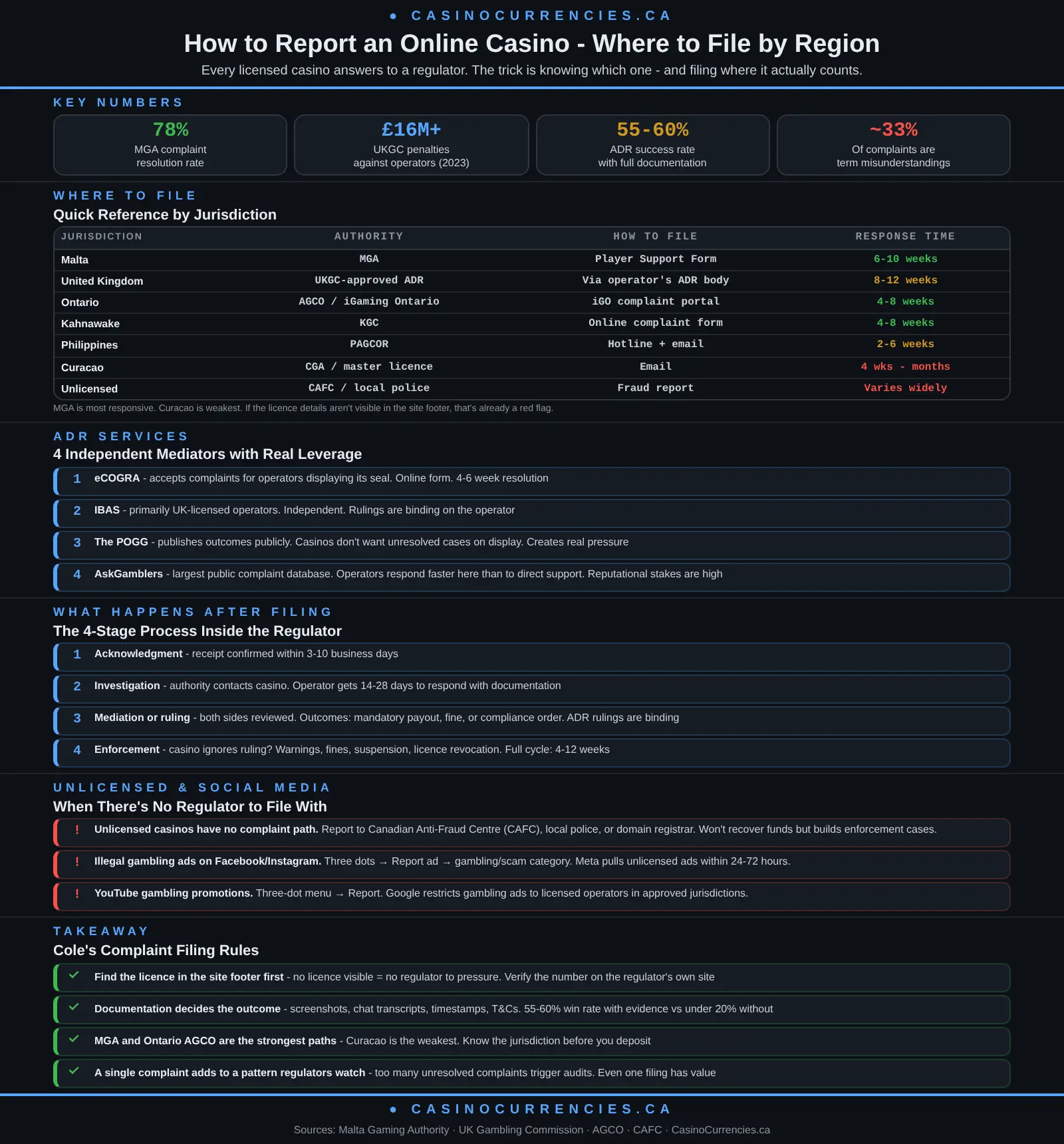
My experience: MGA complaints get a first response within 2-3 weeks. Full resolution typically lands between 6 and 10 weeks. A 2024 enforcement summary from the Malta Gaming Authority reported that 78% of player complaints against licensed operators resulted in a payout or formal explanation within the stated timeframe. That's a solid hit rate compared to other jurisdictions.
UK Gambling Commission (UKGC)
Here's a detail that trips people up - the UKGC doesn't handle individual player complaints directly. Instead, it requires licensed operators to participate in an approved Alternative Dispute Resolution (ADR) scheme. So the process goes: complain to the casino first, get their final response, then escalate to the ADR provider named in their terms and conditions.
The UKGC publishes a list of approved ADR providers on its website. Common ones include eCOGRA, IBAS, and the Centre for Effective Dispute Resolution (CEDR). Response times run 8-12 weeks on average.
If the complaint is about illegal activity - not a payout dispute, but actual fraud or unlicensed operation - the UKGC does accept those reports directly through its online reporting form.
Curacao eGaming
Truth is, Curacao has been the weakest jurisdiction for player complaints for as long as I've been tracking this. The old system operated through a handful of master license holders (Antillephone, Cyberluck, etc.), and getting a response often felt like shouting into a void.
The jurisdiction did overhaul its regulatory framework in 2023-2024, establishing the Curacao Gaming Authority (CGA) as a standalone regulator. Early signs suggest improvement, but I haven't seen enough resolved complaints yet to call it reliable. Players can email their complaint to the CGA or the specific master license holder listed on the casino's site. Expect variable response times - anywhere from 4 weeks to several months.
Kahnawake Gaming Commission
The Kahnawake Gaming Commission, based in Quebec, licenses a number of operators serving Canadian players. Complaints are filed through an online form on their official website. I've found Kahnawake reasonably responsive - typical turnaround sits at 4-8 weeks for an initial review. The commission has the authority to suspend or revoke licenses, which gives complaints real leverage against operators who cooperate with the process.
Reporting an Online Casino in Canada - Provincial Contacts
Canada's gambling landscape is fragmented by province, and each jurisdiction handles online gambling complaints differently.
Ontario (AGCO / iGaming Ontario)
Ontario is the only province with a fully regulated private iGaming market. The Alcohol and Gaming Commission of Ontario (AGCO) oversees licensed operators through iGaming Ontario (iGO). Players can file complaints through the iGO player complaint portal. Response times average 4-8 weeks, and I've seen the AGCO take enforcement action - including fines - against operators who repeatedly mishandle payouts.
If the casino isn't licensed in Ontario but accepts Ontario players anyway, the AGCO still wants to hear about it. Reporting unlicensed operators helps the regulator build enforcement cases.
British Columbia
BCLC operates PlayNow.com - the only provincially sanctioned online gambling platform in BC. Complaints about PlayNow go directly to BCLC's customer support and escalation team. For offshore casinos accepting BC players, provincial regulators have limited reach. Filing with the casino's licensing authority (MGA, Curacao, etc.) is the primary path.
Quebec
Loto-Québec runs Espacejeux, Quebec's legal online gambling platform. Complaints about Espacejeux are handled through Loto-Québec's internal resolution process. Offshore operators? Same story as BC - the provincial body can't touch them. The licensing jurisdiction is where complaints need to land.
Other Provinces
Alberta, Manitoba, Saskatchewan, and the Atlantic provinces don't currently have provincially regulated private iGaming markets. Players in these provinces using offshore sites rely entirely on the operator's licensing authority for dispute resolution. The Competition Bureau of Canada can handle complaints about deceptive marketing practices - misleading bonus advertisements, false payout claims - but it won't intervene in individual payout disputes.
Philippines - PAGCOR Complaints
PAGCOR (Philippine Amusement and Gaming Corporation) licenses a significant number of online casinos serving international markets. To report an online casino to PAGCOR, players can use the agency's hotline or email their complaints department with the casino name, license number, a detailed issue description, and supporting evidence. I've seen PAGCOR act on complaints within 2-6 weeks - more responsive than Curacao, but less consistent than Malta.
Restricted Jurisdictions - Malaysia and Others
Here's the honest take - in jurisdictions where online gambling is outright prohibited, like Malaysia, complaint options are extremely limited. There's no local regulator to file with, because the activity itself sits outside the legal framework.
If the operator holds a license from Malta or the UK, the complaint goes to that licensing body regardless of where the player sits. But if the casino is unlicensed? The options shrink to chargebacks, public complaint forums, and - in extreme cases - legal action. I've covered the regional legal landscape in my country-by-country guide.
Reporting Illegal or Unlicensed Online Casinos
Reporting a bad online casino that's actually licensed is one thing. Reporting an illegal, unlicensed operation is a different process entirely.
Unlicensed casinos don't answer to any regulator - that's the whole problem. There's no complaint form to submit, no authority to pressure them. But that doesn't mean nothing can be done.
- Local law enforcement: In Canada, the Canadian Anti-Fraud Centre (CAFC) accepts reports of online gambling fraud. The CAFC collects data and shares it with law enforcement agencies. Filing a report won't get a payout released, but it contributes to investigations that can eventually shut down fraudulent operators.
- Internet Crime Complaint Center (IC3): For players who made deposits via US-based payment methods, the FBI's IC3 accepts complaints about internet-based fraud, including online gambling scams.
- Domain and hosting reports: If the site is operating a scam - phishing for payment details, running rigged software - reporting the domain to its registrar or hosting provider can result in takedowns. ICANN's WHOIS lookup identifies the registrar.
The Global Gambling Guidance Group (G4) maintains a database of flagged operators, and several consumer watchdog sites track reported online casino scammers publicly.
Reporting Online Gambling Ads on Social Media
Facebook, Instagram, and YouTube have become hotspots for unlicensed gambling promotions. I've seen targeted ads pushing offshore casinos with no visible license, bonus offers that don't exist, and outright scam operations.
To report online gambling activity on Facebook or Instagram, use the platform's built-in ad reporting tool - click the three dots on the ad, select "Report ad," and choose the gambling or scam category. Meta's ad policy prohibits unlicensed gambling advertising, and reported ads do get pulled. The process isn't instant - expect 24-72 hours - but it works.
For YouTube, the report function sits under the three-dot menu on the video or ad. Google's ad policies restrict gambling promotions to licensed operators in approved jurisdictions. Reporting these ads won't recover lost funds, but it reduces the reach of bad operators.
Filing With ADR Bodies - eCOGRA, IBAS, The POGG, AskGamblers
ADR (Alternative Dispute Resolution) services function as independent mediators between players and casinos. They're not regulators - they can't revoke licenses - but casinos that refuse to cooperate with ADR rulings risk losing standing with the regulators that do.
- eCOGRA: Accepts complaints against operators displaying its seal. Submit online with full documentation. Typical resolution: 4-6 weeks.
- IBAS: Primarily handles UK-licensed operator disputes. Independent and well-regarded. Rulings are binding on the operator.
- AskGamblers Casino Complaints: Runs one of the largest public complaint databases. I've seen operators respond faster to AskGamblers filings than to direct support tickets. The reputational stakes are high.
When filing with any ADR body, attach all documentation - screenshots, chat transcripts, terms and conditions, withdrawal confirmations, and a clear timeline. State the desired resolution (full payout, partial settlement, account closure with balance returned). Vague complaints with no evidence get dismissed quickly. I've tracked this: documented cases resolve favorably for the player about 55-60% of the time. Undocumented ones? Under 20%.
Where to Report an Online Casino - Quick Reference Table
| Jurisdiction | Authority | How to File | Typical Response |
|---|---|---|---|
| Malta | MGA | Player Support Form (online) | 6-10 weeks |
| United Kingdom | UKGC-approved ADR provider | Via operator's named ADR body | 8-12 weeks |
| Ontario, Canada | AGCO / iGaming Ontario | iGO complaint portal | 4-8 weeks |
| Curacao | Curacao Gaming Authority | Email to CGA or master license holder | 4 weeks - several months |
| Kahnawake | Kahnawake Gaming Commission | Online complaint form | 4-8 weeks |
| Philippines | PAGCOR | Hotline + email | 2-6 weeks |
| Unlicensed / Illegal | Local law enforcement / CAFC | Fraud report filing | Varies widely |
| Any licensed casino | ADR (eCOGRA, IBAS, POGG) | Online form with documentation | 4-8 weeks |
What Happens After a Complaint Is Filed
Filing a complaint is the action step. But most players have no idea what happens on the other side of that form - so here's the reality.
Stage 1: Acknowledgment. The regulatory body or ADR service confirms receipt within 3-10 business days.
Stage 2: Investigation. The authority contacts the casino for their side. The operator typically has 14-28 days to respond with documentation and reasoning.
Stage 3: Mediation or ruling. The authority reviews both sides and either mediates or issues a ruling. Outcomes can include mandatory payouts, fines, or compliance orders. ADR rulings are binding on the operator.
Stage 4: Enforcement. If the casino ignores the ruling, the licensing authority escalates - warnings, fines, suspension, or license revocation. According to UKGC enforcement data, the commission imposed over £16 million in penalties against licensed operators in 2023 alone.
The whole cycle runs 4-12 weeks. Keeping communication professional throughout strengthens the case.
How Casinos Handle Complaints Internally
When a formal complaint lands - especially from a licensing authority - here's what happens inside the operator's compliance department.
The complaint gets assigned to a compliance officer, not a frontline support agent. The officer pulls the player's full account history: deposits, wagers, bonus claims, KYC submissions, withdrawal requests, support interactions.
The compliance team compares the player's activity against the terms and conditions. If the casino is in the wrong - a withdrawal delayed without justification, a terms violation on the operator's side - most licensed operators settle before the regulator rules. The cost of a regulatory penalty far exceeds the payout in question.
But if the player violated the terms - bonus abuse, multiple accounts, exceeded bet limits - the casino submits that evidence to the authority. Regulators do side with operators when the evidence supports it. I've seen it happen. The complaint process isn't a guaranteed win - it's a fair hearing.
That said, casinos track complaint volumes internally. Too many unresolved complaints trigger regulatory audits. A single complaint might not move mountains, but it adds to a pattern that regulators watch closely.
FAQ
How do I report an online casino for not paying?
Start by filing a complaint with the casino's licensing authority - MGA, UKGC, AGCO, or whichever body issued their license. Include documentation: withdrawal request screenshots, support chat transcripts, and a timeline. If the casino is unlicensed, file with the Canadian Anti-Fraud Centre or pursue a chargeback.
Where do I complain about an online casino in Canada?
In Ontario, file through the iGaming Ontario complaint portal. Other provinces don't have regulated private iGaming markets, so complaints go to the casino's international licensing authority. The Competition Bureau of Canada handles complaints about deceptive advertising practices.
Can I report online gambling on Facebook?
Yes. Use the ad reporting tool - click the three dots on the ad, select "Report ad," and flag it under the gambling or scam category. Meta's policy prohibits unlicensed gambling ads, and reported content typically gets reviewed within 24-72 hours.
What happens after I file a complaint against an online casino?
The authority acknowledges receipt within 3-10 business days, contacts the casino for a response (14-28 day window), then reviews both sides. The cycle takes 4-12 weeks. If the casino ignores the ruling, enforcement actions - fines, suspension, license revocation - can follow.
Is it worth reporting an unlicensed online casino?
It won't recover funds directly, but it matters. Reports to the Canadian Anti-Fraud Centre and local law enforcement build enforcement cases. Domain reports can trigger site takedowns. And public complaint filings on platforms like AskGamblers warn other players.
Who deals with complaints for online casinos?
The licensing authority that issued the casino's license handles regulatory complaints. Independent ADR bodies - eCOGRA, IBAS, The POGG, AskGamblers - mediate disputes between players and operators. For fraud, local law enforcement and consumer protection agencies take reports.