
I've attended more iGaming conferences than I care to count. And every single time, I watch the same pattern repeat - half the attendees wander the floor aimlessly, collect a bag of branded pens, and fly home with nothing to show for the trip but a sore back and a depleted expense account.
The other half? They walk in with a plan, a loaded calendar of pre-booked meetings, and a clear idea of what a good lead looks like. They leave with signed deals. The difference isn't luck. It's preparation - and knowing which events are actually worth the airfare.
This guide covers the conferences that matter, how to land a speaking slot, how to measure real ROI from events, and the pre-event LinkedIn playbook that I've personally used to fill my calendar weeks before boarding a plane.
The Major iGaming Conferences Worth Attending
Not all iGaming conferences are created equal. Some attract 30,000+ decision-makers. Others are glorified cocktail parties with a panel nobody listens to. Here's my shortlist of the events that consistently deliver real business - not just networking theatre.
| Conference | Location | Typical Dates | Estimated Attendance | Best For |
|---|---|---|---|---|
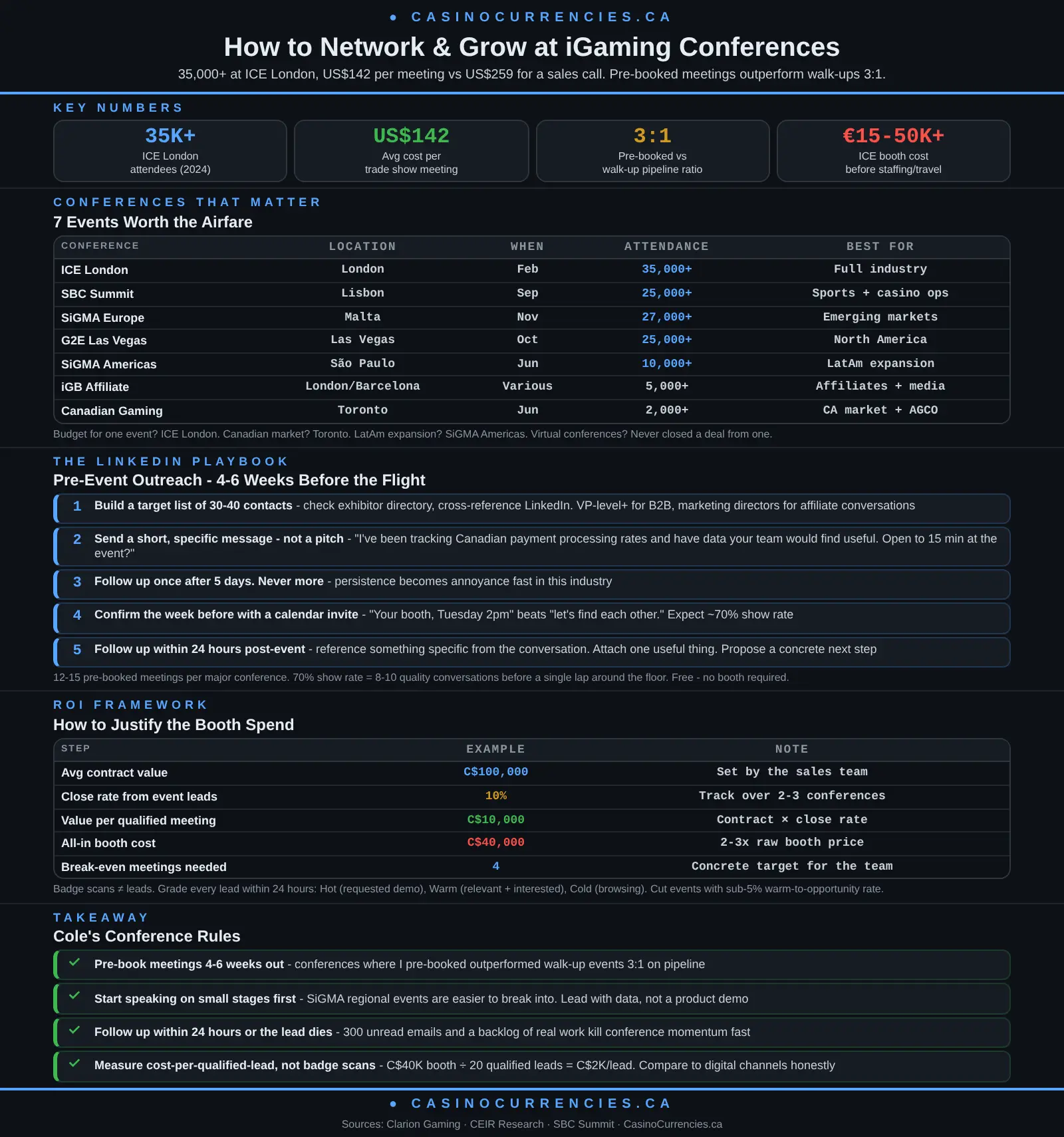
| ICE London | London, UK | February | 35,000+ | Full industry - operators, suppliers, affiliates |
| SBC Summit | Lisbon, Portugal | September | 25,000+ | Sports betting and casino operators |
| SiGMA Europe | Malta | November | 27,000+ | Mediterranean/emerging market operators |
| SiGMA Americas | São Paulo, Brazil | June | 10,000+ | LatAm expansion |
| G2E Las Vegas | Las Vegas, USA | October | 25,000+ | North American land-based and online operators |
| iGB Affiliate | London/Barcelona | Various | 5,000+ | Affiliate marketers and media buyers |
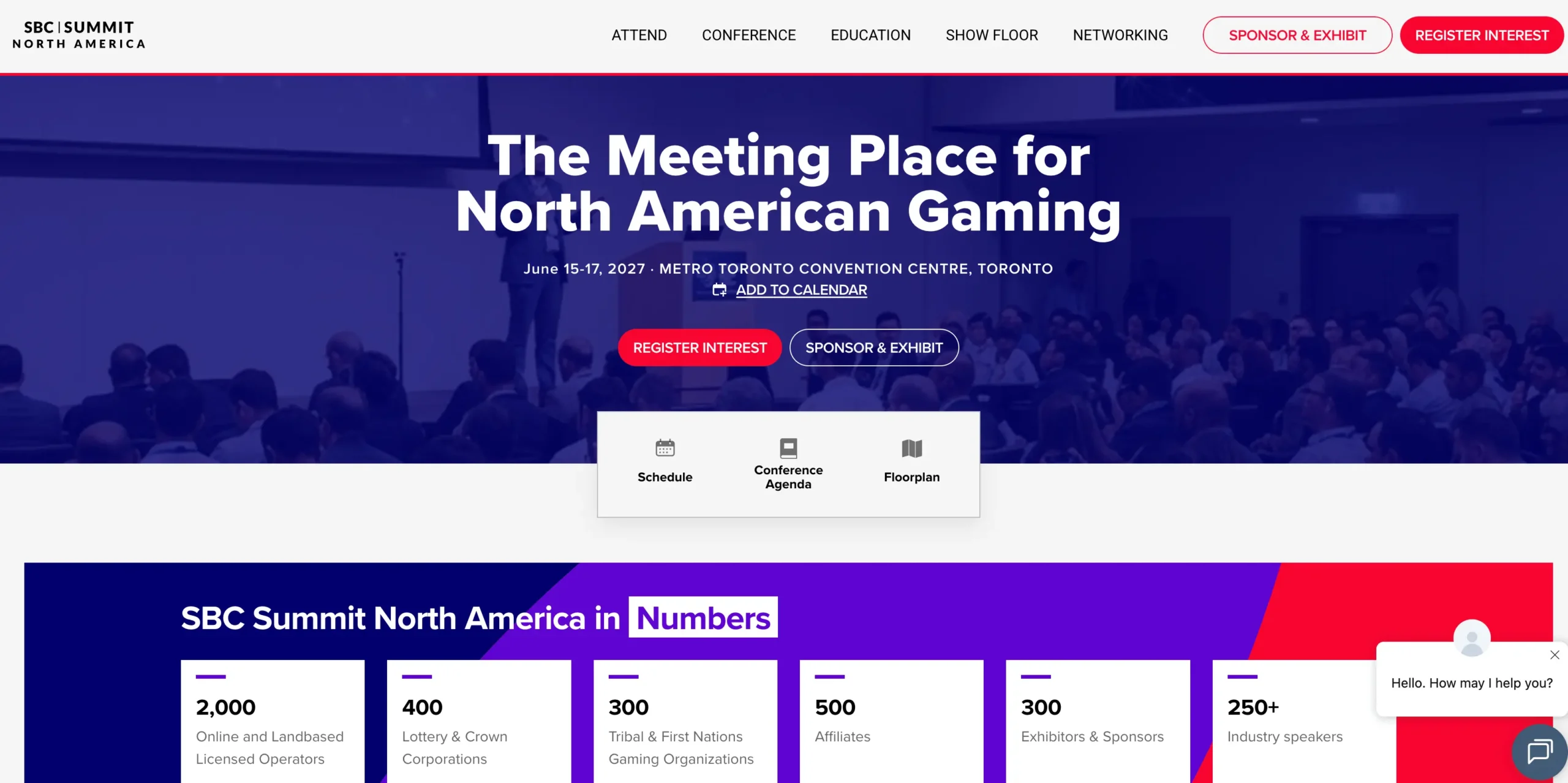
| Canadian Gaming Summit | Toronto, Canada | June | 2,000+ | Canadian market operators and regulators |
ICE London remains the big one. According to Clarion Gaming, ICE 2024 drew over 35,000 attendees from 170+ countries across 45,000 square metres of exhibition space (Clarion Gaming ICE London stats). If I had budget for only one event per year, that's where I'd go.
SBC Summit has grown aggressively since moving to Lisbon - it pulled over 25,000 attendees in 2024, up from around 8,000 just a few years earlier. The shift toward content-rich stages rather than just exhibition booths makes it stronger for operators who want substance alongside deal-making.
For anyone focused on the Canadian market, the Canadian Gaming Summit is smaller but hyper-relevant. Ontario's regulated market launched in April 2022, and since then the conference has become the room where provincial regulators, AGCO representatives, and licensed operators actually sit at the same table.
How to Land a Speaking Slot - What Organizers Look For
Getting on stage at a major iGaming conference isn't about who has the biggest company. Organizers are building a programme that sells tickets and attracts sponsors. They want speakers who bring fresh data, a contrarian take, or a case study nobody's heard yet.
Here's what I've learned after pitching - and getting rejected from - multiple conference stages:
- Lead with a specific insight, not a company pitch. "How I Reduced Chargeback Rates by 40% in Six Months" beats "Our Payment Platform Overview" every time. Organizers reject pitches that sound like product demos.
- Submit early. Most conferences open their call for speakers 6–8 months before the event. The earlier slots go to known names; the remaining spots go to compelling pitches from smaller operators who submit before the deadline crunch.
- Show past speaking clips. Even a recorded webinar or a 10-minute panel clip gives organizers proof that a speaker won't freeze on stage. I started by moderating panels - less pressure, more exposure.
- Offer a co-speaker from a client. Organizers love operator + vendor joint sessions because they signal credibility. A payment provider speaking alongside an operator who uses their product is harder to say no to than either one alone.
- Build relationships with the content team year-round. Conference organizers remember people who engage with their content outside event season. Commenting on their LinkedIn posts, sharing their speaker announcements, attending their webinars - it all helps.
Truth is, most first-time speakers start on smaller stages. SiGMA runs regional events (Americas, Asia, CIS) that are easier to break into than ICE London's main conference stage. Start there, build a reel, and work upward.
Getting Sponsors and Making the ROI Case
Exhibition booths at tier-one iGaming conferences aren't cheap. A basic 9-square-metre stand at ICE London runs between €15,000 and €25,000 before staffing, travel, and the branded swag everyone will throw away. Sponsoring a drinks reception or a lounge area can push costs past €50,000.
So how does anyone justify that spend?
The math only works when the team treats the event as a sales operation - not a brand awareness exercise. Here's the framework I use to build an ROI case for conference sponsorship:
- Set a target number of qualified meetings. Not badge scans, not business cards collected. Actual sit-down conversations with decision-makers who match the ideal customer profile.
- Assign a value per meeting. If the average contract value is C$100,000 and the close rate from conference leads is 10%, each qualified meeting is worth C$10,000 in pipeline value.
- Calculate break-even. If the booth costs C$40,000 all-in, the team needs four qualified meetings to justify the investment. That's a concrete number the sales team can hold themselves to.
I've tracked this across six events. The conferences where I pre-booked meetings outperformed the ones where I relied on foot traffic by a 3:1 ratio on pipeline generated. Walk-up conversations matter, but pre-booked meetings close.
Measuring Lead Quality From Events - Not Just Badge Scans
Badge scanners are the biggest lie in conference marketing. Scanning 200 badges at a booth doesn't mean 200 leads. It means 200 people walked past and stopped long enough for someone to point a device at their lanyard. Most won't remember the conversation by the time they land at home.
Real lead quality measurement looks different:
- Grade every lead within 24 hours. Hot (requested a demo or pricing), warm (relevant role, expressed interest), cold (just browsing). I use a simple spreadsheet - nothing fancy.
- Track conversion rates by event. After two or three conferences, patterns emerge. Some events consistently produce hot leads. Others generate volume but nothing that converts. I cut an event from my calendar after two consecutive years of sub-5% conversion from warm-to-opportunity.
- Measure cost-per-qualified-lead. Total event spend divided by the number of hot + warm leads. If a C$40,000 booth produces 20 qualified leads, that's C$2,000 per lead. Compare that to digital channels and decide where the budget works harder.
According to the Center for Exhibition Industry Research (CEIR), the average cost of a face-to-face meeting at a trade show is roughly US$142 - compared to US$259 for a traditional sales call (CEIR research data). Those numbers hold up in iGaming too, provided the team does the pre-work.
Pre-Event LinkedIn Outreach - Booking Meetings Before the Flight
This is where most iGaming professionals leave money on the table. The week of the conference is too late to start scheduling. I begin outreach 4–6 weeks beforehand.
The playbook is straightforward:
- Build a target list. Check the conference exhibitor directory. Cross-reference with LinkedIn to find the right contacts - VP-level and above for B2B, marketing directors for affiliate conversations. I aim for 30–40 targets per event.
- Send a short, specific message. Not a pitch. Something like: "I see [Company] is exhibiting at SBC Summit. I've been tracking the Canadian payment space and have some data on processing rates I think your team would find useful. Open to a 15-minute meeting at the event?" Personalisation matters. Bulk outreach gets ignored.
- Follow up once. If there's no response after five days, one follow-up. Never more. Persistence becomes annoyance fast.
- Confirm the week before. Calendar invites with a specific time and meeting point. "Let's meet at your booth Tuesday at 2pm" beats "let's find each other at the event."
I typically book 12–15 meetings per major conference. Not all of them show. But even a 70% show rate puts me in 8–10 quality conversations before I've taken a single lap around the exhibition floor. That's the advantage - and it's free. No booth required.
For operators still building their iGaming marketing strategy, conferences should be line items in the budget from day one. And anyone exploring how to start an iGaming business should factor event attendance into first-year costs - these rooms are where partnerships form and distribution deals get signed.
Post-Event Follow-Up That Converts
The 48-hour window after a conference ends is where most leads die. People return to 300 unread emails and a backlog of actual work. The follow-up has to cut through.
- Send a short email within 24 hours. Reference something specific from the conversation - not a generic "great meeting you at ICE" template. Specificity signals that the meeting mattered.
- Attach one useful thing. A relevant article, a data point discussed, or a quick summary of the pricing model mentioned. Give a reason to respond.
- Propose the next step. A 20-minute call the following week. A demo. An intro to a colleague. Something concrete, not "let's stay in touch" - which is code for "this goes nowhere."
I've closed deals 6–8 months after an initial conference handshake. The follow-up chain kept the conversation alive. Without it, that lead would've evaporated.
Missions and Side Events - Who Runs Them and Why They Matter
"Missions" are curated delegation trips organized by trade bodies, embassies, or iGaming industry groups. They send a small group of companies from one market to a conference or trade visit in another. Enterprise Ireland, the UK Department for Business and Trade, and Malta Enterprise have all run iGaming-specific missions in recent years.
Why bother? Missions often include pre-arranged meetings with regulators, introductions to local operators, and subsidised travel or exhibition costs. For smaller companies trying to break into a new market - say, a Canadian operator expanding into LatAm - a mission can shortcut six months of cold outreach. The iGaming affiliate programs scene also benefits from these introductions, as affiliate networks often participate in mission programmes to recruit new partners.
Side events - invitation-only dinners, closed-door roundtables, VIP lounges - are where the real deals happen at major conferences. Getting invited requires being known, which circles back to the speaking and LinkedIn playbook above. Attend enough events, contribute enough on stage, and the invitations come.
FAQ
How much does it cost to exhibit at an iGaming conference?
Booth prices vary widely. ICE London starts around €15,000 for a small stand. SiGMA and SBC offer packages from €5,000 to €50,000+. Factor in travel, staffing, materials, and entertainment - total costs typically run 2–3x the raw booth price.
Can small companies get speaking slots at major iGaming conferences?
Absolutely. Organizers want fresh perspectives. Pitch a specific case study with real data - not a product overview. Start with regional SiGMA events or SBC's smaller stages and build from there.
How far in advance should I start booking meetings for an iGaming conference?
Begin LinkedIn outreach 4–6 weeks before the event. Confirm meetings the week prior. Waiting until the conference week means competing with thousands of last-minute messages.
Are virtual iGaming conferences worth attending?
They're fine for panel content, but I've never closed a deal from a virtual conference. The value of in-person events is the hallway conversation, the dinner meeting, the unplanned introduction. That doesn't translate online.
What's the best iGaming conference for the Canadian market?
The Canadian Gaming Summit in Toronto is the most targeted. For broader North American exposure, G2E Las Vegas covers both land-based and online. ICE London remains the best for global networking.