Every guide on starting an online casino eventually hits the same wall: geography matters. The process of launching a real-money gambling platform in Canada looks nothing like doing it in India, and both bear almost zero resemblance to the regulatory obstacle course in the United States. I've spent years dissecting the licensing frameworks, payment rails, and compliance structures across these markets — and the gap between a well-chosen jurisdiction and a poorly chosen one can mean the difference between a six-figure licensing bill and a five-figure one. Or between launching in three months and waiting over a year.
This guide breaks down the major markets one by one. If the overall process is still unfamiliar, I'd recommend starting with my full walkthrough on How to Start an Online Casino before diving into regional specifics.
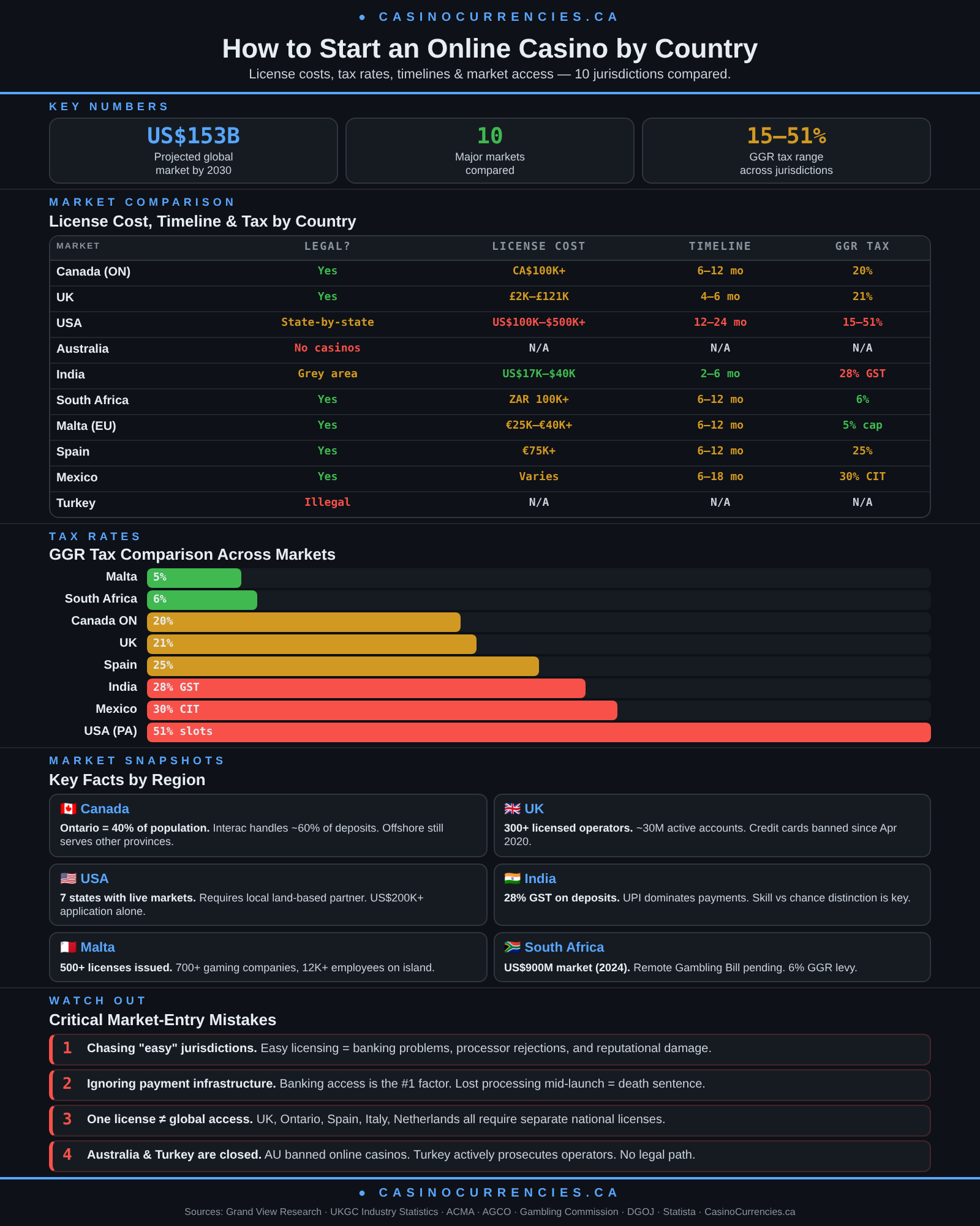
Quick Comparison: Starting an Online Casino Across Major Markets
| Country/Region | Legal to Operate? | Primary License | Approx. License Cost | Timeline to Launch | Tax on GGR |
|---|---|---|---|---|---|
| Canada (Ontario) | Yes, regulated | AGCO/iGO | CA$100,000+ (application + compliance) | 6–12 months | 20% of GGR |
| United Kingdom | Yes, regulated | UKGC | £2,008–£120,764 | 4–6 months | 21% RGD |
| United States | State-by-state | State gaming commissions | US$100,000–$500,000+ | 12–24 months | 15–51% (varies by state) |
| Australia | Restricted (no online casinos for domestic operators) | N/A for casino; sports betting via state licenses | Varies | N/A | N/A |
| India | Grey area — state-dependent | Offshore (Curacao, MGA) or emerging state frameworks | US$17,000–$40,000 (offshore) | 2–6 months (offshore) | 28% GST on deposits |
| South Africa | Yes, regulated | National Gambling Board + provincial boards | ZAR 100,000+ | 6–12 months | 6% of GGR + corporate tax |
| Europe (Malta) | Yes, EU-wide via MGA | Malta Gaming Authority | €25,000–€40,000+ | 6–12 months | 5% gaming tax (capped) |
| Mexico | Yes, regulated | SEGOB (Dirección General de Juegos y Sorteos) | Varies | 6–18 months | 30% corporate income tax |
| Turkey | No — illegal | None (operators use offshore licenses) | N/A | N/A | N/A |
| Spain | Yes, regulated | DGOJ | €75,000+ | 6–12 months | 25% of GGR (general) |
That table is the 30,000-foot view. The details — and the traps — are in the sections below.
How to Start an Online Casino in Canada
Canada is a market I know intimately, and it's one of the more interesting regulatory stories in global iGaming. The country operates under a patchwork system where online gambling regulation falls to each province individually.
Ontario changed the game in April 2022 when it launched its regulated iGaming market through the Alcohol and Gaming Commission of Ontario (AGCO) and iGaming Ontario (iGO). Before that, most operators targeting Canadian players did so under offshore licenses — Curacao, Malta, or Kahnawake. That offshore path still works for provinces outside Ontario, but Ontario's regulated market is where the real money is. The province accounts for roughly 40% of Canada's population and an outsized share of its online gambling spend.
What it takes to launch in Ontario
The AGCO registration process requires operators to meet strict standards — responsible gambling frameworks, advertising compliance, data residency rules, and game certification through approved labs. The application itself isn't cheap, and the ongoing compliance overhead adds up. Operators pay 20% of gross gaming revenue to iGaming Ontario.
Payment processing in Canada revolves around Interac. Roughly 60% of online casino deposits from Canadian players go through Interac e-Transfer — it's fast, trusted, and deeply integrated into the banking system. Credit card acceptance has been declining as banks voluntarily block gambling transactions, which makes alternative methods like e-wallets and cryptocurrency increasingly important.
For other provinces — British Columbia, Quebec, Alberta — the regulatory environment is less defined. Provincially run platforms like PlayNow (BCLC) and Loto-Québec's Espacejeux exist as government monopolies, but they don't prevent offshore operators from serving those players. The legal enforcement against offshore operators has been minimal outside Ontario.
For a detailed cost breakdown of launching in any Canadian market, I've covered the numbers in How Much Does It Cost to Start an Online Casino?.
How to Start an Online Casino in the UK
The United Kingdom is one of the most tightly regulated — and most lucrative — iGaming markets on the planet. The UK Gambling Commission (UKGC) oversees all online gambling, and operating without a UKGC license while targeting British players is a criminal offence.
The licensing process is thorough. Applicants face deep personal and financial background checks, technical audits, and detailed responsible gambling assessments. The 2023 White Paper on gambling reform tightened requirements further — mandatory affordability checks, stricter bonus advertising rules, and enhanced consumer protection obligations came into effect over 2024 and 2025.
Key compliance requirements
- Financial background checks on all directors and persons of significant control
- Source-of-funds verification for players above certain deposit thresholds
- Mandatory self-exclusion integration through GAMSTOP
- Advertising restrictions — no celebrity endorsements, no targeting under-25s
- Regular returns submitted to the Gambling Commission
The UK market is mature and competitive. Over 300 licensed operators compete for roughly 30 million active online gambling accounts, according to Gambling Commission industry statistics. Acquisition costs are among the highest globally — expect to spend £100–£300 per depositing player through affiliate and paid channels. The Remote Gaming Duty (RGD) sits at 21% of GGR, which compresses margins for smaller operators.
Payment methods lean heavily toward debit cards (credit cards were banned for gambling in April 2020), PayPal, Skrill, Neteller, and pay-by-bank solutions. Apple Pay and Google Pay adoption has surged over the past two years.
The UK is a tough market to enter — but for operators willing to invest in compliance and player protection, it remains one of the highest-revenue jurisdictions in the world.
How to Start an Online Casino in the United States
The U.S. market is the most fragmented regulatory landscape in global iGaming. There's no federal online casino license. Instead, each state decides whether to legalize, and each state that does creates its own regulatory framework — with its own licensing process, tax rates, and compliance rules.
As of mid-2026, online casino gambling is legal and regulated in a handful of states — New Jersey, Pennsylvania, Michigan, West Virginia, Connecticut, Delaware, and Rhode Island are among those with live markets. Several more are in various stages of legislative consideration.
The hard truth about the U.S. market
Breaking into U.S. online casino markets as an independent operator is extraordinarily difficult. State licenses require substantial capital reserves, local partnerships (often with existing land-based casinos), and a regulatory approval process that can stretch past two years. Tax rates range from 15% in states like Michigan to over 50% in Pennsylvania (51% on online slots). The state-by-state approach means every new market requires a separate license, a separate compliance infrastructure, and often a separate local entity.
The practical path for most international operators is either partnering with an existing U.S.-licensed entity or entering through a B2B capacity — providing platform technology or game content to a licensed operator. The "I'll just get a New Jersey license" approach underestimates the capital requirements, which often exceed US$200,000 for the application alone, plus multi-million-dollar reserve requirements.
I've outlined the licensing process in more detail in How to Get an Online Gambling License.
How to Start an Online Casino in Australia
Australia is a cautionary tale for anyone thinking "big English-speaking market equals easy entry."
The Interactive Gambling Act 2001 (amended in 2017) prohibits Australian-based companies from offering online casino games to domestic players. Sports betting is legal and regulated through state and territory licensing authorities, but online slots, table games, and live dealer products are off-limits for operators targeting Australians.
Offshore operators do serve Australian players — that's obvious to anyone who's spent ten minutes on an iGaming forum. But Australian regulators have increasingly pursued enforcement against these operators, blocking domains, pressuring payment providers, and issuing fines. The Australian Communications and Media Authority (ACMA) has blocked over 1,000 illegal gambling websites since gaining enforcement powers in 2019, according to its annual reports.
The bottom line: launching an online casino for the Australian domestic market isn't a viable legal path. The sports betting market is accessible, but that's a different business model with its own set of requirements.
How to Start an Online Casino in India
India sits in a regulatory grey zone that both attracts and frustrates iGaming entrepreneurs. Gambling regulation is a state-level matter under the Constitution, and there's no unified federal framework for online gambling.
A few states have moved to regulate or ban online gambling explicitly. Goa and Sikkim have regulated frameworks — Sikkim issues online gambling licenses, though their scope is narrow. States like Tamil Nadu, Andhra Pradesh, Karnataka, and Telangana have enacted varying degrees of prohibition on real-money online games. The distinction between "games of skill" (legal) and "games of chance" (illegal in most states) is legally significant — rummy and fantasy sports have survived court challenges as skill games, while casino-style products operate in murkier territory.
The offshore approach
Most operators targeting Indian players do so through offshore licenses — Curacao is the most common. The 2023 GST reforms introduced a flat 28% GST on online gaming deposits (not profits — deposits), which significantly impacted operator margins and was criticized across the industry. That tax structure, combined with regulatory uncertainty, makes India a high-risk, high-reward market.
Payment methods center on UPI (Unified Payments Interface), which processes billions of transactions monthly across India. Net banking, Paytm, and cryptocurrency round out the deposit methods most commonly used by Indian players at offshore casinos.
How to Start an Online Casino in South Africa
South Africa has a regulated online gambling framework, though it's been slow to fully modernize. The National Gambling Act governs the industry, with the National Gambling Board overseeing licensing alongside provincial gambling boards. Online betting is legal for licensed operators, but the distinction between sports betting (widely licensed) and online casino games has historically been blurred.
The Remote Gambling Bill — which has been in various stages of legislative development — aims to create a clearer regulatory path for online casino operators. Until that framework is fully implemented, operators targeting South African players typically hold provincial licenses or operate from offshore jurisdictions.
Tax obligations include a 6% levy on gross gambling revenue plus standard corporate income tax. Payment methods in South Africa include credit/debit cards, EFT (electronic funds transfer), and mobile money options. The ZAR is the operating currency, and operators must account for currency volatility when modeling revenue projections.
The competitive landscape is less crowded than Europe or North America, but the player base is growing. South Africa's iGaming market was valued at approximately US$900 million in 2024 and is projected to grow steadily as mobile penetration and internet access expand.
How to Start an Online Casino in Europe — The Malta Route
For operators targeting European players, Malta remains the gold standard. The Malta Gaming Authority (MGA) has been licensing iGaming operators since 2004 and has issued over 500 licenses. An MGA license provides access to most EU markets — though individual countries like France, Italy, Spain, and the Netherlands require their own national licenses.
Malta's advantages are clear: a well-established regulatory framework, favorable tax treatment (5% gaming tax with a cap), access to the EU's single market for services, and a deep pool of iGaming talent — over 700 gaming companies operate from the island, employing more than 12,000 people.
The application process requires a registered Malta company, a designated key official, and compliance with the MGA's technical, financial, and responsible gambling standards. Processing takes six to twelve months. I've detailed the full MGA licensing process in How to Get an Online Gambling License.
Spain's DGOJ framework
Spain regulates online gambling through the Dirección General de Ordenación del Juego (DGOJ). The market opened in 2012 and has grown to approximately €1 billion in annual GGR. The license application requires a Spanish entity, a €75,000+ deposit, and compliance with strict advertising rules — Spain's 2021 Royal Decree on advertising virtually eliminated gambling ads from television and radio. The GGR tax sits at 25% for general online games.
How to Start an Online Casino in Mexico
Mexico's gambling market is regulated under the Federal Gaming and Raffles Law, administered by SEGOB (Secretaría de Gobernación). The Dirección General de Juegos y Sorteos issues operating permits, and while the legal framework historically focused on land-based operations, online gambling has grown rapidly under existing permits.
The path to a Mexican online gambling license involves applying through SEGOB, demonstrating technical compliance, and establishing a local entity. The process can take six to eighteen months. Mexico doesn't have a dedicated GGR tax — operators pay standard corporate income tax (30%) and comply with AML regulations enforced by the country's financial intelligence unit.
Payment methods in Mexico include SPEI (the national electronic transfer system), Oxxo (cash payment at convenience stores — a uniquely Mexican solution), and credit/debit cards. Cryptocurrency adoption is growing, particularly among younger demographics.
The Latin American market as a whole — including Argentina and Colombia — is experiencing rapid iGaming growth. Colombia's Coljuegos framework has been operational since 2016, and Argentina's Buenos Aires jurisdiction launched regulated online gambling in 2021.
Turkey — A Market That Doesn't Want Operators
Turkey banned all forms of online gambling in 2007 and has maintained aggressive enforcement ever since. The government blocks thousands of gambling domains, prosecutes local operators, and pressures ISPs and payment providers to cut off access. The Betting and Lottery Authority (İDDAA for sports, Milli Piyango for lottery) holds a state monopoly.
Despite this, offshore operators continue to serve Turkish players through VPNs, cryptocurrency deposits, and mirror domains. I'm including Turkey here because the keyword demand is real — but the editorial responsibility is to state clearly: there is no legal path to operate an online casino targeting Turkish players from within or outside Turkey without violating Turkish law. Enforcement risk is real, including criminal prosecution for individuals involved in marketing or payment processing for illegal gambling sites.
Choosing the Right Market — What the Data Actually Says
Market selection shouldn't be based on where the fewest regulations exist. I've watched operators chase "easy" jurisdictions only to discover that easy licensing often correlates with banking problems, payment processor rejections, and reputational damage that makes scaling impossible.
The smarter approach is to match the market choice to three factors:
- Capital available — Regulated markets cost more upfront but provide stable long-term economics. An Ontario or UK launch requires six to seven figures. A Curacao-licensed operation targeting unregulated markets can launch for under US$100,000 — but the ceiling and the risk profile are both different.
- Target player demographics — Where do the players live, and what payment methods do they use? A platform optimized for Interac won't serve Indian UPI users, and vice versa.
- Long-term strategy — Is the goal to build a sustainable, multi-market brand or to capture short-term revenue in a high-risk niche? That answer should drive every licensing and market decision.
According to Grand View Research, the global online gambling market is projected to reach US$153 billion by 2030. The markets growing fastest — Latin America, parts of Asia, and newly regulated U.S. states — all carry regulatory complexity that rewards operators who invest in compliance infrastructure early.
FAQ
Which country is the cheapest to start an online casino in?
A Curacao-licensed operation targeting broad international markets carries the lowest upfront cost — typically US$17,000–$25,000 for the license, plus platform and operational expenses. But "cheapest" isn't the same as "best." A Curacao license limits access to regulated markets and comes with less regulatory credibility, which impacts banking relationships and player trust.
Can I start an online casino in Canada without an Ontario license?
Technically, offshore operators still serve Canadian players outside Ontario. But Ontario's regulated market — through AGCO and iGaming Ontario — is where the majority of revenue sits. Operating offshore for Ontario residents without registration is illegal and actively enforced. For other provinces, the regulatory gap is wider but narrowing.
Is it possible to start an online casino in the US as a foreign operator?
Not directly. U.S. state licenses require local partnerships, substantial capital reserves, and often ties to existing land-based casino licensees. The realistic path for international operators is B2B — providing platform technology or game content to licensed U.S. operators. Direct consumer-facing entry as a foreign entity is effectively blocked in regulated states.
How to start an online casino in India legally?
The short answer is that a clear legal path for online casino-style games doesn't exist at the federal level. Some operators hold Sikkim licenses for limited gaming. Most target Indian players through offshore licenses (primarily Curacao). The 28% GST on deposits and shifting state-level regulations make India a complex market that requires specialist legal counsel before entry.
Do I need separate licenses for every country I want to operate in?
In many cases, yes. An MGA license covers EU member states in general, but countries like Spain, France, Italy, and the Netherlands require their own national licenses. In the U.S., every state requires a separate license. A Curacao license is technically valid globally but isn't recognized by regulated markets — operators relying on it can't legally serve players in the UK, Ontario, or regulated EU markets.
What's the most important factor in choosing a country to launch in?
Banking access. The jurisdiction determines which payment processors will work with the operation, which banks will hold the merchant account, and how stable that relationship will be. I've seen operators lose their payment processing mid-launch because they chose a license that major acquirers won't underwrite. That's a death sentence for a new casino. Start with the license that unlocks reliable payment infrastructure — everything else follows from there.