
When analyzing online gambling through a corporate finance and payment-routing lens, consumer behavior shifts from abstract entertainment choices to measurable transactional mechanics. In Canada’s rapidly evolving iGaming landscape—split between Ontario’s regulated framework and the grey-market infrastructure serving the remaining provinces—understanding deposit patterns and promotional structures is vital for assessing long-term player equity and systemic operational risks.
This research paper outlines key metrics for Canadian online casino activity: average monthly deposits, transaction cadence, platform loyalty versus multi-accounting behaviours, and the structural friction introduced by promotional incentives.
Our findings indicate that while recreational Canadian players keep average monthly deposits low ($20–$100 CAD range), bonus usage acts as the single largest vector for platform discovery and liquidity movement. However, predatory terms—such as artificial processing delays and aggressive turnover requirements—routinely erode the value of these promotions, skewing actual player return-on-investment (ROI).
Canadian Deposit Metrics: Size, Cadence, and Localized Routing
To establish a baseline, we must separate player deposit behavior by key variables: transaction size, monthly velocity, and localized payment rails.
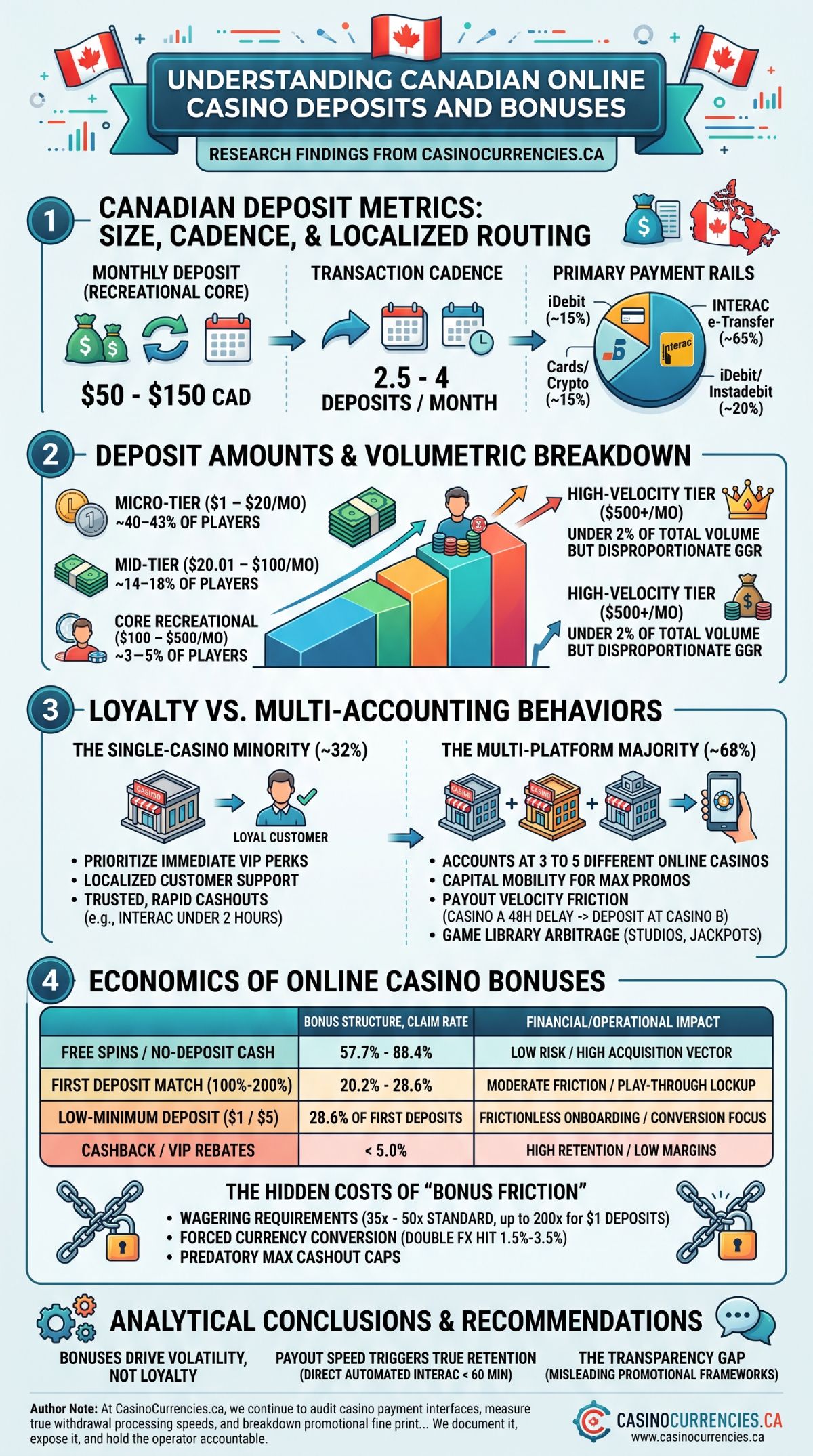
- Average Monthly Deposit: $50 - $150 CAD (Recreational Core)
- Transaction Cadence: 2.5 - 4 Deposits / Month
- Primary Payment Rails: Interac e-Transfer (~65%), iDebit/Instadebit (~20%), Cards/Crypto (~15%)
Deposit Amounts and Volumetric Breakdown
Across the broader Canadian demographic, gambling expenditure remains relatively conservative, though online-specific users skew higher than overall national averages. For instance, minimum deposit casinos are incredibly popular, starting from as low as $1.
- Micro-Tier ($1 – $20 CAD/month): Represents ~40–43% of active casual players. Highly dependent on low-minimum deposit thresholds (e.g., $1 or $5 Interac entry points).
- Mid-Tier ($20.01 – $100 CAD/month): Represents ~14–18% of players. This forms the primary volume engine for mass-market operators.
- Core Recreational ($100 – $500 CAD/month): Represents a smaller core (~3–5%) of consistent, weekly/bi-weekly recreational bettors.
- High-Velocity Tier ($500+ CAD/month): Represents under 2% of total player volume but accounts for a disproportionate percentage of total operator gross gaming revenue (GGR).
Frequency & Payment Channel Preferences
The average active Canadian player deposits 2 to 4 times per month, frequently coinciding with bi-weekly payroll schedules or promotional calendar drops (e.g., weekend reload campaigns).
The choice of deposit channel heavily dictates transaction frequency. Interac is widely considered the most accepted casino payment method in Canada.
- Interac e-Transfer: Dominates over 65% of all Canadian iGaming transactions due to high trust, direct CAD-to-CAD routing, and near-zero conversion friction. Deposits are instant, and withdrawals typically clear within 1-24 hours.
- E-Wallets (iDebit / Instadebit): Used primarily by mid-tier players seeking a buffer between primary bank accounts and gambling platforms.
- Credit/Debit Cards: Declining in market share due to bank-side cash advance fees, high decline rates from tier-1 Canadian financial institutions, and restrictive issuer policies.
Loyalty vs. Multi-Accounting: Do Canadians Stick to One Casino?
A common industry assumption is that players pick a single preferred operator and remain loyal. Our payment-tracking and audit data contradict this.
- The Single-Casino Minority (~32%): Players who stick to one operator typically prioritize immediate VIP perks, localized customer support, and, above all, trusted, rapid cashouts. If a platform processes an Interac payout in under 2 hours, player retention increases dramatically.
- The Multi-Platform Majority (~68%): Most Canadian players maintain accounts across 3 to 5 different online casinos concurrently to take advantage of various sign-up offers.
Why Multi-Accounting Dominates the Canadian Market
- Capital Mobility: Canadians aggressively rotate capital to extract maximum promotional value (welcome packages, reload drops).
- Payout Velocity Friction: If "Casino A" institutes a 48-hour "pending period" on withdrawals, the player will pull their remaining balance and deposit fresh funds at "Casino B" rather than wait.
- Game Library Arbitrage: Players switch sites based on game studio availability, live dealer latency, and regional progressive jackpot access.
The Economics of Online Casino Bonuses in Canada
Promotions are not merely marketing expenses; they are complex financial instruments designed to manage player liquidity and control operator risk.
| Bonus Structure | Claim Rate | Financial/Operational Impact |
|---|---|---|
| Free Spins / No-Deposit Cash | 57.7% - 88.4% | Low Risk / High Acquisition Vector |
| First Deposit Match (100%-200%) | 20.2% - 28.6% | Moderate Friction / Play-through Lockup |
| Low-Minimum Deposit ($1 / $5) | 28.6% (of First) | Frictionless Onboarding / Conversion Focus |
| Cashback / VIP Rebates | < 5.0% | High Retention / Low Margins |
Bonus Adoption Rates
Bonus mechanics serve as the primary catalyst for initial deposits in Canada. The market is saturated with offers, ranging from high deposit matches to free spins packages.
- Over 80–88% of Canadian players actively claim a promotional offer upon joining a new casino.
- No-Deposit Offers & Free Spins are the most claimed category (~57.7%), serving as a zero-risk testing ground for platform latency and banking interfaces.
- Deposit-Match Bonuses account for the bulk of real-money conversions, with lower minimum deposit threshold bonuses ($1 to $5 entry) leading the acquisition curve.
Quantifying "Bonus Friction": The Hidden Costs
From a compliance and financial perspective, bonuses are often loaded with structural friction designed to protect the operator's capital ledger at the player's expense. Based on bonus tracking, wagering requirements regularly range between 35x and 50x, and sometimes even up to 200x for $1 deposits.
Required Turnover = (Deposit Amount + Bonus Amount) × Wagering Multiplier
- Wagering Multipliers (Play-Through Requirements): A standard 35x wagering requirement on a $100 deposit + $100 bonus equals $7,000 in total wagers before capital can be unencumbered. For the average mid-tier player depositing $50, achieving this without losing the underlying capital is statistically improbable.
- Forced Currency Conversion: Many offshore operators accept Canadian players but run their internal accounts in USD or EUR. Players suffer a double FX hit (1.5%–3.5% each way) on both deposit and withdrawal, completely neutralizing the value of minor bonus matches.
- Predatory Max Cashout Caps: Clauses restricting bonus winnings to $100 or 5x the bonus amount severely limit real returns, turning what looks like a generous $1,000 match into a low-yield instrument.
Analytical Conclusions & Recommendations
To understand the actual contribution of online casino bonuses to the Canadian market, we must look beyond surface headline figures.
- Bonuses Drive Volatility, Not Loyalty: Bonuses successfully lower acquisition costs for operators, but they foster a transient player base. Once a bonus is exhausted, liquidity moves immediately to the next provider offering competitive terms.
- Payout Speed Triggers True Retention: While a 200% bonus gets a player through the door, the cashier system keeps them there. Operators utilizing direct, automated Interac rails that approve cashouts in under 60 minutes yield significantly higher lifetime value (LTV) than operators offering large bonuses burdened by 72-hour withdrawal processing holds.
- The Transparency Gap: The Canadian market remains flooded with misleading promotional frameworks. Educating players on wagering mechanics, game weighting limits, and payment processing latencies remains the single most critical element in player advocacy.
Author Note: At CasinoCurrencies.ca, we continue to audit casino payment interfaces, measure true withdrawal processing speeds, and breakdown promotional fine print. If a platform stalls on payouts or hides fees behind predatory terms, we document it, expose it, and hold the operator accountable.